The oblique abdominal machine: what it trains and where it fits on your floor
La machine à obliques travaille la rotation et l'inclinaison du tronc contre une résistance guidée, en complément du gainage. Elle sollicite les obliques externes et internes sur une amplitude contrôlée, sans contrainte cervicale. Le renforcement abdominal ne modifie pas à lui seul la couche de graisse qui le recouvre.
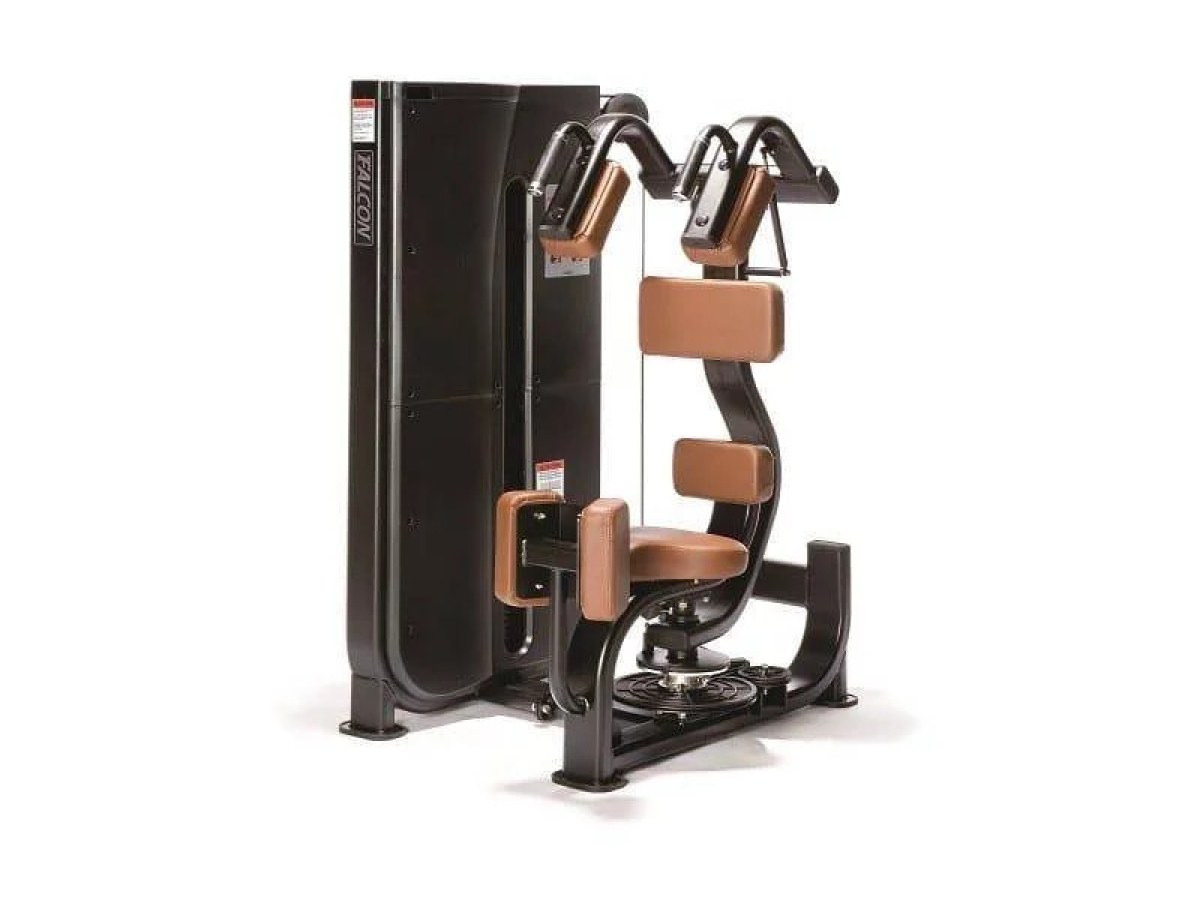
An oblique abdominal machine trains trunk rotation and lateral flexion against a guided resistance, as a complement to bracing work rather than a replacement for it. It loads the external and internal obliques through a controlled range without putting the load through the neck, which is the main weakness of unsupported floor work done at volume. For an operator, the question is not whether the muscle group matters, it obviously does, but whether a dedicated station earns its footprint on your floor. Here is the honest answer.
What the obliques actually do
Trunk musculature is usually discussed in terms of appearance, which is the least useful way to specify equipment. Functionally, the abdominal wall maintains posture and stabilises the spine, and the obliques in particular produce rotation and side bending of the trunk on the hips, and resist those same movements when they are unwanted. Every rotational sport depends on it: racket sports, throwing, striking, golf, and every change of direction in a field sport. So does ordinary life, from carrying an uneven load to getting out of a car. Training rotation under load, rather than only bracing against it, is what a rotary station is for.
What a guided station adds to floor work
Floor based core work is cheap, needs no equipment and belongs on every programme. What it does not offer is progressive external load with a fixed axis. On a rotary oblique machine the pelvis is fixed by the pads and the rotation happens where you want it, in the thoracic and lumbar segment, at a resistance you can record and increase. Three practical consequences follow. The load is measurable, so progression can be programmed rather than guessed. The range is limited by the machine, which matters for a member with a lumbar history. And the position is supported, so a member who cannot yet hold a correct unsupported position can still train the movement.
Setting a user up correctly
Adjust the seat so the trunk is upright and the hips are properly restrained before touching the load; if the pelvis moves with the trunk, the machine is training the hips, not the obliques. The user holds the handles, keeps the chest tall, and rotates to one side on the exhale, returning under control rather than letting the stack pull the trunk back. Range should be set to what the member controls, not to the mechanical maximum of the frame. Both sides are trained to the same load and the same range; asymmetric loading is a coaching decision, not a default.
What the machine does not do
This is worth stating plainly because the category is routinely oversold. Strengthening the abdominal wall does not by itself change the layer of fat covering it. There is no exercise that removes fat from the area it works, so a rotary oblique station is not a waist reduction device and should never be sold to members as one. Body composition responds to overall energy balance and total training volume, not to the choice of one machine. What the station genuinely delivers is stronger, better controlled trunk rotation, better spinal stabilisation in twisted positions, and a measurable training load for a movement pattern that is otherwise hard to progress.
Where it belongs on a commercial floor
A rotary trunk station is a complement, not a headline purchase. On a general fitness floor it sits in the selectorised circuit, near the lower back and abdominal stations, so a member can complete a trunk block without crossing the room. On a floor serving racket sports, combat sports or a rehabilitation clientele it moves up the priority list, because rotational load is central to those populations rather than incidental. On a tight floor plan where the pressing, pulling and lower body patterns are not yet covered, it waits. Our selectorised machines cover that trunk block within a coherent circuit, and the Gold Line selectorised range and Bodytone Forza FH range both include the stations that surround it.
Specification points that matter
Four things separate a station that gets used from one that gathers towels. Pelvic restraint has to be genuinely effective across body sizes, or the exercise degrades. Seat height and pad adjustment have to cover your actual membership, not a nominal average user. The load increment has to be small enough that a lighter member can progress, since trunk musculature tolerates far less absolute load than the legs. And the return of the stack has to be smooth and quiet, because a rotary station in a busy circuit is used constantly and noise carries. As with all indoor equipment for a supervised, publicly accessible facility, the reference is EN ISO 20957-1 class S.
Frequently asked questions
Is a rotary oblique machine safe for members with back problems?
It can be, and that is precisely why the range limiter matters, but it is a medical question before it is an equipment question. Loaded rotation is contraindicated for some conditions. The station allows a supported, restricted, light range, which is what makes it programmable for a supervised return to training, under advice.
Does it replace planks and anti rotation work?
No. Bracing and anti rotation work train the trunk to resist movement; a rotary station trains it to produce movement under load. A complete trunk programme uses both, and neither substitutes for the other.
How much space does it need?
Less than most selectorised stations, because the working movement stays within the frame. The practical constraint is access and circulation around the seat rather than the machine envelope itself, which is why it fits well at the end of a circuit run.
Selectorised or plate loaded for trunk rotation?
Selectorised, in almost every case. Trunk work is done at moderate loads with fast changes between users and between sides, which is exactly what a stack is for.
Planning the trunk block
If you are extending or renewing a circuit, the trunk stations are worth specifying as a block rather than one at a time, so the loads, the pad adjustments and the flow between stations are consistent. Send us your floor plan and your member profile and we will propose the block and its position in the circuit. Request a quote and we will size it with you.