Guided Machines or Free Weights: Planning the Split

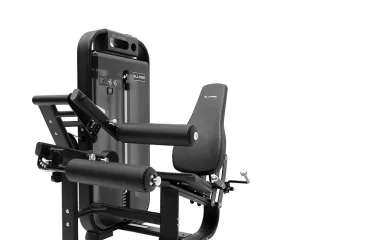
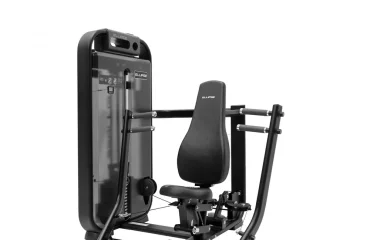
In brief: a guided machine constrains the movement to a fixed path, so the user does not stabilise the load. A free weight leaves the path to the user, so stabilising muscles work alongside the prime movers. Everything else that separates the two categories, on the floor and in the budget, follows from that one mechanical difference.
For a member, guided or free is a training preference. For the operator of a gym, club, hotel, campus or municipal facility, it is a floor-planning decision with consequences for space, supervision, flooring, noise and retention. This article sets out the mechanical difference, what each category does better, what each demands from the operator, and how to set the split for your type of facility.
The one difference everything else follows from
On a guided machine, the frame, the guide rods or the pivot arms hold the load on a fixed trajectory. The user applies force along that path and nothing else. On a free weight, whether a barbell, a dumbbell or a kettlebell, the path exists only as long as the user maintains it. The load has to be balanced in every plane at once.
That single distinction produces every other difference: who can use the equipment without instruction, how much of the body is recruited, how much space each station needs, how much supervision is required, and what the floor underneath has to withstand.
Side by side
| Guided machines | Free weights | |
|---|---|---|
| Movement path | Fixed by the machine | Controlled by the user |
| Stabilising muscles | Largely relieved | Fully recruited |
| Learning required | Minimal, a diagram is enough | Substantial, technique is the limiting factor |
| Isolation of a muscle group | Precise | Harder to isolate |
| Transfer to sport and daily movement | Indirect | Direct |
| Space per training place | Defined by the machine footprint | Larger, includes the working area around the lifter |
| Supervision needed | Low | Higher, particularly under heavy load |
| Floor requirement | Standard studio surfacing | Heavy-duty rubber, platforms where bars are dropped |
| Noise | Low | Significant, a planning issue in hotels and residential buildings |
What guided machines do better
They make a facility usable by everyone on day one. A new member can complete a full session from labelled diagrams without an induction, which matters enormously in hotels, municipal facilities and any room that is unstaffed for part of the day. They isolate a muscle group cleanly, which is why they dominate accessory work and rehabilitation. They allow controlled, repeatable progression in fixed increments, which is what a clinical or coaching programme needs to record. And they occupy a predictable footprint, which makes them easy to lay out.
Where a facility relies on selectorised machines for its core offer, the priority is movement coverage rather than duplication: cover press, row, pulldown, leg press, curl, extension and abduction before adding a second station of anything.
What free weights do better
They recruit the stabilising musculature, which is what makes the strength transfer to sport and to ordinary movement. They allow a genuinely unlimited exercise vocabulary from a small inventory: a bar, a set of plates and a rack cover more movements than a row of machines. They accommodate every body size without adjustment. And they are what experienced members come for, which makes the free-weight area a retention asset rather than a cost line.
They also demand more from the room. Racks and cages need anchoring or ballast, clear safety zones and correctly set safety bars. Benches need stability under an off-centre load. Bars and plates need storage that is closer than the next station, or they end up on the floor.
Setting the split by facility type
| Facility | Where the weight of the offer sits | Why |
|---|---|---|
| Hotel and resort | Guided machines dominant | Unsupervised guests, unknown ability, noise constraints, limited area |
| Municipal facility | Guided machines dominant, a compact free-weight area | Mixed public of all ages, limited staffing, inclusive access |
| Commercial gym | Balanced, with a substantial free-weight zone | Both audiences pay the same subscription and both must be served |
| Strength-led gym and cross-training box | Free weights dominant | Members come for the barbell work; machines cover accessory volume |
| Sports club and academy | Free weights dominant, under coaching | Transfer to performance is the whole purpose |
| Rehabilitation setting | Guided machines dominant | Controlled range, fine increments, repeatable load |
| Campus | Balanced, with strong supervision at the free-weight end | High turnover of users with very mixed experience |
The member journey across the floor
A well-planned room does not treat the two categories as rivals. It sequences them. New members start on guided machines because that is where they can succeed unaided. As confidence grows they move to benches and dumbbells, then to the racks. If your layout makes that progression visible and physically easy, the free-weight area stops being intimidating and starts being the destination. If the two zones are on separate floors or separated by a wall, the progression does not happen and the free-weight area serves only the members who already knew how to use it.
Standards and safety on both sides
Indoor equipment for professional and supervised use, guided or free, is classified under EN ISO 20957-1 class S. Require the class S declaration for machines, benches and racks alike; the classification is not reserved for machines. Class I is the professional class covering inclusive access rather than a level above class S, so it is chosen by user profile.
Beyond the classification, the free-weight zone carries its own operational requirements: correctly set safety bars in every rack, collars available at every bar, plate storage within arm reach of each station, heavy-duty flooring, and clear circulation routes that do not pass behind a lifter.
Frequently asked questions
Are guided machines safer than free weights?
They remove the risk of losing control of the load, which is the main acute risk in free-weight training. They do not remove all risk: poor adjustment, excessive load and entrapment at the weight stack remain. Correct seat and range adjustment is what makes a guided machine safe, not the guidance alone.
Can a facility run on machines only?
It can, and many hotel and municipal rooms do so deliberately. The trade-off is that experienced members will train elsewhere. If retaining them matters to your model, a free-weight area is not optional.
Which should a beginner start with?
Guided machines, unless there is coaching available. They allow a full session to be completed correctly from the first visit, and they build the confidence that makes the move to free weights possible.
Do free weights need more space than machines?
Per training place, yes. A rack needs its safety zone, a bench needs room for a spotter, and loaded bars need a path that does not cross a walkway. Plan the free-weight area from the working zones outwards, not from the equipment footprints.
What does the split cost us if we get it wrong?
Under-provide guided machines and beginners abandon their membership in the first weeks. Under-provide free weights and experienced members leave for a competitor. Both failures show up in retention rather than in the equipment budget, which is why the split is worth planning before the order rather than after.
Planning your split
The right answer is not a ratio you can copy from another facility. It follows from who your members are, how many staffed hours you run and how much floor you have. Send us your floor plan, your member profile and your staffing model, and request a quotation covering both sides of the room, laid out as a single progression rather than two separate purchases.
À lire aussi sur le même thème
- Chest press : Les muscles sollicités et pourquoi cet exercice est incontournable (Spoiler : c’est votre meilleur allié pour un torse en béton)
- Chest Press Machine vs Bench Press: The Complete Guide
- Buying Guide: How to Choose a Professional Chest Press Machine for Your Gym
- Professional Strength Equipment: Buying Guide and Operating Advice
- Strength Training for Women: Busting the Myths (No, You Will Not Turn Into the Hulk)