Urban Fitness Trails: Designing an Outdoor Training Route
Un parcours santé urbain implante des agrès fixes le long d'un itinéraire existant, pour une pratique libre et gratuite. Il relève de la norme EN 16630 et suppose un sol de réception adapté sous les agrès concernés. Sa fréquentation dépend surtout de la visibilité depuis les cheminements piétons.
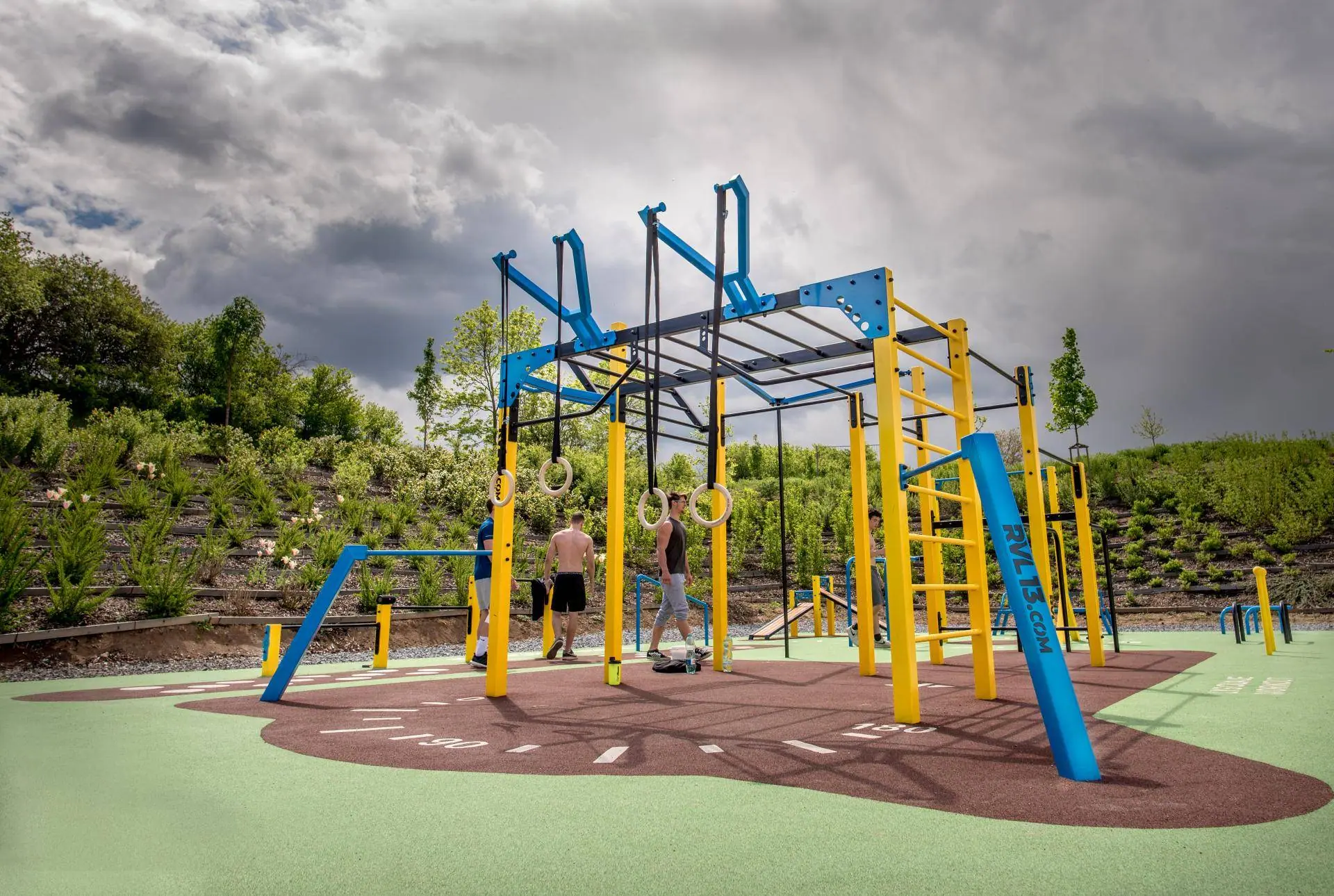
An urban fitness trail puts fixed training stations along an existing route through a town: a riverside path, a park loop, the link between two housing blocks, the last kilometre of a running circuit. Use is free, unsupervised and open at any hour, which is exactly what makes it attractive to a municipality and exactly what makes the specification unforgiving.
This guide is written for the people who actually commission these installations: town halls, parks departments, social housing landlords, campsites, universities and developers. It covers what the equipment has to comply with, how to choose the station mix, where to put the trail so it is actually used, and what it costs to keep.
What an urban fitness trail is, and what it is not
A fitness trail distributes stations along a route rather than concentrating them in one enclosure. That is the difference from a street workout park, where a single rig gathers bars, dips and pull up stations in one footprint. The two are complementary: many towns run a trail along a path and place one denser rig at the point of highest footfall.
Free access also means no instructor, no induction and no supervision. Every station therefore has to be self explanatory, forgiving of misuse, and safe for a user who arrives unprepared. That is a design constraint, not a disclaimer on a sign.
Standards: the part that decides your file
Permanently installed outdoor training equipment for adults falls under EN 16630. The standard governs structural strength, entrapment, protrusions, the free space around each station and the falling space that has to be kept clear. Where a station creates a fall height that requires it, impact absorbing surfacing goes underneath, sized to the equipment, not to the budget.
If children’s play equipment sits on the same site, it is a separate regime: EN 1176-1 for the equipment and EN 1177 for its impact absorbing surfacing. Those standards are not interchangeable with EN 16630, and adult outdoor fitness equipment must never be presented as compliant with the children’s playground standards, or the reverse. Keep the two zones, and the two files, distinct.
Indoor machines are a third regime again, covered by EN ISO 20957-1 class S, and nothing designed for indoor use belongs on an outdoor trail.
Choosing the station mix
A trail that works covers four families of movement, in roughly this proportion:
- Pulling and hanging: pull up bars at two or three heights, monkey bars, rings. The most used stations on almost every installation.
- Pushing and bodyweight: parallel bars, dip stations, inclined benches, wall bars.
- Lower body and mobility: step ups, balance elements, stretching posts, air walkers.
- Cardio and coordination: elliptical and cycling stations where the route has a resting point.
Our fitness trail stations are specified to be combined this way, and our outdoor fitness trail ranges cover complete routes rather than isolated pieces. Where the brief calls for a single dense structure instead, the street workout rig ranges do that job.
Design for everyone who lives there, not only for the fittest
The users a trail actually gets are broader than the ones in the visualisation: teenagers, joggers, retired residents doing mobility work, parents waiting for children, and people in rehabilitation. Two decisions widen the audience more than any other. The first is offering the same movement at two difficulty levels, typically by varying bar height or lever length. The second is including stations reachable from a wheelchair or usable while seated: our accessible outdoor gym equipment exists for that, and it is what turns a trail into public infrastructure rather than an installation for one age group.
Note that class I equipment, which appears in inclusive and rehabilitation projects, is a professional class defined by inclusive access. It is not a level above class S and should never be presented as one.
Siting: the decision that determines whether it gets used
Attendance at a fitness trail depends far more on visibility from pedestrian routes than on the quality of the equipment. A station that people walk past every day is used. The same station forty metres off the path, behind planting, is not, and it becomes a place people avoid after dark.
Four practical siting rules:
- Keep every station in direct sight of a path or a road.
- Follow the existing desire lines instead of forcing a new loop.
- Space stations so the walk between them is a real interval, not a stroll of four metres.
- Check lighting and shade at the hours the trail will actually be used, which in most towns is early morning and after work.
Materials: what survives ten years outdoors
Hot dip galvanised steel with a coating is the standard structural choice and performs well inland. Near the sea, in pool surrounds or anywhere salt and chlorine are in the air, stainless steel outdoor fitness equipment removes the recoating cycle that otherwise starts eating the maintenance budget in year three. Timber trails read more softly in a park setting but need a sound inspection routine.
Under the stations, surfacing is chosen from the fall height. Rubber tiles, wet pour and grass reinforced with a matting system all have their place; the choice belongs to the safety file, not to the aesthetic.
Budget, procurement and maintenance
Equipment is rarely the biggest line. Groundworks, foundations, surfacing and installation frequently equal or exceed the cost of the stations themselves, and they are the items most often underestimated in a first budget. Ask for them to be quoted separately so you can see what you are actually buying.
After handover, plan a routine visual check, a more detailed operational inspection at intervals, and an annual main inspection. Budget for fixings, bearings and surfacing repair. Publish the inspection record: it is what protects the authority if an incident is ever contested.
Frequently asked questions
How many stations does a trail need?
Fewer stations well chosen beat a long list of duplicates. A short route can work with five or six well spaced stations if they cover pulling, pushing, lower body and mobility.
Do we need surfacing under every station?
Not under every one. It depends on the fall height each station creates, which is stated on the technical sheet and drives both the surfacing type and the extent of the area it has to cover.
Can we combine a fitness trail with a children’s playground?
Yes, and it is often the right move for a park, provided the two areas are treated as distinct installations with distinct standards, distinct surfacing and distinct inspection records.
What about grant funding?
Funding schemes for outdoor sports facilities differ from one country to the next and change frequently. Check the current national and regional programmes applicable where you are building before you fix the budget.
Planning a trail?
Send us the route, the available width, the surrounding uses and the age profile of the neighbourhood, and we will propose a station mix, a layout and a costed proposal. Start with our quotation request form.
Réalisations documentées
- Cage street workout ultime, Carcassonne – armée française
- Cage street workout ultime, Tahiti – armée française, Polynésie
- Cage SP Max, centre EPIDE de Combrée – établissement public d’insertion
- Cage SP Max, lycée Saint-Bénigne de Dijon – établissement scolaire
Sources et références
- NF EN 16630 – modules fixes d’entraînement physique de plein air : exigences de sécurité et méthodes d’essai (AFNOR)
- Code du sport, article L322-2 – garanties d’hygiène et de sécurité des établissements d’activités physiques et sportives (Légifrance)