Treadmill incline: the buying criterion commercial gyms underestimate
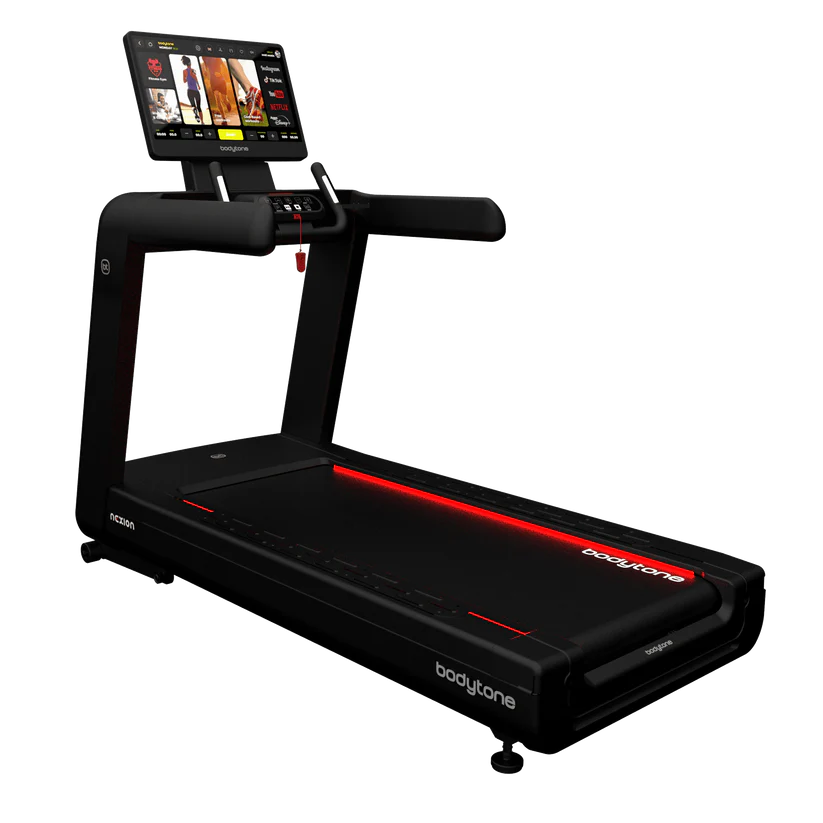
Incline walking has become a majority use case on commercial treadmills, and that moves the buying criterion: the incline motor now matters as much as the drive motor, and your treadmill occupancy profile has already changed whether or not you noticed. The minimum range to specify in a commercial club is 0 to 15 per cent motorised; below 12 per cent you cannot offer the protocol your members are already asking for. Commercial treadmills meeting that specification start at around 3,500 EUR excluding VAT and run to about 4,600 EUR excluding VAT for connected models.
What changed on your treadmill line
For twenty years, treadmill incline was an auxiliary function. It served specific preparation and a handful of runners, and the rest of the time the machine ran flat. Datasheets listed it near the bottom, after motor power and running surface.
That is no longer true. A large share of treadmill use in commercial gyms is now incline walking, driven by simple, widely shared protocols. The best known pairs a 12 per cent gradient with a speed of about 4.8 km/h (3 mph) for 30 minutes. Members arrive knowing the settings before they step on the machine.
For an operator this produces three concrete consequences, none of which is visible on a quotation.
1. Occupancy time lengthens
A running session in a gym is often short and interval-based. An incline walking session is continuous and set to a round duration. At equal footfall, your treadmills therefore turn over more slowly. If your cardio line was already tight at peak, this creates a queue that you will wrongly attribute to a general shortage of machines, when it is concentrated entirely on the treadmills.
2. The incline actuator becomes a wear part
A component designed for a few cycles per session now takes many more, machine after machine. Examine this before purchase: what type of actuator, what travel, how many cycles rated, and above all how it is covered in the manufacturer warranty. Incline is sometimes handled separately from the drive motor warranty, and that separation is easy to miss in a long terms document.
3. The user population changes
Incline walking attracts profiles who were not using treadmills at all: people returning to activity, members carrying excess weight, independent older adults, post-rehabilitation users. That is a genuine commercial opportunity, but it requires a machine that starts slowly, stops cleanly and has ergonomic handrails. A runner’s machine does not suit this population.
One safety point worth acting on. Many users hold the handrails at steep gradients. That distorts their perception of effort and loads the frame mechanically. Simple signage and a word from the coaching team usually correct the behaviour. It costs nothing, reduces wear and improves member satisfaction.
What incline range to specify, by facility
| Facility | Incline range | Minimum speed | Rationale |
|---|---|---|---|
| Commercial fitness club | 0 to 15 per cent, motorised | Start at 1 km/h or below | Covers the incline walking protocols members actually request |
| Premium club, performance centre | 0 to 18 or 20 per cent where available | Start at 1 km/h or below | Headroom for advanced protocols and hill preparation |
| Hotel, residential, workplace gym | 0 to 12 per cent is sufficient | Start at 1 km/h or below | Predominantly walking use, shorter sessions |
| Rehabilitation centre, care home | 0 to 10 per cent, 0.5 per cent increments | Start at 0.5 km/h or below | Fine progression and emergency stop take priority over maximum gradient |
| Cross training box | Incline secondary | Not applicable | Predominantly interval use, often on motorless curved treadmills |
Range is not the only parameter. Increment size matters just as much: jumping from 10 to 12 per cent in one step is uncomfortable for an untrained user, whereas a 0.5 per cent step allows fine adjustment. Check the transition time between levels as well. On some entry-level machines the ramp rises so slowly that hill interval work is impossible.
The six technical criteria to verify before ordering
| Criterion | What to check | Risk if ignored |
|---|---|---|
| Incline actuator | Actuator type, travel, rated cycles | Failure of the most-used component; machine out of service |
| Incline warranty | Its own duration, separate from the drive motor warranty | Out-of-warranty repair on the part most likely to fail |
| Range and increment | Maximum gradient, step size, transition time | Protocols you cannot offer; uncomfortable progression |
| Minimum speed | Starting speed and low-speed increments | Machine unusable for walking and rehabilitation populations |
| Deck and cushioning | Usable belt length and width, cushioning under inclined foot strike | Short stride at gradient, discomfort, premature belt wear |
| Handrails | Length, position, grip geometry during incline walking | Parasitic loading, structural wear, degraded safety |
Deck length deserves a specific note. At 12 to 15 per cent gradient the foot strike moves rearward and the stride shortens. A belt of 150 x 51 cm that feels adequate flat can feel cramped at gradient. For a club expecting heavy incline use, 155 cm of usable length is the sensible floor. Cushioning behaviour also changes with the ramp angle; our treadmill cushioning systems guide explains what to look for.
Sizing the cardio line accordingly
If a meaningful share of your members walk at incline, the arithmetic for how many treadmills you need changes. Two levers, to weigh against your configuration:
- Adding treadmills is the most direct answer and the most expensive in both floor area and budget. It is justified when the queue is concentrated on treadmills and the other machines remain free.
- Rebalancing the line is often more effective. Part of the low-impact cardio demand will move to other machines if they are present in sufficient number and correctly placed: cross trainers, bikes, rowers. Our commercial cardio equipment specifications cover the comparison between families.
- A third lever costs nothing: peak-time duration signage. A posted limit is far better accepted on a machine whose use is predictable than on one where each user runs their own session.
Positioning matters more than it used to. The treadmills used for long incline walks are the machines members spend the most time in front of. Their orientation, the available view and the ventilation become satisfaction criteria rather than plan details. A treadmill facing a blank wall is the last one occupied in the row.
Floor and services around the cardio line
Prolonged incline walking also changes the constraints around the machine. The treadmill vibrates for longer per session, and that transmits into the substrate, which is a genuine issue on an upper floor or a timber deck. A continuous rubber roll surface remains the usual solution under a cardio line, with an acoustic underlay where the substrate requires it.
Plan the electrical supply in advance as well. A line of high-usage treadmills is sized with the electrical contractor at design stage, not after installation. Total cost of ownership, including energy, consumables and servicing, is set out in our treadmill total cost of ownership analysis.
Health and older adult populations
Low-speed incline walking is one of the few cardio uses that suits both athletic and frail populations, provided the machine goes low enough in speed and fine enough in gradient. That dual fit is why it has been adopted so quickly in senior residences and health centres. These settings bring their own accessibility, supervision and safety requirements: long side handrails, low step-up height, an emergency stop the user can actually reach, and a walk-through frame where transfers are involved. Equipment must be specified to EN ISO 20957-1:2024, with class S for professional and commercial use and class I where the equipment is intended for supervised use by people with disabilities.
Frequently asked questions
What maximum incline should a commercial treadmill have?
Specify a motorised range of at least 0 to 15 per cent in a commercial club. Below 12 per cent the incline walking protocols members ask for cannot be offered. A 0 to 12 per cent range is sufficient in a hotel or workplace gym, while a rehabilitation centre should prioritise a shorter range with 0.5 per cent increments and a very low starting speed.
What is the 12-3-30 method and should a gym adopt it?
It is a widely shared walking protocol combining a 12 per cent gradient, a speed of about 4.8 km/h and a 30-minute duration. You do not need to adopt it formally, because members apply it themselves. The operator issue is having machines capable of sustaining it and anticipating the longer occupancy it generates.
Does incline walking wear a treadmill more than running?
It moves the wear. The incline actuator, historically lightly used, becomes a component operated every session, and because sessions are longer, daily running hours rise as well. Check how incline is covered in the manufacturer warranty, since it is sometimes treated separately from the drive motor.
How many treadmills are needed if members walk at incline?
The number depends on your peak footfall, but the parameter to correct is occupancy duration: a continuous walking session ties up the machine far longer than an interval running session. Before adding treadmills, check whether part of the demand can move to cross trainers, bikes or rowers that are correctly sized and well positioned.
Motorised incline or a motorless curved treadmill?
They serve different purposes. A motorless curved treadmill has a fixed curved profile, suits high-intensity interval and sprint work, and needs no power supply, which makes it attractive in cross training environments. It cannot deliver a controlled, adjustable gradient, so it does not replace a motorised incline machine for walking protocols, rehabilitation or older adult programming.
Renewing or sizing a cardio line? Light In Fitness has equipped professional facilities since 2013 across Europe and export markets: real-usage analysis, machine selection, appropriate flooring, delivery and installation. We compare incline ranges and their associated warranties model by model. Request a quote or see our commercial treadmill buying guide.
Sources et références
- Code du sport, articles R322-4 à R322-43 – garanties d’hygiène et de sécurité applicables aux établissements d’activités physiques et sportives (Légifrance)