Professional Cardio Fleet Planning: Treadmills, Bikes, Rowers and Ellipticals by Facility Type
The right split between treadmills, bikes, rowers and ellipticals is not a universal ratio — it follows the facility type and its audience. A general-public club balances around 40 percent treadmills; a cross-training box inverts the logic towards air rowers and air bikes; a rehabilitation centre builds the fleet on recumbent bikes. Cardio is the heaviest line of any gym fit-out, at purchase and in maintenance, and the most used by members — this guide gives the fleet mixes per establishment, the specifications that actually matter, and the arbitrations that decide ten years of operating cost.
The cardio mix by facility type
The percentages below are workshop reference points drawn from our installed projects, not market norms. Use them as a starting point, then adjust against your real peak attendance, average occupation time per machine and available floor area — no theoretical split replaces counting passages on your busiest time slots.
| Facility | Treadmills | Bikes | Rowers | Ellipticals | Dominant consideration |
|---|---|---|---|---|---|
| General-public club | 40% | 30% | 15% | 15% | Incline walking growing fast |
| Premium club | 35% | 30% | 20% | 15% | Connected consoles, visual coherence |
| Cross-training box | 15% | 30% | 35% | 20% | Air bikes, air rowers, ski ergs |
| Hotel | 45% | 30% | 10% | 15% | Unsupervised ease of use |
| Rehabilitation centre | 25% | 55% | 10% | 10% | Very low start speeds, recumbents |
| Care home / health-referral setting | 15% | 65% | 10% | 10% | Low step-through, backrests, accessibility |
| Corporate gym | 35% | 40% | 15% | 10% | Free use, acoustics, low maintenance |
Treadmills: the most technical line
- Motor type: AC motors are the continuous professional specification — better endurance, quieter, more efficient. DC suits moderate duty such as a quiet hotel floor.
- Power: at least 3 hp continuous in professional use; more where heavy users or high speeds are routine. Power means nothing read apart from motor type.
- Running surface: professional decks sit around 51 x 153 cm — check the exact dimension against your users, not a generic threshold.
- Cushioning: distributed elastomer damping protects joints under intensive use and degrades silently — put it on the maintenance checklist.
- Class: Class S under EN ISO 20957 for commercial use.
Variants worth knowing: very-low-start-speed treadmills (below 1 km/h with fine increments — indispensable in rehabilitation), non-motorised curved treadmills (no consumption, almost no failures — the box favourite), and high-speed sprint units for performance centres. For model-level selection, see our commercial treadmill buying guide.
Incline walking: the usage shift purchase plans ignore
Incline walking has become a majority treadmill use, with three direct consequences for buyers:
- The incline motor becomes a first-line component. Check that the warranty covers it — it is sometimes treated separately from the drive motor.
- The incline range becomes a purchase criterion: demand 0–15 percent motorised. Below 12 percent you cannot offer the most requested walking protocols.
- Rotation drops: a continuous walking session occupies the machine longer than interval running, so equal attendance needs more units — or demand shifted to ellipticals and bikes.
Before adding a treadmill, check whether part of the low-impact demand can move to ellipticals, bikes or rowers: an extra treadmill costs more, consumes more and occupies more floor than a well-placed elliptical. The full argument is in our treadmill incline specification guide.
Bikes: four sub-families not to confuse
- Indoor cycling / spin bikes: heavy flywheel, dynamic position — for group classes, where all bikes must be strictly identical.
- Upright bikes: road-like position, magnetic resistance, programme console — the best footprint-to-use ratio for open floors.
- Recumbent bikes: backrest and forward pedals make them the most accessible ergometer on the market — which is why they dominate rehabilitation and health-referral floors; low step-through versions ease transfers further.
- Air bikes: fan resistance with moving arms, progressive and unlimited — the cross-training reference.
Common criteria: passive magnetic resistance by preference (no consumption, quiet, long-lived), full seat and handlebar adjustment, watts on the console (in health settings power output is the tracking metric, not a gadget), user weight rating of at least 150 kg, and step-through accessibility for older users.
Rowers: four technologies, four sensations
| Technology | Behaviour | Where it belongs | Watch-out |
|---|---|---|---|
| Air | Progressive, stepless, closest to on-water rowing | Boxes, performance, competition | Fan noise in group settings |
| Magnetic | Silent, preset levels | Clubs, corporate, hotels | Less realistic feel |
| Water | Realistic feel and sound | Premium spaces, studios | Tank maintenance, higher cost |
| Air-magnetic hybrid | Modulable resistance | Demanding mixed floors | More complex mechanics |
Specify an anodised aluminium rail with a quiet bearing carriage, footplates adjustable across shoe sizes, a console showing watts and 500 m pace, and vertical storage where floor area is tight. Model-level criteria are in our commercial rowing machine buying guide.
Ellipticals: the most useful load transfer
The elliptical reproduces a running motion without impact — the machine to shift low-impact demand to instead of buying another treadmill. Check stride length first (a short stride mechanically excludes tall users), flywheel position (rear for a classic path, front for a more vertical one), fine magnetic resistance steps, articulated arms, and a 150 kg user rating.
Reference fleets and budgets
| Configuration | Indicative composition | Order of magnitude (EUR excl. VAT) |
|---|---|---|
| Neighbourhood club, ~500 m2 | 8–10 AC treadmills, 4 cycling + 4 upright bikes, 3 rowers, 3–4 ellipticals | 60,000–95,000 |
| Cross-training box, ~200 m2 | 2–3 curved treadmills, 4–6 air rowers, 4–6 air bikes, 1–2 ski ergs | 25,000–45,000 |
| Hotel floor, ~60 m2 | 2 AC treadmills, 2 upright bikes, 1 magnetic rower, 1 elliptical | 15,000–22,000 |
| Rehabilitation centre, ~200 m2 | 2 low-start-speed treadmills, 5–6 recumbents with heart-rate tracking, 2 low-resistance rowers, 2 arm ergometers, 2 ellipticals | 35,000–50,000 |
Figures are project estimates excluding VAT, before delivery and installation.
The critical arbitrations
- AC vs DC: AC for continuous professional duty. The energy difference across a treadmill fleet is real but too configuration-dependent to quote as a single percentage — have it estimated on your project. National energy-efficiency rules for larger commercial buildings may also apply; check your building’s thresholds before writing energy claims into a tender.
- Passive magnetic resistance first: eddy-current systems consume nothing in use — often self-powered consoles included — while active electromagnetic systems draw power continuously, which adds up across a fleet.
- Fleet coherence: group-cycling studios need strictly identical bikes; open cardio floors tolerate two or three brands if grouped visually by family. See our commercial cardio brand comparison.
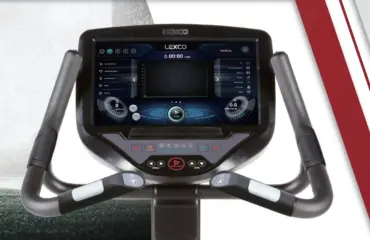
- Simple vs connected consoles: connected units raise perceived value and engagement but add cost, a failure point and personal-data obligations. In hotels and corporate spaces a simple, legible, reliable console usually serves better.
- Read the standard correctly: under EN ISO 20957, Class S covers professional and commercial use, Class H domestic use, and Class I professional use designed for inclusive access by people with specific needs. Class I is not “more robust than S” — specify S for a commercial floor and I where inclusive-use stations are required, which makes it a genuine criterion in health contexts. “Semi-professional” does not exist in the standard.
Frequently asked questions
What is the right treadmill-to-bike ratio for a commercial club?
Start from 40 percent treadmills, 30 percent bikes, 15 percent rowers, 15 percent ellipticals for a general-public club, then adjust on observed peak-hour occupation. Premium clubs shift slightly towards rowers; boxes invert the mix entirely.
What incline range should a professional treadmill offer?
0–15 percent motorised. Below 12 percent you cannot programme the incline-walking protocols members increasingly ask for, and the machine ages out of demand early.
Which cardio machines suit seniors and rehabilitation?
Recumbent and low step-through bikes first, plus treadmills that start below 1 km/h with fine increments. Watts display and heart-rate tracking are the follow-up tools practitioners need.
How long should professional cardio last?
Seven to twelve years depending on family and duty, provided preventive maintenance is followed — belts, decks, cables and consoles are the usual wear items, and availability of spare parts matters more than any spec-sheet feature.
Are connected consoles worth it?
In member clubs competing on experience, often yes. In hotels, corporate gyms and health settings, simple consoles cost less, fail less and avoid personal-data questions — spend the difference on one more machine.
Have your fleet sized on real numbers
Light In Fitness distributes professional cardio ranges across all families and has sized fleets for clubs, boxes, hotels and health facilities since 2013. Browse the professional cardio range, then send us your floor plan and peak attendance for a fleet proposal and itemised quotation within 24 working hours. Request your free quote.
Sources et références
- NF EN ISO 20957-1 – équipement d’entraînement fixe, partie 1 : exigences générales de sécurité et méthodes d’essai (AFNOR)
- AFNOR Normalisation – dossier thématique sur les appareils d’entraînement fixes et leurs classes d’usage
- Code du sport, articles R322-4 à R322-43 – garanties d’hygiène et de sécurité applicables aux établissements d’activités physiques et sportives (Légifrance)
À lire aussi sur le même thème
- Commercial Cardio Equipment: Treadmills, Bikes, Rowers — Which Brand to Choose
- Rowing haltères. L’exécution est tout !
- Rowing Machine or Treadmill: Which Cardio Machine for Your Gym?
- Aquabike fleet ROI: a three year model for aquatic centres
- Indoor cycling bike resistance systems: magnetic or friction, belt or chain