Indoor cycling bike resistance systems: magnetic or friction, belt or chain
Deux choix techniques structurent l'investissement dans un vélo de biking : la méthode de freinage, magnétique ou à patin, et le mode d'entraînement de la roue, courroie ou chaîne. Le magnétique supprime le contact mécanique donc l'usure et le bruit ; la courroie élimine la lubrification. Ces deux paramètres commandent le coût de maintenance sur la durée de vie du parc.
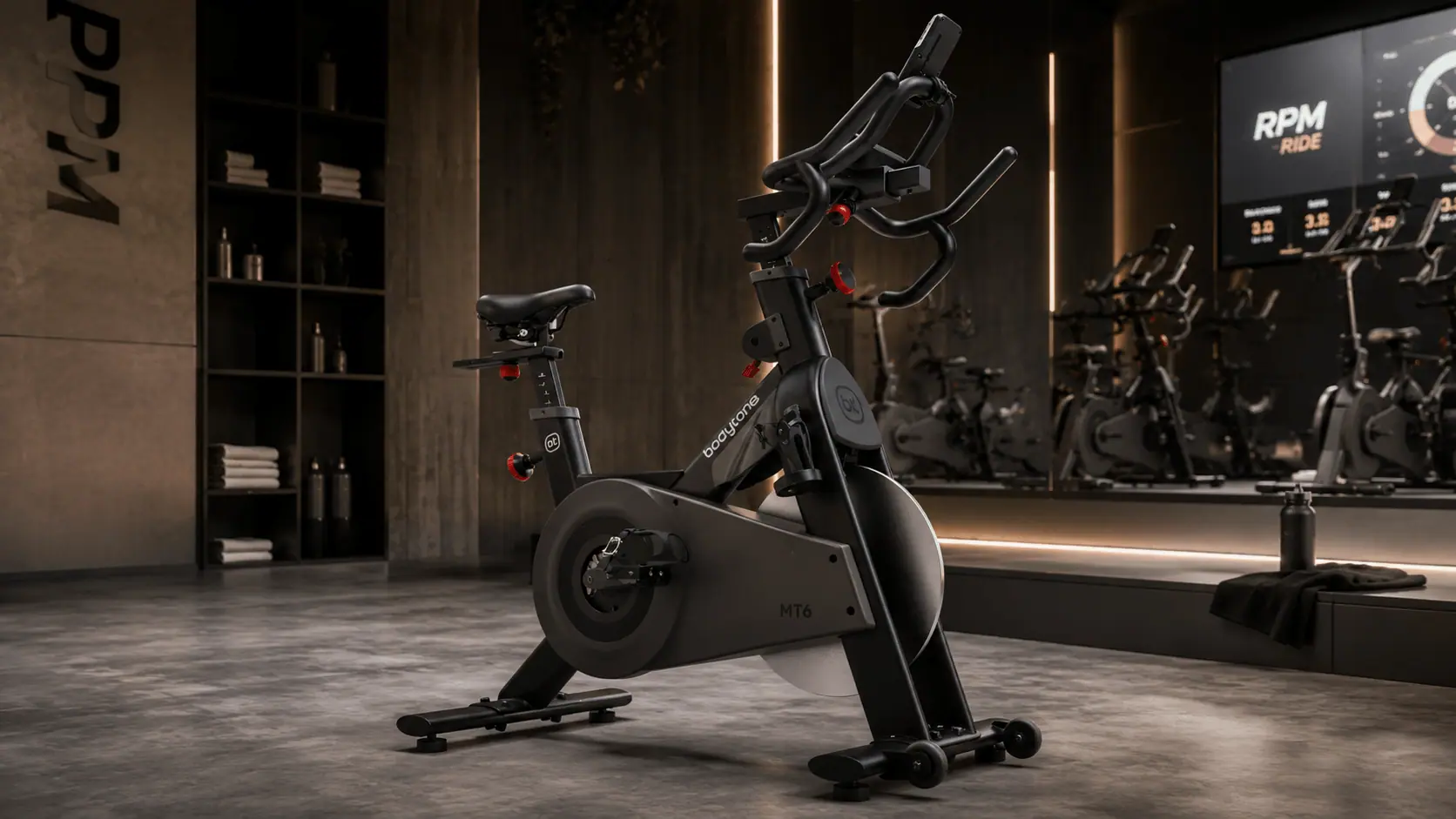
Two decisions define a commercial indoor cycling bike: how the resistance is created, and how the pedals drive the flywheel. Braking is either magnetic or friction pad. Transmission is either a Poly-V belt or a chain. The four possible combinations differ in noise level, ride feel, maintenance cost over ten years and realistic fleet life. This article sets out each system and the decision matrix Light In Fitness has applied to studio cycling projects since 2013.
Braking system one: magnetic resistance
Magnetic braking uses the opposing force created by a permanent or electromagnetic magnet positioned close to the metal flywheel. Resistance is adjusted by varying the distance between magnet and wheel, through a micro adjustment dial or digital steps, typically 8 to 32 levels on connected models. There is no contact, so there is no wear part in the braking system at all.
Noise sits at 30 to 38 dB under intensive pedalling, which lets an instructor speak without an overdriven microphone and keeps music dynamics intact. Adjustment is precise enough for HIIT protocols and power calibrated training zones, there is no overheating risk on long sprints, and most modern magnetic bikes carry Bluetooth and ANT+ for synchronisation with indoor cycling applications. Magnetic braking now accounts for roughly 65 to 70 per cent of new indoor cycling bikes distributed in Western Europe in 2025.
The limitation is feel. Magnetic resistance is progressive and linear, which riders from a road cycling background sometimes describe as less organic. Standing sprints lose part of the immediate muscular bite that direct friction gives, and on the most demanding choreography, where resistance changes rapidly, the dial response can feel marginally delayed.
Braking system two: friction pads
Friction braking reproduces the original indoor cycling mechanism. A pair of high density felt or composite pads presses directly onto the steel or cast iron flywheel, creating resistance by real physical friction. Adjustment is continuous, from completely free to full lock, and professional models integrate an emergency stop: firm pressure on the dial halts the flywheel immediately.
The benefit is authenticity. Resistance pushes back under the leg with immediate response, like a real climb. Standing sprints give clean muscular loading, which suits intense choreography. The resistance range is unlimited where magnetic systems have a technical ceiling, and initial purchase cost is 15 to 25 per cent lower than a magnetic bike of equivalent flywheel mass. Most established indoor cycling certifications were historically calibrated on friction feel.
Against that, pads are a consumable, replaced every 6 to 18 months depending on intensity, at 25 to 60 EUR per pair and about 15 minutes of labour per bike. Friction generates fine dust around the flywheel shroud and audible heating on long maximal efforts. Noise of 45 to 55 dB rules this system out of acoustically sensitive settings such as upper tier hotels with adjacent bedrooms, care homes and quiet wellness areas.
Transmission one: Poly-V belt
A Poly-V belt replaces the chain with a multi groove belt in EPDM rubber reinforced with synthetic fibres such as kevlar, aramid or glass fibre, tensioned between the crank ring and the flywheel pulley. The multi groove profile transmits torque without slipping, and the system runs dry with no lubrication at all.
Belt life runs 8,000 to 15,000 hours depending on construction quality, equivalent to 10 to 15 years of intensive studio use. Operationally the belt contributes no mechanical noise, which is what allows a magnetic and belt bike to reach 30 to 35 dB overall. There is no grease, no dust adhesion, no derailment risk mid session, and pedalling stays smooth through rapid cadence changes. An annual tension check covers ten years of commercial service.
In its standard form a belt does not allow a fixed gear: the flywheel keeps turning freely when the rider stops pedalling. It is marginally less responsive than a chain at very high torque, above roughly 800 W in maximal sprints. Low cost bikes using unreinforced rubber belts can stretch within 18 months, which is why the specification should call for a fibre reinforced Poly-V belt explicitly.
Transmission two: chain drive
A chain drive follows road bike architecture: a metal chain, typically nickel plated or stainless 1/2 by 1/8 section comparable to reinforced BMX chain, links the crank ring to a fixed sprocket on the flywheel. Because the sprocket is fixed, the chain turns as long as the flywheel turns, producing the characteristic forced pedalling sensation.
Riders get direct feedback and the vibration of a road bike, the fixed gear enforces cadence discipline and controlled stops, steel handles peak torque with more margin, and repair is simple since links can be replaced individually. Chain life runs 5,000 to 10,000 hours before replacement, with parts at 30 to 80 EUR.
The costs are mechanical noise from link movement and guide friction, lubrication every 6 to 12 weeks in commercial use, a derailment risk on maximal sprints or abrupt stops, and chain grease that marks light clothing on accidental contact.
The four configurations compared
| Criterion | Magnetic and belt | Magnetic and chain | Friction and belt | Friction and chain |
|---|---|---|---|---|
| Total noise level | 30 to 35 dB | 40 to 48 dB | 45 to 55 dB | 50 to 60 dB |
| Road feel | Smooth, modern | Hybrid | Moderately authentic | Maximum |
| Annual maintenance | Near zero | Chain lubrication | Pad replacement | Pads and lubrication |
| Indicative purchase price | 1,200 to 2,800 EUR | 1,400 to 3,200 EUR | 900 to 2,200 EUR | 1,100 to 2,600 EUR |
| Five year maintenance cost | 50 to 100 EUR | 200 to 350 EUR | 250 to 400 EUR | 400 to 600 EUR |
| Life in intensive studio use | 10 to 12 years | 8 to 10 years | 8 to 10 years | 7 to 9 years |
| Bluetooth and ANT+ | Native | Available | Optional | Rare |
| Best suited to | Premium studio, hotel, care home, wellness | Mixed cardio and road studio | CrossFit box, commercial club | Choreographed studio, road cyclists |
Flywheel mass, the third variable
Flywheel mass governs pedalling smoothness and perceived session quality, and it has to be crossed with the braking and transmission choice rather than read in isolation. Professional bikes range from 12 to 25 kg.
| Flywheel mass | Training profile | Typical audience |
|---|---|---|
| 12 to 16 kg | Cardio and velocity classes, high cadence at 90 to 110 rpm, short HIIT formats of 30 to 45 minutes | Beginner to intermediate riders working on conditioning and weight loss |
| 18 to 22 kg | The most common commercial studio specification: alternating fast and heavy cadence, flat and moderate climb simulation, standard 50 minute class formats | General studio membership |
| 24 to 25 kg | Strength sessions, long climb simulation and advanced endurance protocols where muscular power dominates | Trained road cyclists, sports conditioning, athletes on specific work |
As Michaël Galy, founder of Light In Fitness, puts it: across 87 cycling studios equipped since 2018, roughly 70 per cent of commercial clubs chose magnetic for acoustic comfort and the absence of maintenance, and 30 per cent of CrossFit boxes and premium choreographed studios chose friction for fidelity of feel. Neither choice is better in the abstract; it has to match the actual use.
Frequently asked questions
Which configuration suits a hotel or a care home?
Magnetic braking with a Poly-V belt. At 30 to 35 dB it is the only combination compatible with bedrooms on adjacent floors or a quiet wellness area, and it removes almost all maintenance from a site with no technical staff on hand.
Is friction braking obsolete?
No. It remains the reference for choreographed classes and for riders who want authentic road feel, and it offers an unlimited resistance range that magnetic systems cannot match. It is a deliberate choice with a known consumable cost of 25 to 60 EUR per pair of pads every 6 to 18 months, not a compromise.
How much maintenance does a chain drive actually need?
Lubrication every 6 to 12 weeks in commercial use, plus periodic tension adjustment, and chain replacement between 5,000 and 10,000 hours. Over five years that adds 200 to 600 EUR per bike depending on the braking system, against 50 to 100 EUR for magnetic and belt.
What flywheel mass should a general commercial studio specify?
18 to 22 kg covers the widest range of class formats and rider abilities, which is why it is the most common specification. Go lighter only for cardio and velocity focused programming, and heavier only where strength and long climb protocols are the core offer.
How long do professional bikes last under intensive use?
Between 7 and 12 years depending on the configuration, with magnetic and belt at the top of that range. Our professional bikes support more than 30 hours of use per week in studio configuration.
Specify your cycling fleet with Light In Fitness
Tell us your class formats, bike count, acoustic constraints and whether power measurement is required, and we will return a configuration with braking system, transmission, flywheel mass and a five year maintenance budget. Request a quote within 24 working hours, or browse our indoor cycling bikes and professional cardio machines.
Réalisations documentées
- Dalles et sols sportifs : livraisons documentées – plusieurs chantiers
- Sol sportif extérieur, square Georges-Vallerey – Taverny (95)
- Functional Rig inox – installations sur trois continents
- iGreenMill, tapis de course extérieur – installations sur trois continents
Sources et références
- Code du sport, articles R322-4 à R322-43 – garanties d’hygiène et de sécurité applicables aux établissements d’activités physiques et sportives (Légifrance)