Equipping a professional indoor cycling studio: bikes, flooring and room specification
Un studio de cycling professionnel repose sur quatre piliers : une flotte homogène de 10 à 30 vélos, un système de freinage adapté, un sol technique et une gestion du son et de la lumière. L'homogénéité de la flotte conditionne la cohérence des cours collectifs. Le freinage magnétique supprime l'usure des patins et le bruit de frottement.
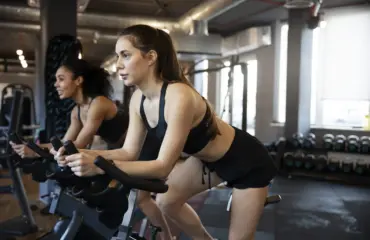
An indoor cycling studio rests on four pillars: a homogeneous fleet of ten to thirty professional bikes, a 15 mm shock absorbing floor, an immersive room, and the teaching logistics that keep it filled. Get the bike specification right and the room delivers one of the best revenue to floor area ratios in the building. Get it wrong and you own thirty bikes that instructors quietly avoid. This guide covers the technical choices, the room layout and the budget lines.
Why the format still earns its floor area
A studio of fifteen bikes running a normal timetable turns over six to twelve classes a day at full capacity, which is ninety to a hundred and eighty paid places daily on a footprint of only 60 to 100 m2. Three structural reasons keep the format attractive: an unbeatable revenue to area ratio, a contained coaching cost of one instructor for ten to thirty participants, and an equipment service life of eight to twelve years that spreads across several accounting periods.
Four technical configurations of professional cycling bike
The specification comes down to two variables: the braking system, which creates resistance, and the transmission, which links the crank to the flywheel. Crossing them produces four configurations.
| Configuration | Dominant characteristic | Best suited to |
|---|---|---|
| Magnetic braking with poly-V belt | Acoustic output around 30 to 35 dB, near zero brake maintenance | Premium studios, hotels, care settings, wellness suites |
| Magnetic braking with chain | Quiet braking combined with road feel from the chain | Mixed cardio and road oriented studios |
| Friction braking with poly-V belt | Sprint feel with a quiet transmission | Cross training boxes, general commercial clubs |
| Friction braking with fixed gear chain | Maximum road feel, high robustness | Choreographed professional studios, road cyclist conditioning |
Magnetic braking removes the consumable brake pad and the noise that comes with it, which is what makes it the default in hotels and any room adjacent to bedrooms or offices. Friction braking gives a more abrupt resistance change, which some choreographed formats deliberately use.
Flywheel mass: match it to the class format
Beyond braking and transmission, flywheel inertia governs pedalling smoothness and the perceived quality of the session. Professional bikes range from 12 to 25 kg.
- Light flywheel, 12 to 16 kg. High cadence work at 90 to 110 rpm, thirty to forty-five minute interval formats, general conditioning. Suits beginner to intermediate participants.
- Mid flywheel, 18 to 22 kg. The most common specification in commercial studios. Allows alternation between fast and heavy cadence, flat and moderate climb simulation, and standard fifty minute choreographed formats.
- Heavy flywheel, 24 to 25 kg. Strength sets, long climb simulation and endurance protocols. Suits experienced road cyclists and athletic conditioning.
Order the whole fleet in one configuration. A mixed studio where the front row feels different from the back row generates complaints from participants and reluctance from instructors, and it makes maintenance stock harder to hold.
The seven components of a complete studio
A cycling studio is not just a fleet of bikes. Seven components structure the project, and under-specifying any one of them undermines the participant experience or the life of the equipment.
| Component | Specification | Why it matters |
|---|---|---|
| Bike fleet | 10 to 30 identical units, braking, transmission and flywheel specified to the format | Fleet homogeneity is the first driver of instructor and participant satisfaction |
| Flooring | 15 mm fine grain non-slip rubber tile, loose laid or bonded, from 22 EUR per m2 excluding VAT | Absorbs vibration, protects the substrate, controls sweat ingress |
| Bike layout | Arc or rows, 1.20 m lateral spacing and 1.50 m in front of the instructor | Determines how many bikes the room genuinely holds and whether an instructor can reach every rider |
| Sound system | Stereo speakers of 200 W RMS minimum, mixer with instructor microphone, equalisation set to the room | Under-specified audio is the most common reason a well equipped studio underperforms |
| Lighting | Dimmable LED or tungsten, programmes able to follow the music | The room atmosphere is a large part of the product being sold |
| Mirrors | One full wall | Lets riders check posture without the instructor stopping the class |
| Connectivity | Dedicated Wi-Fi, Full HD or 4K group display, Bluetooth or ANT+ consoles | Required for data driven formats and leaderboards |
Budget markers
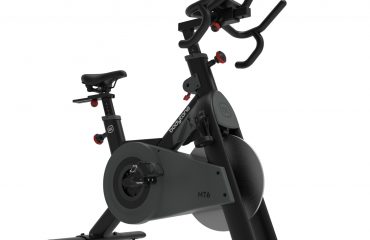
Bike prices in our professional ranges give the order of magnitude for a fleet. A Bodytone MT6 professional indoor cycling bike lists at 1,425.40 EUR excluding VAT, and an Etenon ION8 at 1,950 EUR excluding VAT. A fifteen bike studio therefore sits between roughly 21,000 and 30,000 EUR excluding VAT for the fleet alone. Add the floor, at 22 EUR per square metre for a 15 mm tile over 60 to 100 m2, and the audio, lighting and display package, which is quoted per room because it depends entirely on the acoustics and the ceiling.
Light In Fitness distributes several professional cycling ranges, including Bodytone, Lexco and Ziva. No single manufacturer covers all four braking and transmission configurations equally well, which is the practical argument for specifying from a multi-brand catalogue rather than defaulting to one supplier.
Standards and use classes
Specify bikes conforming to EN ISO 20957 class S, the professional and commercial class. Class H is the domestic class and has no place in a commercial studio specification, and there is no semi-professional category in the standard whatever a supplier sheet may state. Under ISO 20957-1:2024, classes A, B and C are accuracy classes describing how closely displayed values match measured values, which is the relevant clause if you intend to run power based formats and leaderboards where riders compare outputs.
Frequently asked questions
How much floor area does a fifteen bike studio need?
Between 60 and 100 m2 depending on layout. Work from 1.20 m of lateral spacing between bikes and 1.50 m clear in front of the instructor position, then check that the room still allows a rider to leave mid class without disturbing the row.
Magnetic or friction braking for a hotel?
Magnetic, without hesitation. Acoustic output of around 30 to 35 dB and the absence of a brake pad to replace are decisive where the room sits near bedrooms, meeting rooms or offices, and unsupervised guests will not report a worn pad before it fails.
What maintenance does a cycling fleet need?
Weekly cleaning of the frame and console, because sweat is the main corrosion agent in a cycling room, plus periodic checks of pedals, cleats, saddle and handlebar clamps. Friction brakes add a pad replacement cycle. Expect eight to twelve years of service life on a professional fleet, and hold a small stock of consumable parts so a bike is never out of the row for long.
Do I need connected consoles?
Only if you intend to sell data driven formats with a group display and leaderboard. Those formats justify power measurement and Bluetooth or ANT+ connectivity across the whole fleet. A studio running conventional choreographed classes gets more value from the sound system and the lighting than from consoles.
Specify your cycling studio
Light In Fitness has equipped clubs, hotels, resorts, care settings and public facilities from Tours, France, since 2013, with more than 2,500 customers served. We audit the room, specify the fleet and the floor together, and issue a quotation within 24 working hours. Stock items ship in five to ten working days across France, Belgium, Switzerland and Luxembourg, with export costed project by project.
Browse indoor cycling bikes and rubber gym flooring tiles, or request a quote with your room dimensions and class timetable.
Réalisations documentées
- Dalles et sols sportifs : livraisons documentées – plusieurs chantiers
- Sol sportif extérieur, square Georges-Vallerey – Taverny (95)
Sources et références
- Code du sport, articles R322-4 à R322-43 – garanties d’hygiène et de sécurité applicables aux établissements d’activités physiques et sportives (Légifrance)