How to Choose a Magnetic Indoor Cycling Bike for a Studio
A magnetic indoor cycling bike bought for a commercial studio is judged on different criteria from one bought for a spare bedroom. It will be ridden by dozens of different bodies a week, adjusted between every class, cleaned with disinfectant twice a day and expected to stay silent enough for an instructor to be heard over it.
This guide sets out what a gym operator, a hotel, a club or a rehabilitation centre should actually check before ordering: how the resistance system works, what adjustability really means on a shared bike, how robustness is specified, what the console needs to display, and what the bike costs to keep in service.
1. Adjustable resistance: what magnetic braking really is
Magnetic resistance works by moving magnets closer to or further from a metal flywheel. The magnets never touch the flywheel: the braking force comes from eddy currents induced in the moving metal. It is a contactless system, which is precisely why it is not friction braking, and the distinction matters commercially.
What contactless braking gives an operator:
- Precise, repeatable intensity. A given position on the resistance range produces the same load today and next month, which is what makes structured class programming possible.
- Almost no wear. There is no pad wearing against the flywheel, so there is no consumable to replace and no resistance drift as the pad thins.
- Quiet running. The instructor and the music carry over the bikes rather than competing with them, which is a real consideration in a shared building or a hotel.
Felt-pad friction bikes still exist and are cheaper. They also need pad replacement, they change behaviour as the pad wears, and they are noisier. On a commercial floor it is the maintenance profile, not the purchase price, that usually decides the comparison.
2. Comfort and fit on a bike nobody owns
In a studio the bike is set up from scratch several times an hour, by riders who range from a 1.55 m first-timer to a 1.95 m cyclist. Adjustability is therefore not a comfort feature, it is the feature that determines how many of your members can ride safely.
- Saddle adjustable for height and fore-aft position. Fore-aft is the adjustment most often missing on cheaper bikes, and it is the one that positions the knee correctly over the pedal axle.
- Handlebar adjustable for height, and ideally for reach. This is what lets a rider with a short torso or a stiff lower back hold a sustainable position.
- Tool-free adjustment with clear markings. If a setting takes longer than a few seconds, the class starts late and riders simply leave the bike where the last person left it.
- A quality chainset or belt drive and smooth, immediate braking. A drivetrain that runs true is what makes a standing effort feel controlled rather than jarring.
Correct positioning is the main protection against knee, hip and lower-back complaints in a class environment, and it is worth training front-of-house staff to set a bike up rather than leaving it to the rider.
3. Robustness and build
Commercial bikes are built from heavier material than consumer-market ones, and the specification points to check are few and unambiguous:
- Frame. Steel or reinforced alloy, with a corrosion-resistant finish that tolerates sweat and disinfectant.
- Maximum user weight. Take the manufacturer figure and treat it as a hard limit, not a target. A studio needs headroom above the heaviest rider it expects.
- Flywheel mass. A heavier flywheel carries momentum through the dead spot of the pedal stroke, which is what riders perceive as smoothness and stability at high cadence.
- Stabilisers and levelling feet. A bike that rocks on an uneven floor will loosen its own fixings over time.
The professional indoor cycling bike range is built for EN ISO 20957-1 class S, the class intended for supervised professional use. Equipment specified for the consumer market has no place on a commercial floor, whatever the badge on the frame says.
4. Console and data
Most professional bikes carry an on-board computer with an LCD display. In a class setting the console is what turns an instruction into a measurable target, so check that the values are readable from the riding position and consistent from bike to bike.
| Reading | What it is used for |
|---|---|
| Distance covered | Tracking the distance completed |
| Training time | Managing the session and its intervals |
| Heart rate | Controlling intensity |
| Calories burned | Estimating energy expenditure |
Two practical points. Calorie figures on any cardio console are estimates, so present them to members as such. And if you intend to run leaderboards or connected classes, confirm the heart-rate pairing and any connectivity before you order rather than after.
5. Footprint, moving and cleaning
Folding frames belong to the consumer market and have no place in a studio. What a commercial operator needs instead is a bike that can be moved without two people and cleaned without damaging it.
- Transport wheels. One person should be able to tip and roll a bike to clean underneath it or reconfigure the room.
- Footprint and spacing. Plan the grid around the space an instructor needs to reach every rider, not around the bike outline alone.
- Cleanability. Sealed consoles, protected bearings and finishes that tolerate the disinfectant your protocol actually uses.
If the room also has to serve general members outside class hours, pair the studio bikes with professional upright exercise bikes rather than asking one product to do both jobs.
A short checklist before you order
- Define the use: class studio, open gym floor, hotel, or rehabilitation.
- Confirm the resistance is contactless magnetic and that the range is marked.
- Check saddle height and fore-aft, and handlebar height and reach.
- Read the maximum user weight and the flywheel mass on the data sheet.
- Confirm EN ISO 20957-1 class S in writing.
- Agree spare parts, consumables and the service response before signing.
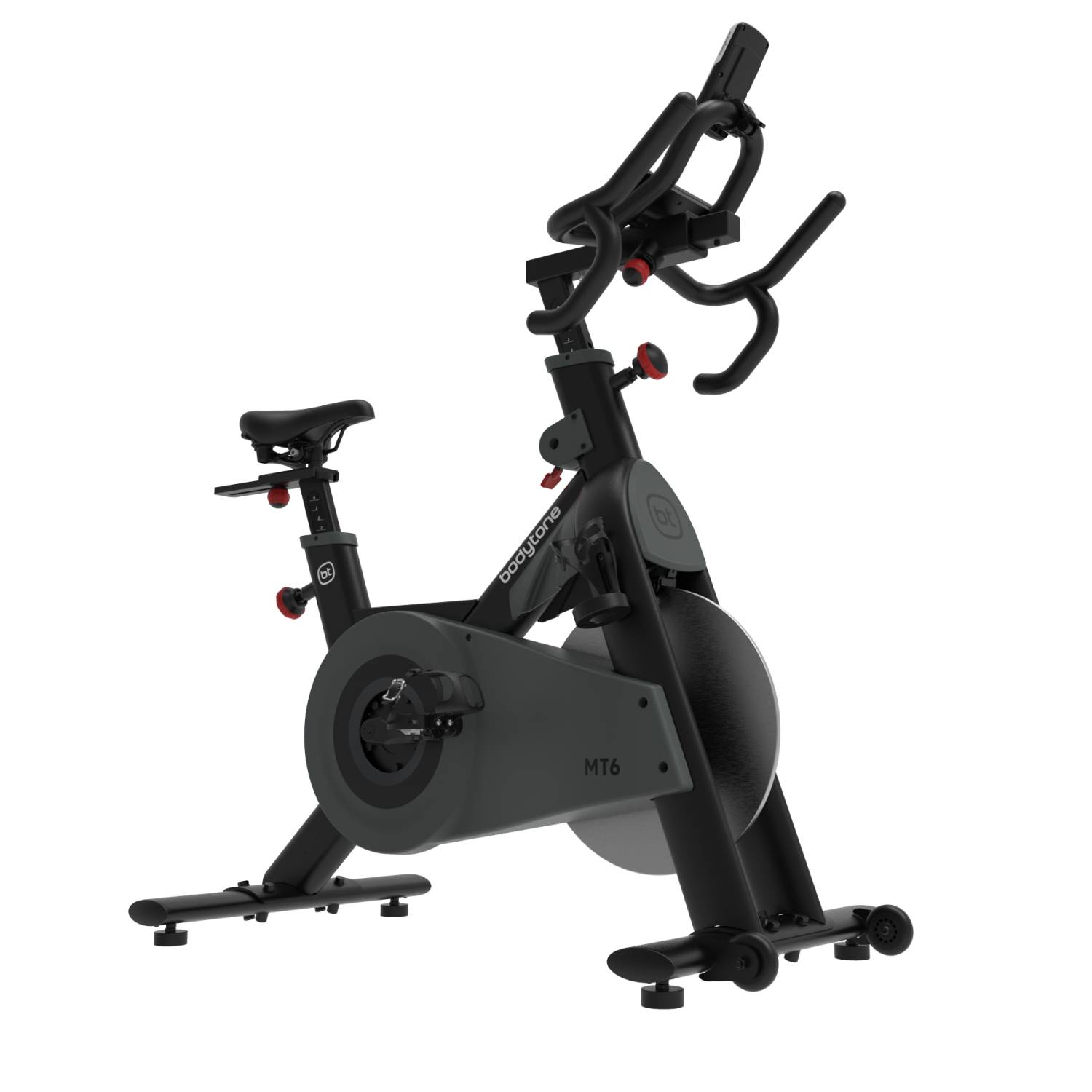
The Bodytone MT6 indoor cycling bike is a useful reference point when comparing specifications, because its data sheet states each of the points above explicitly.
Frequently asked questions
Is a heavier flywheel always better?
Not automatically. Mass improves smoothness through the pedal stroke, but a well-balanced lighter flywheel with good bearings can feel better than a heavy, poorly balanced one. Ride before you commit, and compare like with like.
Does an indoor cycling bike train the upper body?
No. It is a lower-body and cardiovascular machine. Riders who want upper-body work need a separate station, and it is worth saying so plainly rather than letting a class description imply otherwise.
How many bikes should a studio order?
Size the room to the class you intend to sell, then add spacing for the instructor to move. Ordering to the maximum the floor can physically hold is the most common planning mistake we see.
Specify your cycling studio
Send us the room dimensions, your class format and your expected rider profile, and we will return a bike grid with spacing, quantities and console options. Request a quote.