Treadmill cushioning systems: how to specify shock absorption for a commercial fleet
On a commercial treadmill, cushioning is not softness, it is the calibrated management of impact, stability and durability. A deck that feels comfortable in a thirty second showroom test can be unusable after fifteen minutes, and a system that absorbs well on day one can be flat by day five hundred. This guide explains how treadmill cushioning works, what it changes for a facility operator, and how to specify it against the way your machines will actually be used.
What cushioning actually is
The shock absorption system of a treadmill is not a single component but an assembly:
- The running deck and its flexibility.
- The elastomers, silent blocks or pads mounted under the deck.
- On some designs, a suspended frame or differentiated zones between the front and rear of the deck.
- The belt and its mechanical behaviour.
- On certain models, variable cushioning systems that change stiffness along the deck.
Each contact generates a substantial vertical force. Biomechanical measurements place the peak ground reaction force in running at roughly 2.0 to 2.9 times body weight depending on speed and conditions, with other work citing a broader range of 1.5 to 3 times body weight. The purpose of a cushioning system is not to remove that force, which is impossible, but to lower the peak, spread the load over time and limit what travels abruptly up the ankle, knee, hip and spine chain.
Why cushioning becomes strategic in professional service
The more a treadmill is used, the more the cushioning system determines outcomes the operator cares about:
| Consequence | What it affects commercially |
|---|---|
| Muscular and joint fatigue | Session length and how often a member returns to the cardio floor |
| Tolerance across user profiles | Whether beginners, returning exercisers and heavier users stay on the machine |
| Noise and vibration | Decisive in hotels, workplaces and any room above occupied space |
| Durability of deck, pads and frame | Replacement cycle and the total cost of the cardio fleet |
| Perceived quality of the space | The cardio row is usually the first thing a prospective member tries |
Three misconceptions worth clearing
The first is that softer is always more protective. Cushioning that is too soft feels spongy, degrades stability and changes the gait. Correct cushioning absorbs without bottoming out.
The second is that all treadmills cushion alike. Two machines can carry the same belt thickness and feel completely different, because the difference is made by the deck, the frame and the elastomer elements rather than the running surface itself.
The third is that cushioning can be judged in a twenty second test. It can only be judged over duration. After ten to twenty minutes you can tell whether impacts start to feel hard or whether the stride stays comfortable, and that is the test to insist on before committing to a fleet.
Cushioning approaches and what each one changes
| Approach | Principle | Feel | Best suited to |
|---|---|---|---|
| Deck on elastomer pads | The deck rests on damping elements distributed along its length | Balanced when correctly calibrated | The robust standard for general professional use |
| Differentiated zones | Softer at footstrike, firmer at toe-off | Comfort with responsiveness | Regular cardio use, mixed membership |
| Very firm structure | Minimal deformation, maximum stability | Solid and direct | Sprint and interval work, users who want feedback from the surface |
| Very soft cushioning | Marked deformation | Cushioned, sometimes unstable | Walking and gentle return to activity, with a stability caveat |
These are tendencies rather than categories. Perceived feel depends heavily on the overall design, which is why a duration test on the actual model matters more than a specification line.
Specifying cushioning against your use case
Five questions settle the specification. Who runs on it, in terms of experience and body mass. How many hours per week the machine will run, occasional use against continuous flow. At what intensities, from walking to interval work to sprinting. What the acoustic and vibration context is, an apartment building, a hotel or an open cardio floor. And which priority ranks first: comfort, performance feel, robustness or versatility.
Three typical answers follow. For a hotel, residence or workplace, the priorities are universal comfort, low noise and reliability, which points to balanced, stable cushioning and simple servicing. For a high traffic gym, the priorities are robustness, stability and behaviour over time, which points to a professional frame, a durable deck and effective but not soft cushioning. For return to activity, higher body mass and rehabilitation settings, the priorities are tolerance, safety and progression, which favours generous cushioning with handrails and low starting speeds.
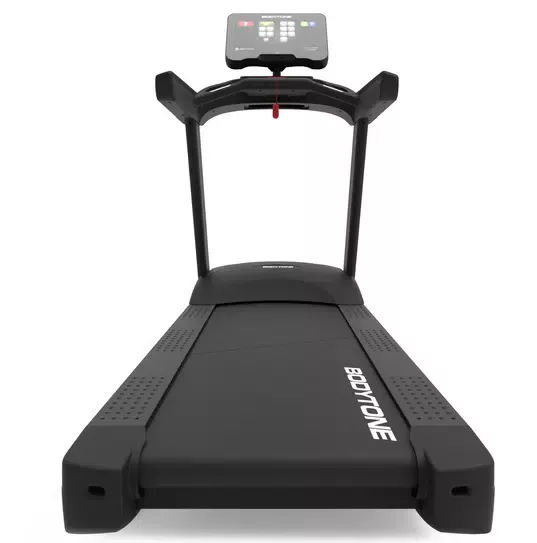
Reference points from our range, excluding VAT: a Lexco LT7X professional treadmill lists at 5,400 EUR and a Bodytone EVOT2 professional treadmill at 7,799 EUR.
Cushioning is also a maintenance question
Comfort on day one is not the subject. Day five hundred, under real use, is. Three things degrade over a fleet’s life: elastomers and pads age and harden, a deck can compress, and an under-lubricated belt increases friction, heats up and loads the whole system. A treadmill that has never had its belt lubricated will feel harder and consume more current than the identical machine on a maintenance schedule, and the deck will reach end of life sooner.
Two practical measures follow. Put belt lubrication and deck inspection on a documented schedule rather than a reactive one, and specify machines whose decks are reversible or replaceable so the whole machine is not written off when one face is worn. As an operating provision, 3 to 5 percent of fleet value per year for preventive maintenance is the benchmark to hold.
Standards and floor build-up
Specify treadmills conforming to EN ISO 20957 class S, the professional and commercial class under ISO 20957-1:2024. Class H is the domestic class and does not belong in a specification for a shared facility, and semi-professional is not a category in the standard. Under the treadmill, a 15 mm rubber tile, listed at 22 EUR per square metre excluding VAT, is the usual specification; where the cardio row sits above occupied space, an acoustic underlay is decided before the floor is laid, because it cannot be added later without lifting the whole floor.
Frequently asked questions
Does treadmill cushioning prevent injury?
No, and it should not be sold that way. Running injuries are multifactorial, involving training load, recovery, technique, history and footwear. What cushioning can do is reduce peak mechanical loading, and research on shock absorption systems indicates these can reduce the impact of ground reaction forces at joints such as the knee and ankle. That improves tolerance to repeated effort, which is a real operational benefit without being a medical claim.
How do I compare two machines objectively?
Run each for at least fifteen minutes at the speeds your members actually use, with a heavier user as well as a lighter one, and listen to the machine as well as feeling it. Then ask the supplier for the deck and pad replacement parts, their price and their expected cycle. A supplier who cannot answer the second question has not designed for a commercial life.
What incline should be used to approximate outdoor running?
A slight incline of around 0.5 to 1 percent is commonly used to approximate outdoor conditions. It is a programming detail rather than an equipment specification, but it is worth including in member induction material.
Which cushioning suits a hotel fitness room?
Balanced cushioning on a stable frame, with low noise and simple servicing. Guests use the machine unsupervised and will not report a problem before it becomes a failure, so specify for reliability and quiet operation rather than for the softest feel.
Specify your cardio fleet
Light In Fitness has equipped clubs, hotels, workplaces and public facilities from Tours, France, since 2013, with more than 2,500 customers served. We issue quotations within 24 working hours, ship stock items in five to ten working days, and deliver across France, Belgium, Switzerland and Luxembourg, with export costed project by project. Machine ranges carry two to five year warranties.
Browse professional treadmills and acoustic underlay for gym floors, or request a quote with your expected daily running hours and building context.
Sources et références
- NF EN ISO 20957-1 – équipement d’entraînement fixe, partie 1 : exigences générales de sécurité et méthodes d’essai (AFNOR)
- AFNOR Normalisation – dossier thématique sur les appareils d’entraînement fixes et leurs classes d’usage