Professional Strength Machines: The Quality That Makes the Difference
Whether the person on the station is an experienced lifter or somebody in their first month of training, one thing holds: when it comes to strength equipment, quality decides the outcome. Those are the machines that let a user push their limits without wondering whether something is about to give way under the load. That is precisely why professional strength equipment is not optional on a commercial floor. We are not talking about the cheap units that are regretted after three repetitions, but about machines built to take the effort, session after session, for years.
So why invest in professional strength machines, and how exactly do they deliver training that is effective, safe and worthy of a serious facility? Here is the full picture.
Durability and stability: the machine should outlast the membership
The first reason to invest in professional strength machines is durability. Picture a user pushing heavy, fully focused, two repetitions away from a personal best, when the machine starts to creak. Not ideal. Professional equipment is built to take that, whatever the load and whatever the frequency of use.
Why it matters
- Materials. Professional strength machines are built from solid materials such as reinforced steel, designed to withstand the most demanding users.
- Stability. There is nothing worse than a machine that rocks under a user. Professional stations are built to stay stable under heavy loads, which is what makes the training safe. No risk of the frame shifting during a set of squats.
What it changes
With quality equipment a user can concentrate entirely on the performance, without fearing that something will fail under pressure. For the operator, that same durability is what turns a purchase into an asset rather than a recurring line in the maintenance budget.
Safety first: only the muscles should be suffering
Anyone who has had a weight escape their hands mid-set knows how central safety is in strength training. This is where professional machines earn their price: they are designed with safety in mind, from integrated safety systems to high-specification cables and a geometry intended to minimise injury risk.
Why it is critical
- Integrated safety systems. Many professional stations carry safety features such as automatic catches or adjustable supports that keep the bar off the chest during a bench press.
- Ergonomic design. Professional machines are designed to fit the body, with adjustable seats, appropriate handles and optimised movement angles. The result is lower injury risk and more comfortable sessions.
- Quality cables and pulleys. No cables slipping under tension, no pulleys squealing after three repetitions. On professional equipment every component is built to last, and nobody has to worry about a cable failing mid-pull.
What it changes
Members train with peace of mind, without inspecting every bolt before a set. Beyond protecting the user, those safety systems let people concentrate on their objectives rather than on the risks. For the facility, they also reduce the supervision load on a busy floor.
One point of specification underpins all of this. Indoor equipment for supervised commercial and institutional use is covered by EN ISO 20957-1 class S. Anything rated below that class is tested for a different duty cycle and does not belong on a commercial floor.
Versatility: one machine, many possibilities
One of the great strengths of professional equipment is versatility. We are not talking about a simple bench, but about machines built to train several muscle groups from a single station. That saves users from running between machines during a circuit or juggling dumbbells of different weights.
Why it is essential
- Complete training. Many professional stations are multi-function machines that allow a full-body programme. Leg extensions one day, chest work on the same frame the next.
- Space. In a small club room, a versatile machine is how you maximise the floor. Instead of three separate stations, one can cover a complete session. A multi-station unit such as the 10-station cable crossover is the clearest example of that logic.
- Movement quality. Professional machines are engineered for smooth movement without jerks, which is essential for effective training. Muscles are worked in a targeted, controlled way without compromising movement quality.
What it changes
Sessions stop being a search for a free machine. Users optimise their time and cover everything in one pass, which for an operator also means better throughput per square metre at peak hours.
Comfort and ergonomics: every centimetre counts
Who decided strength training had to be uncomfortable? On professional equipment the ergonomics are worked out so that every movement is fluid and natural, rather than producing aches caused by a machine that does not fit the person on it.
Why it is a game changer
- Adjustability. Professional machines let seats, handles and pulling angles be set to the individual. Whether a user is 1.50 m or 2 m tall, there is a correct position to be found.
- Lumbar support. Some stations include supports designed specifically to protect the back during pushing or pulling exercises.
- Materials that stay comfortable. Quality equipment uses coverings that are hard-wearing and comfortable at the same time. No foam that deforms and no upholstery that wears through after a few weeks.
What it changes
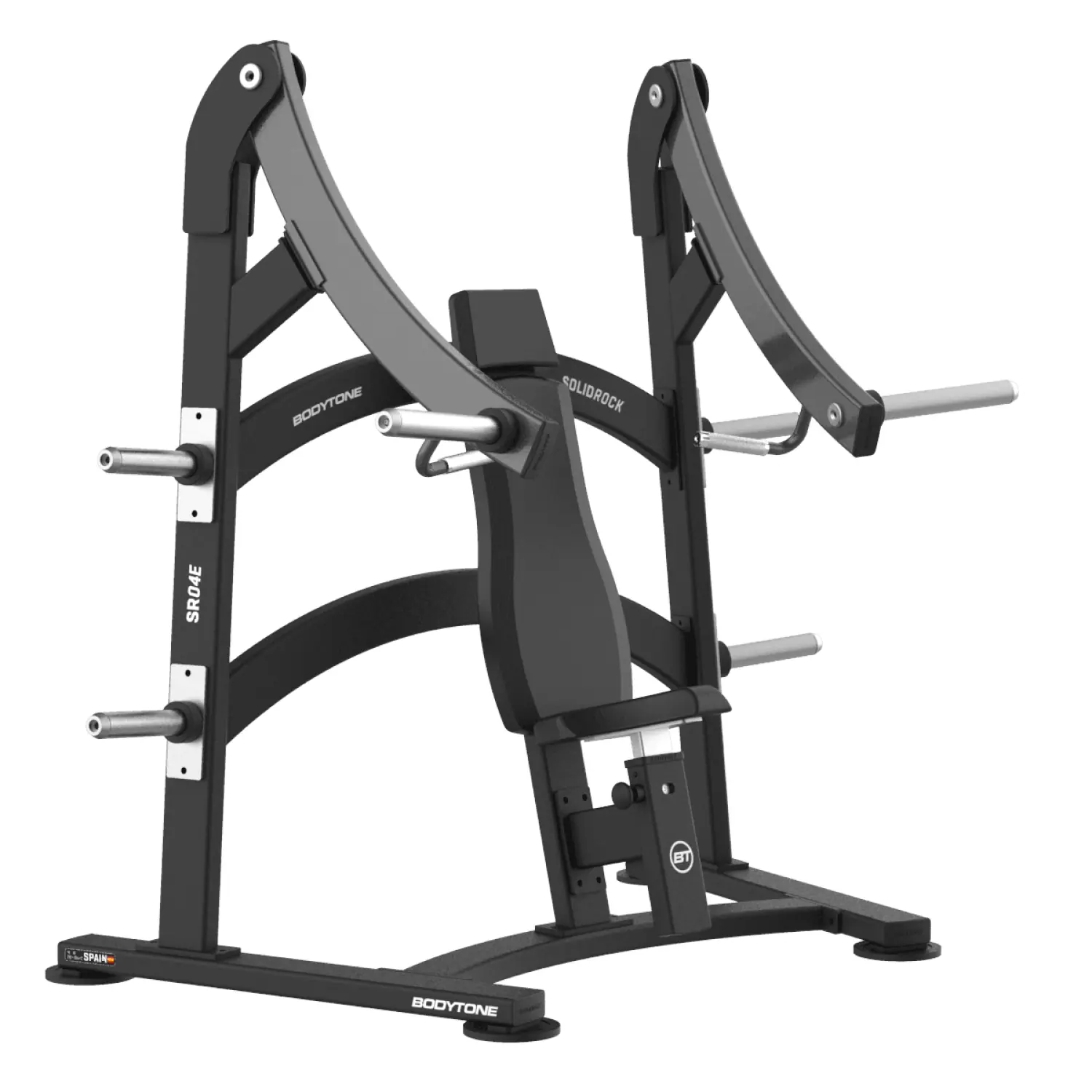
A well designed machine maximises results while reducing the injury risk that comes from poor posture. More comfort means more use, and more use is what justifies the station on the floor plan. Our professional strength training machines are specified on exactly that basis, and the Solid Rock plate-loaded range covers the heavy end of the same requirement.
Design and technology: instrumentation that earns its place
Professional strength machines are not only robust and ergonomic; some are also equipped with technology that makes training more interactive and more precise.
Why it is useful
- Performance tracking. Some professional machines carry sensors that track performance in real time, such as repetition count or movement speed.
- Built-in programmes. Some machines offer integrated training programmes that guide a user through a session structured around their objectives.
- Adaptive resistance. The most modern stations adjust resistance automatically according to the user strength and progress.
What it changes
Each session becomes measurable. Progress can be followed precisely and effort adjusted accordingly. For an operator, instrumented stations are also a retention tool, because members who can see progress are members who come back. That said, instrumentation is worth paying for only once the frame, the cables and the ergonomics are right: a sensor on a station that rocks is a sensor on a problem. A well built mechanical station such as the Gold Line 45 degree leg press will outlive several generations of screens.
Frequently asked questions
What makes a strength machine professional rather than consumer grade?
The intended duty cycle and the testing behind it. Indoor equipment for supervised commercial and institutional use is covered by EN ISO 20957-1 class S; equipment rated below that class is a different specification, not a cheaper version of the same one.
Which components fail first?
Not the frame. Cables, pulleys, bearings and upholstery are the wear parts, which is why their specification and spare-parts availability matter more than the headline frame warranty.
Are multi-function machines a compromise?
Not necessarily. They are the right answer where floor area is the constraint and the programme is general. Where the population is specialised, dedicated stations give better movement quality per exercise.
Is instrumented equipment worth the premium?
It is worth it once the mechanical specification is right, and as a retention tool rather than a training necessity.
How do adjustments affect who can use a machine?
Directly. A station with a narrow adjustment range excludes part of the membership regardless of build quality, so the adjustment range is part of the specification, not a detail.
Why professional equipment is the intelligent investment
Investing in professional strength machines is above all a decision about quality. These machines deliver durability, safety, comfort and performance, and they let users progress efficiently without unnecessary injury risk. Whether the room is a full commercial gym, a club or an institutional facility, this is equipment that stays in service for years without weakening.
Send us the room, the membership profile and the programme you run, and we will propose the stations that match. Request a quote for a costed proposal.
À lire aussi sur le même thème
- Chest press : Les muscles sollicités et pourquoi cet exercice est incontournable (Spoiler : c’est votre meilleur allié pour un torse en béton)
- The Different Types of Olympic Barbell in a Professional Gym
- Building an Outdoor Plate-Loaded Gym with Olympic Machines
- Strength Training: Principles, Effects and Exercises