Gym Strength Equipment Explained: Racks, Barbells, Benches and Dumbbells
Anyone walking into a strength room for the first time is faced with frames, bars and benches of every shape and size, and very little on them explains what they are for. That gap matters to operators as much as to members: equipment used wrongly is equipment that produces injuries, complaints and, eventually, a machine nobody touches. New users should always be shown the room by a coach or a floor assistant, and the equipment itself should be chosen so that correct use is the obvious use.
This guide goes through the pieces found in almost every strength room, what each one is for, and the points a coach should be making about them.
Squat racks and power cages
A squat rack is a large, heavily built frame designed to hold a loaded barbell at shoulder height so a user can step under it, unrack it and squat. The squat is one of the most valuable movements in a strength programme because it loads the lower body and the trunk together, hips, thighs, glutes and calves working with the core rather than in isolation.
The rack is also the single station in the room where a mistake has the largest consequences, which is why frame quality is not the place to save money. A Gold Line squat rack and power cage gives the mass and the footprint that a loaded bar demands.
Coaching point: two adjustments have to be right before the first repetition. The J-hooks holding the bar must sit at a height the user can unrack without standing on their toes, and the safety arms must be set just below the lowest point of the movement. Set correctly, a failed repetition ends with the bar on the safeties. Set wrongly, or not at all, it ends on the user.
The barbell
The barbell is the most used tool in the room because of how many movements it supports. It is loaded on the squat rack, but it also drives bench pressing, overhead pressing, rows, deadlifts and curls. Bars come in different diameters and knurling patterns, which change the grip and suit different movements.
When plates are loaded on both ends, they must be locked with collars. A collar is not an accessory: without it, plates slide as soon as the bar tilts, the load shifts to one side, and the user is pulled off balance mid-repetition.
Coaching point: the load has to allow a neutral spine throughout. If the back has to round or arch to complete a repetition, the bar is too heavy, full stop. The other high-risk moments are the ones people pay least attention to: lifting the bar off the floor at the start and putting it back down at the end. Most barbell back injuries happen in those two seconds rather than during the working repetitions.
The incline bench
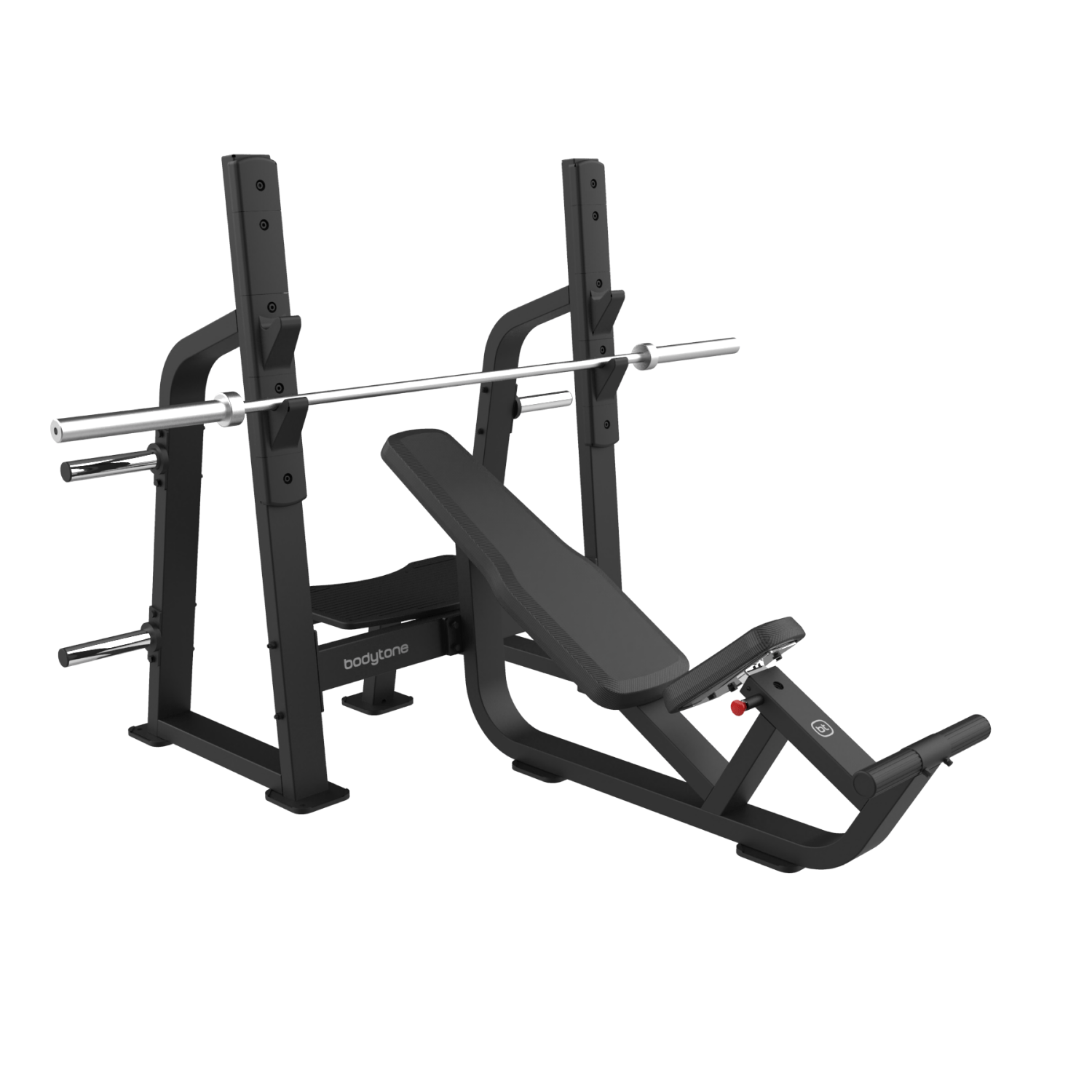
An incline bench supports the head, back and pelvis with the feet either flat on the floor or on a footplate, and sets the torso at an angle where the head sits higher than the hips. That angle shifts the emphasis of a press towards the upper chest, the front of the shoulders and the triceps.
An incline press can be performed with a barbell or with dumbbells, and the two are not interchangeable: the barbell allows a heavier load, dumbbells allow a longer range and demand more stabilisation. A dedicated station such as the Bodytone FBC07 olympic incline press combines the bench and the bar supports in one frame, which is usually the better answer in a supervised commercial room.
Coaching point: keep the back in contact with the pad. If the user has to arch off the bench to move the weight, the weight is too heavy. And the thumb must wrap around the bar in opposition to the fingers, never alongside them. A thumbless grip on a loaded bar over the chest is the single most dangerous habit seen in a strength room.
Dumbbells
Dumbbells are the most recognisable equipment in any strength room and probably the most used. They allow variation in two dimensions at once: in movement, because each arm works independently through its own range, and in load, because a rack lets a user move from 3 kg for minimal resistance up to 30 kg or more without touching a plate.
That second point is what makes them essential to circuit work. In a sequence run without rest, unloading and reloading plates between stations breaks the circuit; picking up the next pair of dumbbells does not. A range such as the Ziva Performance Hexagon RPU dumbbells covers a full rack for a commercial room.
They also carry a lower cost per usable load than a barbell with a full set of plates, which is one reason a small facility can build a credible free-weight offer around a dumbbell rack before it buys anything else.
Coaching point: control matters more with dumbbells than with a barbell, because nothing links the two sides. The user has to hold the movement together through the whole range, which is exactly what makes dumbbells so effective: the nervous system stays engaged at every degree of joint movement instead of following a fixed path.
Almost every muscle group can be trained with them, from the arms and shoulders through the chest and back. They also load the lower body indirectly when simply held at the sides, adding resistance to lunges and step-ups on top of body weight.
Equipping a strength room
Training tools come in many shapes and weights, so the discipline is in choosing what the room actually needs rather than buying everything available and ending up with equipment nobody uses. In a commercial setting, three questions decide it: how many people train at peak hours, how much supervision they have, and how much floor area each station can justify.
The order that works for most rooms is a rack, a bar and plates, an adjustable or incline bench, and a dumbbell range, before any isolation machine is considered. Those four cover the major movement patterns for the whole membership. Isolation machines then fill in the gaps, and they are much easier to specify once you can see how the room is actually used.
Light In Fitness has equipped strength rooms since 2013 and supplies professional ranges with support that continues after delivery, including replacement in case of transit damage. Our team can review your floor plan, propose a configuration and quote equipment, delivery and installation together: start from the quotation request page or write to contact@lightinfitness.com.
À lire aussi sur le même thème
- Leg Curl: A Complete Guide to Hamstring Training
- L’Échec en Entraînement : Utile mais Non Impératif à la Progression de l’Hypertrophie Musculaire chez les Sportives Débutantes
- Optimisation de l’Hypertrophie Musculaire : L’Ordre d’Exécution des Exercices Polyarticulaires est-il Crucial ?
- Barbells vs Dumbbells: How to Balance a Professional Free-Weight Zone