Professional Strength Training Equipment for Gyms and Clubs
Equipping a commercial training floor is a different exercise from fitting out a private room. Machines that run twelve to sixteen hours a day, under users of every size and every level, are judged on frame geometry, bearing quality, upholstery durability and on whether a spare part will still be available years after installation. This guide sets out what a professional buyer should look at before signing an order for strength equipment.
What makes a strength machine professional
For indoor training equipment the reference standard is EN ISO 20957-1 class S, the class written for supervised commercial use: gyms, clubs, hotels, corporate facilities, schools, rehabilitation centres and armed forces sites. Class S covers the load cycles, the safety distances and the stability requirements that a shared training floor imposes. Class I is a separate professional class for inclusive access, designed for users with reduced mobility; it is a different intended use, not an intensity grade above class S.
Beyond the standard, the tell-tale signs are mechanical: welded and powder-coated steel sections rather than thin folded tube, sealed bearings on every pivot, guide rods that stay true after tens of thousands of repetitions, and upholstery that can be replaced without returning the machine to the factory.
The main families of strength equipment
Plate-loaded machines load Olympic discs directly onto the movement arm. They are mechanically simple, extremely robust and popular in strength-oriented and cross-training facilities. Our Solid Rock plate-loaded range is built around this principle, with iso-lateral arms that let each side work independently.
Selectorised machines use a weight stack and a selector pin. They are the fastest to use in a busy circuit, the easiest to supervise and the safest for beginners, which makes them the backbone of most club floors.
Cable stations and multi-stations concentrate many exercises in a single footprint, which matters when floor area is the constraint rather than budget.
Free weights, racks and benches complete the floor and are indispensable for athletic and cross-training programmes.
The full catalogue of indoor machines is grouped under professional strength training machines.
Matching the equipment to the type of facility
A city-centre club with high turnover and short sessions is best served by selectorised stations and cable machines that need no setup time. A strength or cross-training box will get more out of plate-loaded machines, racks and platforms. Hotels and residential developments usually work with a compact mixed floor: a few cardio units, one multi-station and a small free-weight area. Rehabilitation centres and inclusive facilities need machines with low seat entry, wide access and progressive load increments. Schools and clubs need equipment that tolerates unsupervised misuse without losing its geometry.
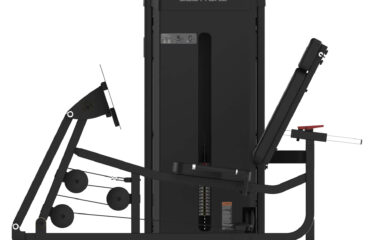
A single reference makes the point: a machine such as the SRX54 vertical leg press occupies a very small footprint for the load it handles, which is why it appears so often in facilities where square metres are expensive.
Steel, upholstery and expected service life
Structural steel is where the service life of a machine is decided. Our steel structures carry a warranty of up to 20 years, and stainless steel parts are covered for life. Upholstery, cables, grips and bearings are wear items: what matters commercially is not that they never wear out but that they are catalogued, stocked and replaceable on site by a technician.
Frequently asked questions
Can indoor class S machines be installed outdoors?
No. Indoor equipment is not designed for weather exposure or unsupervised public access. Adult outdoor fitness equipment falls under EN 16630, which is a different standard with different anchoring, corrosion and safety requirements.
Is plate-loaded or selectorised the better choice?
Neither is better in the abstract. Selectorised machines win on throughput and supervision; plate-loaded machines win on robustness, on the feel of the resistance curve and on maintenance simplicity. Most complete floors use both.
Can a floor be equipped in stages?
Yes, and it is often the sensible route. Starting with the selectorised core and adding plate-loaded stations later spreads the investment, provided the layout is drawn for the finished floor from the beginning.
What should be checked before installation?
Floor loading capacity, ceiling height for overhead movements, access route for delivery, the sports flooring itself and the circulation distances between machines. These points are far cheaper to resolve on a plan than on site.
Planning your equipment list
The most useful conversation starts with the floor area, the expected number of members and the training style you want to support, not with a list of machine names. Send us those three elements and we will come back with a layout and a costed proposal: request a quote.