Professional Indoor Cycling Bikes for Gyms and Studios

In short: a professional indoor cycling bike is defined by four things – a rigid frame built for continuous class use, a flywheel heavy enough to give a road-like pedal stroke, a magnetic resistance system that adjusts smoothly and stays silent, and handlebars and saddle that adjust fast enough to fit a new rider between classes. Everything else is secondary.
Indoor cycling has held its place on the gym floor for two decades because it fills a studio with paying members using very little space per head. But a class bike lives a harder life than almost any other machine in the building: hours of standing sprints, sweat, and a different rider every forty-five minutes. This guide sets out what a club, hotel gym or studio operator should actually specify.
What an indoor cycling bike is
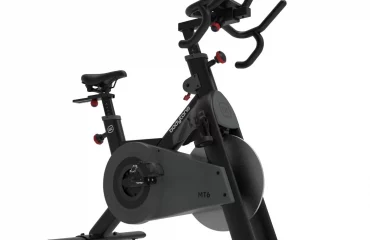
An indoor cycling bike – also called a spin bike – is built specifically for studio cycling. Unlike an upright exercise bike, it carries a flywheel that reproduces the sensation of a road bike, giving a smooth, dynamic pedal stroke. Most models carry an LCD console for tracking performance, and the resistance system allows fine adjustment, so no two sessions have to feel the same.
Indoor cycling bike versus upright exercise bike
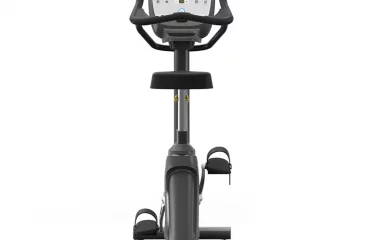
The two share a family resemblance and very little else. The indoor cycling bike is built around studio use: a solid frame, a high-inertia flywheel and a riding position close to a road bike. The upright exercise bike is built around comfort and simplicity, with a more upright posture and a gentler entry point – which is exactly what a rehabilitation room, a hotel gym or an induction programme needs.
In practice most clubs run both. The cycling studio drives class attendance and intensity; the upright bikes serve the members who want steady cardio without a class timetable.
Why operators put them in
Indoor cycling burns calories quickly and improves general condition, and because resistance is adjustable every rider in the room works at their own level from the same bike. That is what makes it viable as a group format: one class, one instructor, twenty different fitness levels, no equipment changes. Regular use builds cardiovascular capacity, and the group setting keeps attendance up in a way solo cardio rarely does.
The specification that matters
Flywheel and inertia
The flywheel is what separates a cycling bike from every other cardio machine. It carries the pedal stroke through the dead spot at the top and bottom of the rotation, which is what makes the ride feel like a road bike rather than a machine. The heavier the flywheel, the more realistic the feel and the better the rider can hold a cadence – which matters most in the seated endurance blocks where cadence control is the whole point of the session.
Magnetic or friction resistance
Friction systems brake the flywheel with a pad. Magnetic systems apply resistance without contact, which makes them smoother, quieter and free of the wear that pads suffer.
| Magnetic | Friction pad | |
|---|---|---|
| Feel | Smooth, fine adjustment | Adjustable, more abrupt |
| Noise | Silent | Audible under load |
| Maintenance | No wearing contact part | Pad wears and is replaced |
For a studio running classes back to back, magnetic resistance is the default choice: it holds a constant resistance through a whole session, and a silent bike lets the instructor be heard without fighting twenty machines.
Adjustable handlebars and saddle
This is the specification point operators underestimate. A bike that fits one rider well and everyone else badly is a bike that causes injuries and empties classes. Handlebar and saddle must both adjust – and adjust quickly, because the adjustment happens in the two minutes between one class and the next, by a member who has never done it before. Look for clear markings and levers that need no tools.
Choosing for professional use
Four criteria decide whether a bike survives club use.
- Frame strength and durability. Continuous studio use demands a frame built to take repeated standing efforts, not occasional ones.
- Flywheel mass. The heavier the flywheel, the more faithful the pedal stroke and the better the resistance behaves across intensities.
- Console. An LCD display lets riders follow the session and lets instructors set targets everyone can see.
- Fit and comfort. Adjustable saddle and handlebars, sized for the full range of members you actually have.
Products such as the Bodytone MT6 professional indoor cycling bike are built around exactly this brief – magnetic, quiet, and specified for continuous class use. The full range sits under indoor cycling bikes.
Resistance range
A professional bike offers a wide span of resistance settings so a class can simulate everything from a long climb to a flat sprint. What matters as much as the span is how fast the rider can move through it: interval work depends on changing resistance in a single beat of the music. A stiff or vague resistance control ruins the format regardless of how good the rest of the bike is.
The console
The LCD console reports speed, distance, session time and calories, which lets riders set targets and track progress across weeks. Some consoles add heart rate monitoring, which lets a rider match resistance to the intended training zone rather than to how hard the session feels. For an operator the console is also a retention tool: members who can see numbers improve tend to come back.
What indoor cycling delivers
Cardiovascular effect
Regular indoor cycling raises heart rate into working zones and, sustained over time, improves cardiovascular capacity – the well-established benefit of any regular aerobic training. It is low-impact, which is why it suits members who cannot run, and why it appears so often in supervised return-to-fitness programmes.
Endurance and condition
Because resistance is adjustable, every rider trains at their own intensity. Over time the format builds leg strength and lung capacity, and burns a high number of calories per session, which is what makes it a mainstay of weight management programmes.
Studio versus individual use
On the open floor the bike serves members training to their own schedule. In a class studio it becomes a group format, and the group is the point: the instructor, the music and twenty riders in the room deliver an intensity almost nobody reaches alone. Most clubs get the best return by doing both – a bank of bikes on the floor and a dedicated studio for the timetable.
Frequently asked questions
What is the difference between an indoor cycling bike and an upright exercise bike?
The indoor cycling bike has a heavy flywheel and a road-bike riding position, built for high-intensity studio classes. The upright exercise bike has a more upright posture and prioritises comfort and simplicity for steady cardio.
Magnetic or friction resistance for a studio?
Magnetic. It adjusts more finely, stays silent so the instructor can be heard, holds a constant resistance through a session, and has no pad to wear out and replace.
Why does flywheel mass matter?
A heavier flywheel carries the pedal stroke through the dead spot of the rotation, giving a smoother, more road-like feel and better cadence control.
Specifying a cycling studio
Bike count, studio dimensions, class timetable and ventilation all interact. Send us the room and the format you want to run, and we will come back with a bike specification, a layout and a price. Request a quote.