Professional Indoor Cycling Bikes: Equipment, Programming and Upkeep
Indoor cycling is one of the few class formats that fills a studio at seven in the morning and again at seven in the evening, which is precisely why the bikes take a beating that no domestic machine survives. For a club, a hotel or a corporate facility, the question is not whether members will use the bikes but whether the bikes will still feel the same after two years of group classes. This guide looks at what separates a professional machine from a light one, how to programme sessions on it, and what upkeep actually keeps it running.
What a professional indoor cycling bike has to deliver
Three components decide the life of a studio bike: the frame, the braking system and the transmission. A welded steel frame absorbs out of the saddle work by riders of very different weights. The braking system determines both the feel of the resistance and how often a technician has to intervene. The transmission decides how quiet the room is, which matters more than it sounds when twenty bikes run at once with an instructor speaking over them.
Two systems dominate. Friction braking with a pad is simple and inexpensive but wears, and a worn pad changes the resistance felt by the rider from one week to the next. Magnetic braking works by induction, without contact with the flywheel, so nothing wears out and the resistance stays consistent over time. In a room running several classes a day, that difference shows up directly in the maintenance budget.
Two professional bikes side by side
| Bodytone MT6 | M-5811 | |
|---|---|---|
| Braking | Magnetic, two neodymium magnets, no contact with the flywheel | Magnetically controlled flywheel |
| Transmission | Poly-V belt, no chain, no greasing | Belt drive, chain drive available as an option |
| Frame | Welded steel, robotised welding process | Stainless steel frame with aluminium components |
| Flywheel | Weighted aluminium, 20 kg inertia equivalent | Magnetically controlled flywheel |
| Maximum user weight | 150 kg | 150 kg |
| Typical use | Group cycling studios, hotels, corporate rooms | Clubs looking for a premium ride feel |
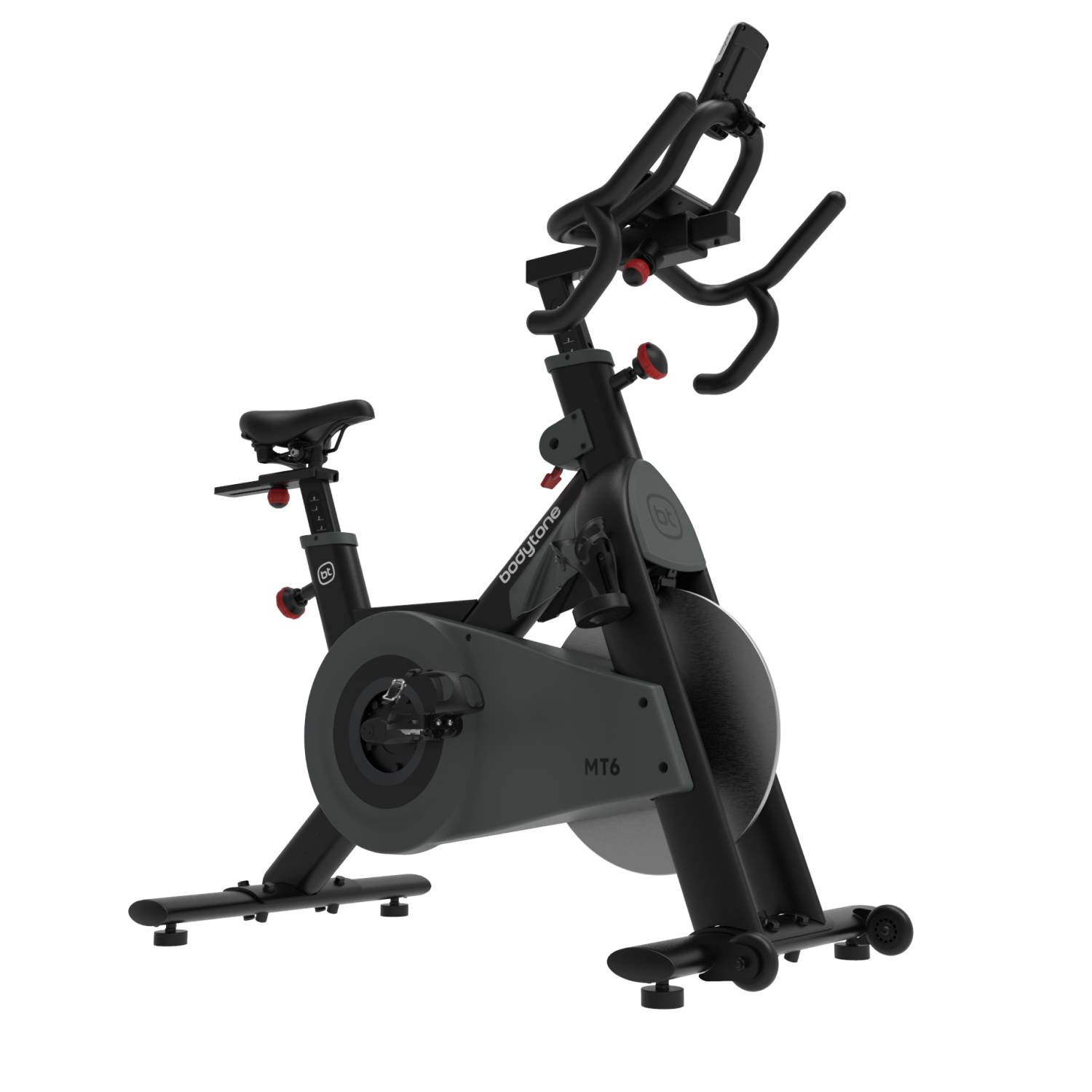
Bodytone MT6
The Bodytone MT6 professional indoor cycling bike is built around silence and low maintenance. Its two neodymium magnets brake by induction without touching the flywheel, so there is no pad or felt to replace and the resistance curve stays stable over the life of the machine. The Poly-V belt removes the chain and with it the greasing, the tensioning and the noise. The weighted aluminium flywheel, with a 20 kg inertia equivalent, gives the smooth pedal stroke a class needs when riders are asked to hold a cadence. It complies with EN ISO 20957-1 and carries a three year warranty.
M-5811
The M-5811 magnetic indoor cycling bike takes a different route to the same objective. Its frame is stainless steel with aluminium secondary components, the crank and flywheel are shrouded, and the drive is by belt with a chain version available. The result is a bike with a controlled, progressive feel, aimed at operators who want a premium ride rather than the lightest possible maintenance schedule. It also accepts riders up to 150 kg.
Choosing between them
Neither model is a lesser version of the other. If the priority is a silent room, minimal servicing and a resistance that behaves identically in month one and month thirty, the MT6 answers that brief. If the priority is the ride feel itself and the finish of the machine, the M-5811 makes its case. Most fleets are decided by the room rather than by the specification sheet: ceiling height, ventilation, the number of bikes per square metre and the class timetable weigh at least as much. The full range of professional indoor cycling bikes is organised around those two priorities.
Programming sessions that use the equipment
A bike is only worth what the programming makes of it. Three phases structure any class regardless of level.
- Warm up: easy pedalling at a comfortable cadence, long enough to raise the temperature and free the joints. It is also when the instructor checks saddle and handlebar positions.
- Main set: this is where intensity and duration are varied. Alternating resistance blocks, sprints and steady endurance work over a training cycle covers the physiological range without asking riders to do the same thing every week.
- Cool down: a few minutes of easy pedalling followed by stretching, which is what makes the next session possible.
The intention behind the class changes the balance between these phases. A general fitness clientele responds to interval formats and to music driven sessions. Riders preparing for an event need dedicated endurance blocks and simulated climbs. A rehabilitation or corporate setting stays in the moderate range with tight control of position and cadence.
Position: the detail that decides everything else
Most complaints attributed to the bike come from the setting rather than the machine. Saddle height, saddle fore and aft position, handlebar height and reach are the four adjustments to make before the first pedal stroke, and they need to be made for each rider rather than left where the previous class put them. Saddle discomfort in the first sessions is normal and settles; persistent pain means a setting is wrong or a saddle cover is needed. Knee pain almost always points to a saddle that is too low or too far forward.
Maintenance that actually gets done
Maintenance on a studio bike is short but regular. Bolt torques should be checked periodically, since group classes progressively loosen assemblies. The rails, the flywheel housing and the pedals need cleaning: sweat is corrosive and is the main cause of premature ageing in a cycling room. Machines with a chain need the manufacturer’s lubrication schedule; belt driven machines remove that task entirely. Pedals, saddles and grips are wear parts and should be treated as consumables in the budget, not as failures.
The other half of the job is the room itself. Ventilation, floor protection under the bikes and a cleaning routine after each class extend equipment life more reliably than any individual component choice.
Frequently asked questions
Is heavier resistance always better?
No. Resistance that is too low turns the session into unloaded spinning with no training effect, and resistance that is too high destroys cadence and loads the knees. The useful range is the one where the rider can hold the target cadence for the length of the block.
Magnetic or friction braking for a club?
Magnetic, in almost every case. There is no wear part in contact with the flywheel, the resistance stays consistent, and the noise level in the room is lower.
How many bikes does a studio need?
It follows from the size of the room, the required spacing between bikes and the class capacity you intend to sell, which is why the fleet is sized against a floor plan rather than a catalogue.
Can these bikes be used outside class times?
Yes. Outside the timetable they work as individual cardio stations, which is how hotels and corporate rooms use them most of the time.
Sizing a fleet
The number of bikes, the spacing between them and the choice of model follow from the room, the timetable and the clientele. Send the dimensions of the studio and the class capacity you are aiming for, and a fleet can be specified and costed around them: request a quote.
Réalisations documentées
- Functional Rig inox – installations sur trois continents
- iGreenMill, tapis de course extérieur – installations sur trois continents
À lire aussi sur le même thème
- Illuminez vos objectifs de fitness: Une exploration des plateformes d’entraînement à LED de Light In Fitness
- Tout ce que vous devez savoir sur les suppléments intra-entraînement
- Augmentez vos performances avec le sac Power Twist Bag révolutionnaire
- Découvrez les exercices d’abdominaux les plus efficaces pour un ventre sculpté