Lexco LPS-117 Leg Press: A Buyer Guide for Commercial Gyms
Choosing a leg press is rarely a question of taste. On a commercial floor it is a question of throughput, of footprint per member, of how many years the frame will keep its geometry under a full stack cycled sixty times a day. The Lexco LPS-117 seated leg press sits in the selectorised range that Light In Fitness supplies to gyms, hotel fitness rooms, municipal sports halls and rehabilitation centres across Europe. This guide sets out what the machine actually offers a professional buyer, how to position it on the floor, how to brief your instructors on it, and what to budget for its upkeep.
Why a seated leg press still earns its floor space
Free-weight squatting will always have its place, but a selectorised leg press does something a rack cannot: it lets an untrained member load the quadriceps, hamstrings and glutes heavily without needing a spotter, a technical model or a warm-up bar. For an operator, that translates into three concrete things. The machine is usable by beginners on their first session. It is usable by older members who cannot load a spine axially. And it is usable by physiotherapists working within a prescribed range of motion.
The LPS-117 targets the quadriceps, the hamstrings and the gluteal group as a chain, with the emphasis shifting according to where the feet are placed on the platform. High and wide loads the posterior chain; low and narrow shifts the work towards the quadriceps. That single adjustment is why one machine covers a spread of member profiles that would otherwise need two or three stations.
All the equipment described here is professional gym equipment built and certified for supervised commercial use under EN ISO 20957-1 class S. It is not intended for unsupervised installation, and the specification below should be read with that in mind.
Lexco LPS-117: build and specification
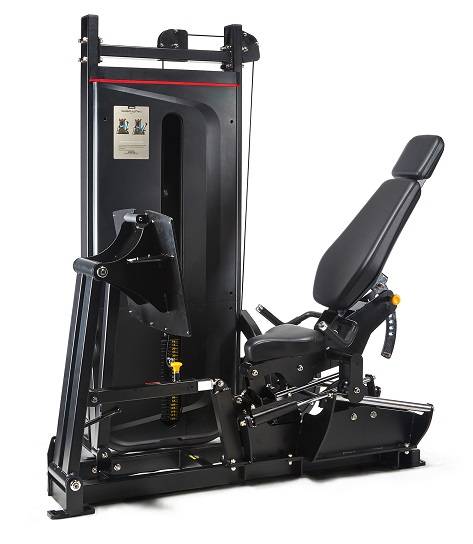
The LPS-117 is a dual-rail seated leg press with an inclined rear rail, which allows a deeper, squat-like bottom position than a single-plane sled. The frame is steel, the pulley guarding is double-sided ABS, and the seat is urethane memory foam rather than the standard vinyl-over-plywood pad found on lighter machines.
| Specification | Lexco LPS-117 |
|---|---|
| Machine type | Seated leg press, selectorised, dual rail |
| Dimensions (W x D x H) | 1,075 x 1,890 x 1,952 mm |
| Maximum load stated by the manufacturer | 200 kg |
| Backrest adjustment | 7 positions |
| Footplate adjustment | 7 positions |
| Seat | Urethane memory foam, ergonomic profile |
| Weight stack shroud | Double-sided ABS |
| Standard | EN ISO 20957-1 class S, supervised commercial use |
| Catalogue price | 5,850.00 EUR excluding VAT |
The footprint matters more than the headline figures. At roughly 1.08 m wide and 1.89 m deep, the LPS-117 needs a bay of about 2 m x 3 m once you allow for entry and exit on the loaded side and for the seat travelling backwards. Plan that bay before you plan the rest of the strength zone: a leg press placed against a wall with no exit corridor is the single most common cause of a member queue at peak hour.
Full dimensional data, stack detail and current availability are on the Lexco LPS-117 leg press product page.
Briefing your instructors: five coaching points
A leg press generates more avoidable injuries than almost any other selectorised station, and nearly all of them come from the same handful of errors. Give your floor staff these five points and most of the risk disappears.
- Set the backrest first, not the footplate. The member should be able to reach the bottom of the range without the lumbar spine rounding off the pad.
- Place the whole foot on the platform, mid-foot roughly under the knee, with the knees tracking over the second toe.
- Keep the back and hips in contact with the pad throughout. The moment the pelvis lifts, the load transfers to the lower back.
- Exhale on the push, keeping a controlled tempo rather than snapping the knees into extension.
- Inhale on the return and stop the descent at the point where contact with the pad is lost, not at the mechanical limit of the rail.
Instruct members never to lock the knees out at the top under a heavy stack. On a dual-rail machine the sled carries real momentum, and a hard lockout puts the whole load through the joint rather than the musculature.
How the LPS-117 compares with other leg stations
Buyers usually weigh the seated leg press against three alternatives: a leg extension, a seated leg curl, and a plate-loaded 45-degree sled.
- Versus a leg extension. The Lexco LPS-115 leg extension isolates the quadriceps in an open kinetic chain. It is a complement to the leg press, not a substitute: it cannot load the glutes or the hamstrings, and it does not transfer to standing tasks in the same way.
- Versus a seated leg curl. A curl station covers the hamstrings in flexion, which the leg press only reaches indirectly. Most floors that carry an LPS-117 also carry a curl station for that reason.
- Versus a plate-loaded sled. A plate-loaded sled reaches higher absolute loads, but it needs plate storage, staff time to strip and reload, and it excludes members who cannot handle 20 kg discs. A selectorised stack removes all three constraints, which is why it dominates in hotel, municipal and rehabilitation settings.
If you are specifying a full circuit rather than a single station, the whole Lexco selectorised machine range shares the same adjustment logic, the same seat material and the same guarding, which shortens staff training considerably.
Programming the leg press into a commercial timetable
Two to three lower-body sessions a week per member is the practical ceiling for most club populations, and the leg press typically appears in two of them. Rotate the emphasis rather than the exercise: one session with a moderate load and a controlled tempo, one with a heavier load and fewer repetitions, adjusting the footplate position between the two so the same station covers both.
Progression comes from adding a pin, not from adding range. Increase the stack in small increments and keep the range of motion constant, so the machine remains a measurable reference point across the member base rather than a variable one.
Maintenance and service life
A selectorised leg press is a low-maintenance station, but low maintenance is not no maintenance. Three routines are enough.
- Wipe the pads, handles and platform daily with a soft cloth and a non-abrasive cleaner. Solvent-based products degrade urethane foam and cloud ABS guarding.
- Check the moving parts weekly: cable tension and end fittings, guide rod alignment, pin and selector movement, and any play in the sled bearings. Lubricate the guide rods according to the manufacturer schedule.
- Keep the machine on a level, dry floor. On a sprung or foam floor, verify the levelling feet after the first month, then at each service visit.
Documented weekly checks are also the evidence you will be asked for if a member incident is ever investigated, so log them rather than relying on memory.
Frequently asked questions
Is the LPS-117 suitable for a hotel or residential fitness room?
Yes, provided the room is specified for supervised or access-controlled use. The machine is built to EN ISO 20957-1 class S, which is the professional classification for equipment installed in a commercial or shared setting.
How much space should be allowed around the machine?
Allow a bay of roughly 2 m by 3 m. The machine itself measures 1,075 x 1,890 mm; the remainder is entry, exit and seat travel.
Can beginners use a leg press without supervision?
They can use it safely after a single induction covering backrest setting, foot placement and range of motion. That induction is the difference between a safe station and a claim.
What does the machine cost?
The catalogue price is 5,850.00 EUR excluding VAT. Multi-station and full-circuit configurations are quoted individually.
Which muscles does the leg press actually train?
Quadriceps, hamstrings and gluteal group as a chain, with the balance between them determined by foot placement on the platform.
Specifying your leg press
The Lexco LPS-117 is a straightforward machine to justify on a commercial floor: a dual-rail seated leg press with seven-position backrest and footplate adjustment, a urethane memory foam seat, ABS guarding and a 200 kg stated maximum load, built to the professional EN ISO 20957-1 class S specification. It suits gyms, hotel fitness rooms, municipal facilities, clubs and rehabilitation centres that need one station to serve a wide spread of member profiles.
Light In Fitness has equipped professional facilities since 2013 and can quote the LPS-117 on its own or as part of a complete strength circuit, with layout drawings for your floor plan. Request a quote and tell us the room dimensions and the member profile you are equipping for.
À lire aussi sur le même thème
- Exercice de planche – que fait la planche, quels muscles font-elle travailler ? Comment réaliser correctement une planche ?
- Des exercices efficaces pour renforcer les muscles abdominaux en un rien de temps
- Back Strength Training: The Complete Guide for Gyms
- Top Astuces pour la Réduction et Prévention des Maux de Dos