The Complete Guide to Strength Machines for Your Gym

Selecting the strength equipment for a gym floor is one of the decisions an operator lives with the longest. The machines set the training offer, they dictate how the floor flows at peak times, and they stay in service for a decade or more. This guide covers the equipment families, what each one is for, how to match the mix to your member profile, and the standard to insist on before you sign anything.
Why professional strength machines are a different category
Equipment intended for a commercial floor is engineered for continuous, unsupervised use by users of very different sizes and abilities. That drives heavier frames, better bearings, harder-wearing upholstery, guarded weight stacks and adjustment mechanisms that survive thousands of cycles. It also drives certification: machines for this environment are built to EN ISO 20957-1 class S, the specification for professional use.
This matters commercially as much as technically. A machine that fails early on a busy floor costs you the repair, the downtime and the member goodwill. Specifying to the professional class from the outset is the cheapest decision in the whole project.
The two families: guided load and free weight
Selectorised and guided-load machines
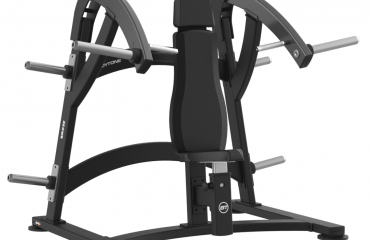
These machines move along a predetermined path. The user sits or lies in a supported position, selects a load from a stack, and performs the movement without having to control balance. The value is precision and safety: a specific muscle group is loaded directly, posture errors are limited by the machine geometry, and there is no failed-repetition risk. The chest press and the leg press are the classic examples.
Guided load suits beginners, older members, supervised rehabilitation and anyone adding volume at the end of a session. It also gives high throughput, because changing the load takes seconds.
Free-weight equipment
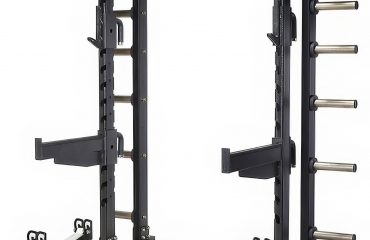
Racks, benches, barbells and plate-loaded stations impose no fixed path. The user controls the trajectory, which recruits stabilising musculature alongside the prime movers and develops balance and coordination under load. A squat rack lets one user train squats, presses and pulls in the same footprint.
Free weights suit experienced members and any club with a strength or performance identity. They demand more floor area per user, more flooring specification and, in practice, more supervision.
Which mix?
Very few clubs are well served by only one family. A mixed-membership site needs both: guided load so newcomers can start safely and progress, free weights so experienced members have a reason to stay. Where the membership is predominantly new to training, weight the mix toward guided load. Where the club positions itself on strength, weight it toward racks and plate-loaded stations. The ratio, not the brand, is the decision that shapes the floor.
Covering the body: the stations that matter
- Chest press — the horizontal push. Loads the pectoralis major with the anterior deltoid and triceps assisting; intuitive enough that new members use it unprompted.
- Lat pulldown and seated row — the vertical and horizontal pull. Non-negotiable if the floor has pressing stations, or the shoulder imbalances follow.
- Leg press — heavy lower-body loading with the back supported, for members who cannot yet load a free squat safely.
- Adductor and abductor — the inner and outer thigh, routinely neglected and directly relevant to hip stability.
- Shoulder press and arm stations — the finishing stations that keep circulation moving at peak times.
- Squat rack — the anchor of the free-weight area, covering squats, overhead pressing and rack pulls in one footprint.
Our strength training machines cover the full floor, with dedicated selectorised machines for the guided-load area and squat racks and power racks for the free-weight zone.
What to compare between suppliers
Durability
Frame gauge, weld quality, bearing type and cable specification determine whether a machine is still comfortable to use in year eight. Ask what the wear parts are, how long they are stocked, and how quickly they ship.
Ergonomics
Seat and pad adjustment should be operable one-handed from the training position. Range-of-motion adjustment matters for shorter and taller members. Clear instruction placards reduce both injury risk and the demand on floor staff.
Footprint and layout
Compare the space each station needs in service, not the shipping dimensions. Access clearance, stack side and user entry direction decide how many stations actually fit and whether the floor circulates.
Total cost of ownership
Purchase price is one input. Spare part pricing, upholstery replacement, warranty terms and the cost of a service visit are the others. A machine chosen on headline price alone frequently costs more across its life.
Maintenance that protects the investment
- Daily cleaning — wipe contact surfaces with a soft cloth and a disinfectant compatible with the upholstery, to prevent sweat build-up and corrosion.
- Lubrication — grease guide rods and moving parts on schedule to keep the action smooth and prevent premature wear.
- Periodic inspection — check cables, pulleys, fixings and stack pins for wear, and log every check. Replace a frayed cable immediately rather than at the next service.
A documented maintenance routine is also what keeps the warranty intact and gives you a defensible position if a member is ever injured.
Frequently asked questions
Guided load or free weights for a new gym?
Both, in a ratio set by your member profile. Guided load lets beginners start safely; free weights retain experienced members. A floor built on only one family loses part of its market.
Which standard should commercial machines meet?
EN ISO 20957-1 class S, the professional class for equipment in unsupervised commercial use. Ask for the test report, not just a declaration.
How many stations does a floor need?
It depends on peak occupancy rather than total membership. The usable answer comes from your floor area and expected peak footfall, which is why we lay out a proposal rather than quote a station count in the abstract.
Are machines enough on their own for muscle development?
Guided-load machines support progressive overload very effectively and safely. A complete offer still includes free-weight and body-weight work so that stabilising musculature and coordination are trained too.
Planning your floor
Send us your floor area and ceiling height, your member profile and the training offer you want to run. You will get a laid-out proposal with machine references, station spacing, flooring requirements and installation constraints, so the whole floor is costed before you commit to any of it. Request a quotation to start.