Professional Strength Equipment: Buying Guide and Operating Advice
Un appareil destiné aux professionnels relève de la classe S de la norme EN ISO 20957 et suppose des pièces détachées approvisionnables sur dix ans. Sa robustesse tient à la section de la structure, à la qualité des soudures et à celle des roulements. Le plan de maintenance préventive conditionne la durée de vie réelle du parc.

Professional strength equipment is bought against a different brief from anything sold for private use. A machine on a commercial floor has to survive a duty cycle measured in thousands of hours a year, carry the operator’s liability, and still be serviceable a decade after it was installed. A machine that meets the professional brief sits in class S of EN ISO 20957 and comes with a spare-parts chain you can rely on for ten years. Its robustness comes from the section of the frame, the quality of the welds and the quality of the bearings, and its real service life is decided by the preventive maintenance plan you put around it.
This guide works through the whole purchase: defining the brief, sizing the floor, the equipment families and what each is for, the upper- and lower-body stations, materials and brands, integrating cardio, accessories, maintenance, and how to get the most out of the installation once it is in.
Defining the brief before you look at products
What the facility is actually for
The equipment list follows from the purpose of the site, not the other way round. A club chasing strength and hypertrophy needs plate-loaded machines and heavy racks. A facility built around endurance and conditioning needs cable stations, functional space and cardio. A rehabilitation service needs low starting loads, fine increments and wide adjustment. An athletic performance centre needs equipment matched to the demands of the specific sport. Most sites are a blend, and the useful exercise is to write down the proportions before you look at a single catalogue.
Sizing the floor
Available area determines both the type and the quantity of equipment that will fit. Start with the total surface, then plan circulation before you plan stations: aisles wide enough for two people to pass, clear loading zones around plate-loaded machines and racks, and no station positioned where a user has to step backwards into a walkway. Then split the area into defined zones for free weights, selectorised machines and floor work. A floor planned as zones is safer, easier to supervise and easier to programme than a floor filled machine by machine.
Setting the budget properly
Three costs, not one. The purchase price varies widely with build quality, durability and features. The maintenance cost runs for the life of the equipment, and better-built machines generally need less of it, which can invert an apparent price advantage within a few years. And the financing structure matters: staged payment and leasing turn a capital outlay into an operating cost, which is often what makes a full fit-out possible in the first place.
The equipment families
Selectorised machines
Selectorised machines guide the movement path and enclose the load in a weight stack with a pin. They are the right choice where technique has to be controlled and injury risk minimised, which makes them the natural backbone of a circuit and the safest option for a mixed membership. The guided path puts the work on the target muscle and lets a beginner train productively from the first session. Smith machines, leg presses and multi-station gyms sit in this family.
Racks and squat cages
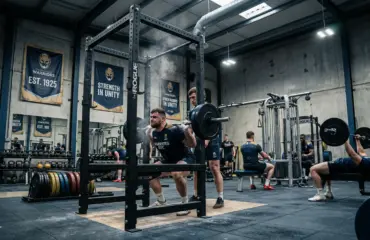
Racks and cages are the universal free-weight structure: squats, presses, pulls and everything else that needs a barbell and a large range of motion. Their value on a commercial floor is that one structure serves many movements and many users. Adjustable safety bars are the critical component: they catch a failed lift and are what allow a member to train heavy without a spotter. Specify them, and check their adjustment range against the height of your users.
Weight benches
Benches support everything from pressing to abdominal work. Flat benches give maximum stability for heavy pressing. Adjustable benches change the angle and so cover several movements in one footprint. Incline benches target the upper chest and shoulders through a fixed, optimised geometry. Most floors need all three, in a ratio set by the number of racks and dumbbell stations they serve.
Dumbbells, barbells and plates
Free weights remain the widest exercise catalogue per euro spent. The specification points are the increment structure of the dumbbell set, the load rating and knurl of the barbells, and whether the plates are bumper or cast. Storage is part of the specification rather than an afterthought: a rack that returns weights to a defined place is what keeps a free-weight area usable at peak time.
Multi-station gyms
Multi-station units combine several exercises in one frame and deliver the widest exercise catalogue per square metre. They are the answer for hotels, residential facilities, corporate rooms and any site where floor area is the binding constraint, and they allow several users to train simultaneously on one footprint.
Upper-body stations
Pec fly and rear delt
The pec fly isolates the chest through an arc of arm adduction, on a guided path that makes it safe to train close to failure. The rear delt machine works the posterior deltoid and upper back, the region most often under-trained on a floor where members gravitate to pressing. Programming both is what keeps shoulder development balanced, and it is the single most effective equipment answer to the posture complaints that show up in a general membership.
Chest press variants
The chest press is fundamental to any commercial strength floor, loading the pectorals, triceps and anterior deltoids. It comes in three main forms. Plate-loaded chest presses let the load be varied by adding discs and give the most athletic feel. Electronically regulated chest presses adjust resistance automatically, which speeds up circuit training. Incline chest presses shift the emphasis to the upper chest and add variation to a programme.
Arm training accessories
Resistance bands add progressive load to body-weight work and travel between zones easily. Grip aids help maintain hold on bars and dumbbells through long sets, delaying hand fatigue rather than limb fatigue. Kettlebells bring a functional dimension to upper-body work, with dynamic movements that load several muscle groups at once.
Lower-body stations
Leg press
The leg press loads the quadriceps, hamstrings and glutes through a multi-joint movement while keeping compressive load off the spine, which is why it carries heavy loads safely. Horizontal leg presses work from a lying position and keep the back well aligned. Inclined leg presses give a more natural loading line. Plate-loaded leg presses suit experienced users who want heavy, controlled work. Load should be introduced progressively in every case, technique first.
Abductor and adductor machines
The abductors and adductors govern hip stability and are routinely under-trained. Adductor machines load the inner thigh from a seated or lying position; abductor machines load the outer thigh and are directly relevant to injury prevention. Both matter more on a floor that serves a sports club or a rehabilitation service than the space they occupy would suggest.
Glute and calf machines
Glute stations, including hip thrust and hip extension machines, give focused loading of the posterior chain, which is now among the most requested categories on a commercial floor. Calf machines load a group that free-weight work rarely reaches properly. On both, posture is what determines whether the exercise is productive, so machines with clear start positions and obvious adjustment earn their place.
Materials, build and choosing a range
What professional construction actually is
Indoor commercial strength machines are built from heavy-gauge carbon steel sections, powder-coated for abrasion and corrosion resistance. Stainless steel is not the material of an indoor strength machine; it is specified for outdoor, coastal and pool-side equipment, where chloride attack would destroy a coated frame. On an indoor machine, the things that determine service life are the section thickness of the frame, the quality of the welds, the sealed bearings, the cable and pulley specification, and the density of the upholstery foam.
Finish and warranty
A properly applied powder coating prevents corrosion and abrasion and extends the life of the frame considerably. Warranty terms are a reliable proxy for a manufacturer’s own confidence: ask for the frame term separately from the parts-and-labour term, and confirm the intended duty cycle the warranty assumes.
Innovations worth paying for
Connected machines with integrated sensors track user performance and feed a member app or a coaching platform. Electronically regulated resistance adjusts load automatically within a set, which shortens circuits. Improved ergonomic design aligns pivots more closely with anatomical joints and reduces the number of users who end up out of position. Each of these is worth paying for when it matches how your floor is actually programmed, and worth skipping when it does not.
Ranges to consider
Light In Fitness supplies several professional strength ranges rather than a single house line, which is what allows a specification to be matched to a site rather than to a catalogue. Bodytone covers selectorised, plate-loaded and cable ranges across the whole commercial spectrum. Lexco offers selectorised and plate-loaded machines at a competitive fit-out cost. Etenon covers selectorised and cable stations. Ziva and Xebex cover the cross-training and conditioning end. O’Live Pro covers converging and functional strength machines.
Our professional strength training machines are organised by family so a floor can be specified coherently: selectorised machines for the circuit backbone and racks and power cages for the free-weight area.
Integrating cardio with the strength floor
Treadmills
Treadmills are the backbone of a cardio area: interval work and steady endurance on one machine, an interface any member can use unaided, performance tracking on modern consoles, and a running surface designed to reduce joint impact compared with road running. Positioned near the strength area, they support interval work between sets.
Cross trainers
Cross trainers load the upper and lower body simultaneously with very low joint stress, which makes them the machine of choice for high energy expenditure without impact and for members returning from injury. Adjustable incline and resistance let one machine serve very different training intentions.
Rowing machines
The rower recruits legs, back and arms in one movement and trains the cardiovascular system hard. Adjustable resistance suits all levels, and rowing intervals between strength sets are among the most effective ways to keep a session’s density high. On a floor where space is tight, a rower delivers more whole-body work per square metre than almost anything else.
Accessories for professional use
Battle ropes
Battle ropes build muscular and cardiovascular endurance at once, loading arms, shoulders and trunk in high-intensity intervals. They come in different lengths and thicknesses so intensity can be matched to the user, and they work particularly well in group formats where the exercise can be varied continuously.
Medicine balls and wall balls
Weighted balls develop strength and endurance through compound movements while training stability and balance. Wall balls in particular combine a squat with a throw, loading legs, upper body and core in one movement. Both are easy to use, suit beginners and advanced users alike, and fit into a wide range of programmes.
Roman chairs and power racks
Roman chairs support lower-body and trunk work with proper back support. Power racks give a robust structure for heavy squatting and pressing, with adjustable safety bars that minimise injury risk if a lift fails. Both allow high-intensity training to be done safely by a member training alone, which is what a commercial floor needs.
Maintenance and safety
Cleaning
Clean equipment lasts longer and is safer. Clean daily after use, particularly surfaces in skin contact such as benches and handles. Carry out a more thorough weekly clean including accessible internal parts such as bearings and cables. Inspect monthly for signs of wear or damage. Use non-corrosive products and soft cloths matched to the material, and check that dust and grit are not accumulating in mechanisms.
Wear points
Inspect cables and pulleys for fraying or damage. Check rivets and fixings are present and tight. Check bench and pad surfaces for tears. These checks are what keep a floor safe and what extend equipment life, and they should sit on a written maintenance calendar rather than depending on someone noticing.
Safety protocol
Train your staff on correct equipment use and maintenance procedures. Post clear signage reminding users to clean equipment after use. Put a fault-reporting system in place so any malfunction or damage is recorded, and make sure staff can withdraw defective equipment from use immediately. A machine left in service after a fault is reported is the most avoidable liability on a commercial floor.
Getting the most out of the installation
Programming
A well-designed programme sets a clear objective for each session, defines how often each muscle group is trained, varies exercises to avoid stagnation, and builds in rest between sets and sessions. Equipment supports programming; it does not replace it.
Technique
Body alignment, full range of motion, controlled movement and attention to stabilising muscles are what make training productive and keep it safe. Machines with clear start positions and legible pictograms do a large part of this teaching automatically, which is exactly why they belong on an unsupervised floor.
Tracking
Training logs recording load and repetitions, periodic strength tests, body composition measurement and coach feedback are the mechanisms that let members see progress. A floor where members can see progress is a floor with better retention, which is ultimately what the equipment investment is for.
Frequently asked questions
What makes a strength machine professional?
Class S under EN ISO 20957 for supervised commercial use, a frame and bearing specification built for a commercial duty cycle, and a spare-parts chain that runs for around ten years. Class I is a professional class for inclusive access, not a higher intensity tier.
Are professional strength machines made of stainless steel?
Indoor commercial machines are built from powder-coated carbon steel, not stainless. Stainless steel is specified for outdoor, coastal and pool-side equipment where corrosion resistance is the governing requirement.
How much space does a commercial strength floor need?
It depends on the station mix and your peak occupancy. Plan circulation and loading zones first, then place stations, rather than filling the area and hoping the routes work.
How often should commercial strength equipment be serviced?
Daily cleaning, a weekly deeper clean including accessible bearings and cables, and a monthly inspection for wear or damage, all recorded on a written maintenance calendar. Real service life depends more on this plan than on the purchase decision.
Specify your strength floor
A strength fit-out is a ten-year decision. The specification that survives it starts from the purpose of the site, the surface available and the supervision model, then works down to families, then to machines.
Send us your floor plan, your member profile and your intended programming, and we will put together a costed specification. Request a quote and our team will work through the layout with you.
À lire aussi sur le même thème
- Strength Training for Women: Busting the Myths (No, You Will Not Turn Into the Hulk)
- Les bienfaits de la musculation pour la santé mentale : Mieux dans son corps, mieux dans sa tête (Et non, soulever des poids ne vous rendra pas dingue)
- Avoiding Strength Training Injuries: Five Mistakes to Stop Making
- Professional Strength Machines: The Quality That Makes the Difference