Equipping a Sports Club Weights Room: Equipment, Standards and Funding
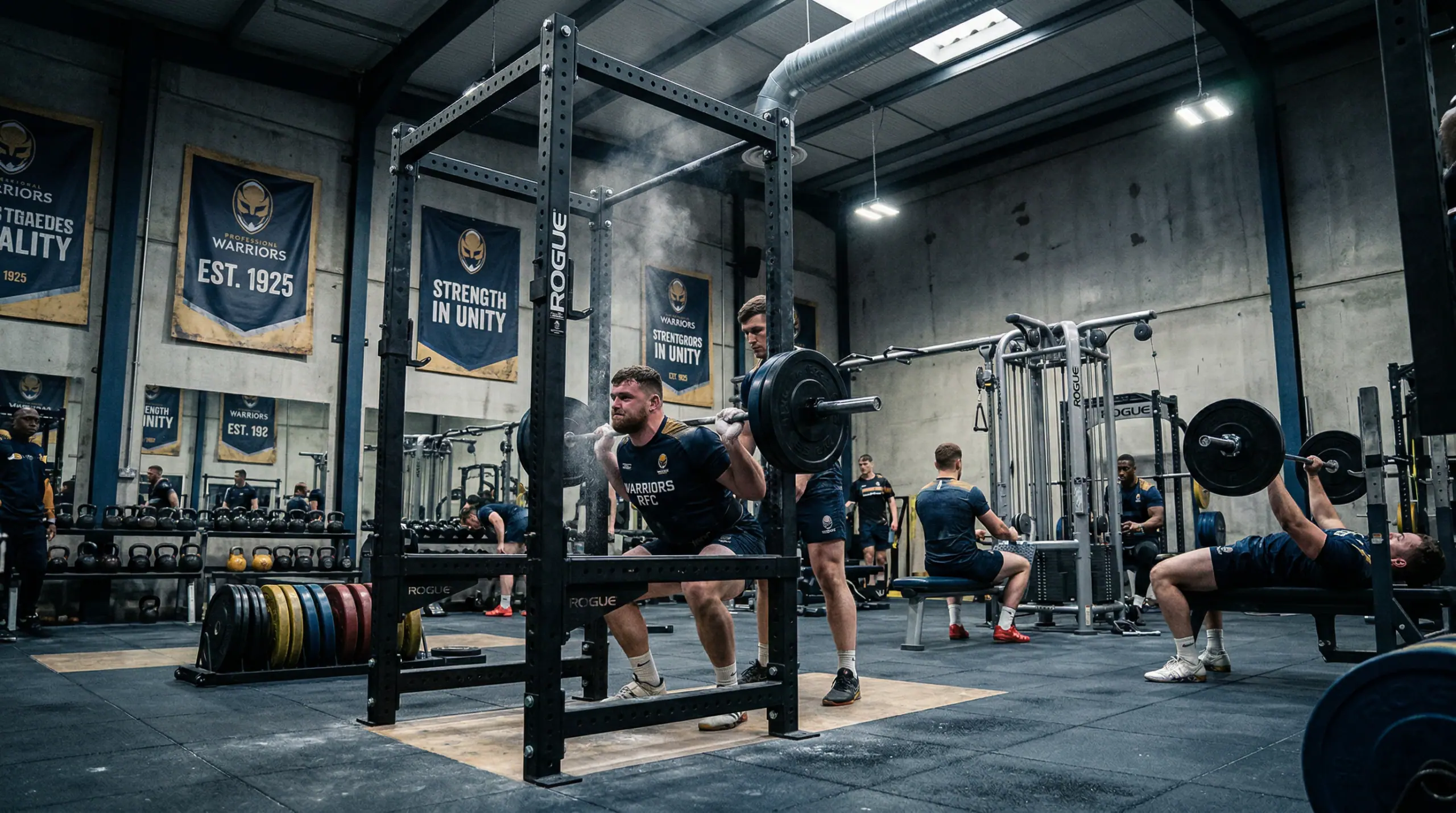
Athletic performance is built on specific strength work. Whether you run a rugby, football or basketball club, a well-designed strength and conditioning room has become essential — for performance, for injury prevention and for player retention. This guide covers the equipment choices, the safety standards and the funding routes that make a club weights room project succeed.
Sport-specific needs: one room, different priorities
Each discipline places different demands on the body, and the equipment list should reflect that:
- Rugby: power, explosiveness and contact resilience. Priority on heavy-duty squat racks, pressing benches and sled or prowler work.
- Football: speed, agility and injury prevention — particularly hamstrings and adductors. Nordic benches, leg curls and cable stations earn their place.
- Basketball and volleyball: vertical jump development, trunk stability and joint mobility. Trap bars, plyometric boxes and core stations are key.
- Athletics and combat sports: Olympic lifting platforms, bumper plates and open functional space.
A multi-sport club should build around a versatile free-weights core — racks, platforms, bars, dumbbells — and add sport-specific machines according to the sections it serves.
Recommended equipment by club level
| Club level | Core equipment | Indicative budget (estimate) |
|---|---|---|
| Small amateur club | 2 racks, Olympic bars and plates, dumbbells 5–40 kg, adjustable benches, rubber flooring | 10,000–25,000 EUR excluding VAT |
| Regional / national club | Racks and platforms, selectorised machines, cable stations, cardio ergometers, mobility zone | 30,000–70,000 EUR excluding VAT |
| Professional structure | Full plate-loaded and selectorised lines, connected equipment, force-measurement tools, recovery zone | 100,000+ EUR excluding VAT |
These figures are project estimates covering equipment and flooring; building works are extra. For layout inspiration and product ranges, see our sports club gym equipment page and our full catalogue of professional strength training machines.
Safety standards: EN ISO 20957 class S compliance
For a sports club — a collective facility used by many athletes of different ages and sizes — equipment must comply with the European standard EN ISO 20957 (the successor to the historic EN 957 series; the current general part is EN ISO 20957-1:2024) in class S, the classification for commercial and institutional use. Class H home equipment is not acceptable in a club environment: it is neither engineered nor certified for intensive collective use, and its presence exposes the club’s officers to liability after an accident.
Professional installation is strongly recommended: correct anchoring of racks and rigs, level flooring under platforms and documented commissioning all extend equipment life and protect users. Budget for annual inspections and keep a maintenance log from day one — our annual gym maintenance plan explains what that involves.
Flooring: the foundation of the room
A club weights room needs high-density rubber flooring — typically 15–20 mm tiles under free-weight areas and 30–40 mm under Olympic lifting platforms — to absorb impact, protect the slab and control noise. See our rubber gym flooring guide for thickness recommendations by zone.
Funding a club weights room
Equipping a club represents a significant investment, but clubs rarely have to fund it alone. Common routes across Europe include:
- National and regional sports agencies: most countries operate grant schemes for facilities that widen participation or support health-through-sport programmes.
- Sports federations: many federations run infrastructure development funds or equipment subsidy schemes for affiliated clubs.
- Municipal support: local authorities frequently co-fund equipment for clubs using council-owned facilities.
- Sponsorship and club fundraising: naming rights for the strength room or per-machine sponsorship work well at local level.
- Leasing: spreading the cost over 3–5 years preserves cash flow and can include maintenance.
Our article on funding a sports facility project details eligibility criteria and how to build a strong application file.
How Light In Fitness supports club projects
Since 2013, Light In Fitness has equipped sports clubs, federations and public facilities with professional-grade strength and cardio equipment, all certified to EN ISO 20957 class S and delivered with full compliance documentation — useful for grant files and insurance. We provide needs assessment, 3D layout plans, delivery, installation and after-sales service. Request a free quote and receive a costed proposal within 24 working hours.
Layout and zoning of a club strength room
A club room works best in four zones. The free-weights zone holds racks and platforms along a wall, with 1.5 m clearance per station and bar storage within reach. The machine line — selectorised stations for guided, low-supervision work — suits mixed-ability squads and injury-prevention protocols. A conditioning strip of 10–15 m takes sleds, rowers and air bikes for energy-system work. Finally, a mobility corner with mats and bands doubles as the warm-up and rehabilitation area. Keep sight lines open so one coach can supervise the whole room — an L-shaped or open-plan layout beats partitioned spaces for squad training — and plan storage generously: a tidy room is a safe room when thirty juniors arrive at once.
Maintenance and lifecycle planning
Club equipment lives a hard life: high volume, variable technique and minimal individual ownership. Build three habits from day one: a daily visual check by the duty coach (cables, collars, upholstery), a quarterly serviced inspection, and an annual review that feeds a rolling replacement plan — cardio units typically need renewal after 8–10 years, strength structures last far longer. Keeping a simple log protects the club’s officers legally and turns unpredictable breakdown costs into a plannable budget line.
Common pitfalls in club equipment projects
Three mistakes recur in club projects. Buying home-grade equipment to stretch the budget — it fails quickly under squad use and creates liability exposure. Under-investing in flooring — the cheapest line item to get right at the start and the most disruptive to retrofit. And designing for today’s first team only — a room specified with juniors, veterans and women’s sections in mind (adjustable equipment, lighter bar options, guided machines) multiplies usage across the whole club and strengthens every future grant application.
FAQ — Sports club weights rooms
What is the minimum equipment for a small club?
Two squat racks with Olympic bars and plates, a set of dumbbells from 5 to 40 kg, two or three adjustable benches and rubber flooring cover the essential strength needs of most team sports. Add a rower or air bike for conditioning. This baseline typically fits within 10,000–25,000 EUR excluding VAT, as a project estimate.
Which standard must club equipment meet?
EN ISO 20957 class S (commercial use), with CE marking and a supplier-provided declaration of conformity. Class H home equipment is not permitted in a collective club setting.
Can a club get funding for gym equipment?
Yes. National sports agencies, federations and local authorities all operate schemes that can cover part of the investment, especially for projects that widen access to sport or support health programmes. A clear technical file with certified equipment strengthens any application.
Should a club buy machines or free weights first?
Free weights first: racks, bars, plates and benches serve every sport and every athlete level for the lowest cost per training station. Selectorised machines come next for safe unsupervised use and targeted injury-prevention work.
Sources et références
- NF EN ISO 20957-1 – équipement d’entraînement fixe, partie 1 : exigences générales de sécurité et méthodes d’essai (AFNOR)
- AFNOR Normalisation – dossier thématique sur les appareils d’entraînement fixes et leurs classes d’usage