Military Base Gym Equipment: Strength Training for Defence Facilities
Physical readiness matters to armed forces, police and fire and rescue services across Europe. A gym on a military base needs more than a list of machines. Equipment must withstand heavy use and support the force’s training protocols. The purchase must also follow public procurement rules. This guide takes estate managers and training staff through those choices.
Why the weights room is critical operational infrastructure
Military physical training: far more than sport
In the armed forces, physical condition is not optional. It directly determines medical fitness for duty, success in selection tests and the ability to perform operational missions. Military physical training protocols typically include:
- Functional strength work (core stability, pull-ups, bench press, squats)
- Cardiorespiratory conditioning (interval running capacity, aerobic base)
- High-intensity circuit training modelled on field conditions
- Recovery and injury prevention
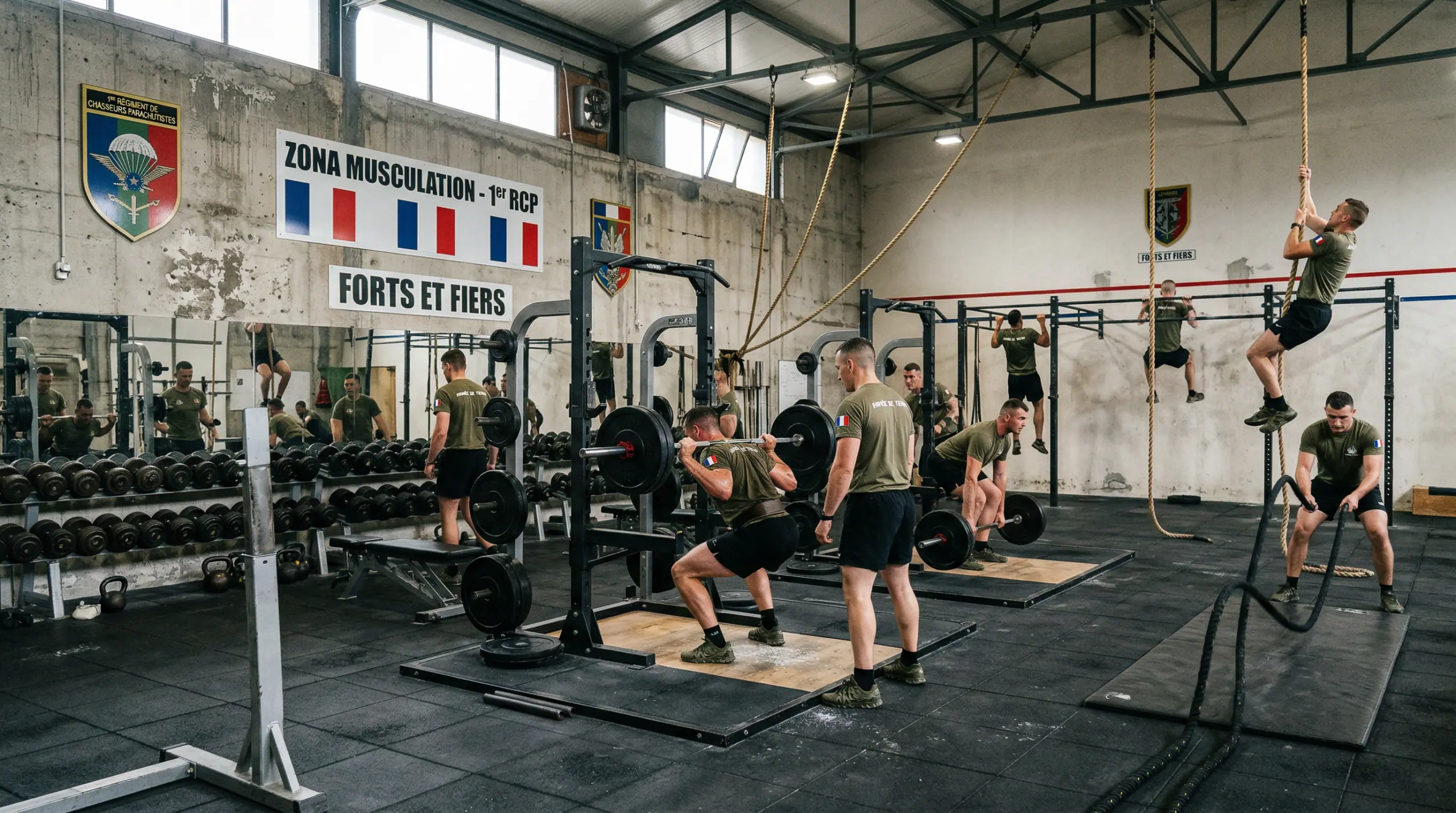
A well-equipped on-base weights room lets units cover all of these requirements on a single site, regardless of weather or the availability of outdoor training areas.
Specific needs of security and emergency services
- Firefighters: prolonged-effort tolerance, pulling strength, mobility in heavy protective kit
- Police units: maintaining condition through sedentary duty periods, strength for physical interventions
- Specialist intervention units: versatility, endurance and power
- Deployed personnel: maintaining physical standards far from permanent infrastructure
In every case, the equipment must withstand intensive use by many users of very different body types, six to seven days a week.
Essential criteria for military-grade fitness equipment
1. Maximum robustness and durability
Strength equipment designed for a typical commercial gym is engineered for 6–8 hours of daily use. On a military base, shift rotations often mean 10–14 hours of daily use with heavy unit loads. Minimum requirements:
- High-strength steel frames (minimum 3 mm wall thickness for rigs and racks)
- Anti-corrosion finishes (epoxy or thermoset powder coating)
- Rated load above 200 kg for strength stations
- Sheathed steel cables with reinforced outer sleeves on pulley machines
- High-density upholstery (60+ kg/m3 foam) resistant to heavy perspiration
2. Functional versatility
Space is often constrained in a barracks. A multifunction rack or cross-training rig supports more than 30 different exercises on a single footprint.
| Equipment | Exercises covered | Simultaneous users |
|---|---|---|
| Squat cage / power rack | Squat, bench press, pull-ups, rows | 2–4 |
| Wall-mounted pull-up station | Pull-ups, muscle-ups, L-sits | 2–3 |
| Professional adjustable bench | Flat, incline, decline pressing, curls | 1–2 |
| Dumbbells 5–50 kg (pairs) | Isolation, circuits, functional work | 4–6 |
| Olympic bars and plates | Deadlift, clean and jerk, snatch | 1–2 |
| Suspension trainers | Core, mobility, rehabilitation | 2 |
| Skipping ropes / battle ropes | Conditioning, coordination | 1–2 |
3. Safety and standards compliance
Specify professional equipment suitable for the facility’s intended use. EN ISO 20957 sets safety requirements for indoor stationary training equipment. Its current general part is EN ISO 20957-1:2024. Class H covers home use. Class S covers professional and commercial use. Class I concerns inclusive professional use by people with specific needs.
It is not a higher durability grade. Prove intensive-use suitability through test reports, maintenance terms and the manufacturer’s declared limits. Check CE marking only where the equipment’s applicable EU legislation requires it. See class S versus class H equipment, the ISO reference and the European Commission’s CE guidance.
Typical weights room configurations for a base
Minimum configuration (60–100 m2 / 20–50 personnel)
Free-weights zone:
- 1 four-post squat cage with integrated pull-up bar
- 2 Olympic bars (20 kg) with a 200 kg plate set
- 1 dumbbell rack with 10 pairs (10–50 kg)
- 2 professional adjustable benches
Conditioning zone:
- 2 air rowers or ergometers
- 2 air bikes for high-intensity conditioning
- 1 commercial treadmill
Functional / cross-training zone:
- Kettlebells 8–32 kg (set of 6)
- Medicine balls 3–9 kg (set of 4)
- Suspension trainers
- 12 m battle ropes
Flooring: 15 mm rubber tiles under the free-weights zone and 3 mm non-slip vinyl in the cardio zone — see our range of rubber gym flooring tiles.
Full configuration (150–250 m2 / regiment-scale unit)
- 3–4 cross-training rigs or full cages
- 1 professional Smith machine
- Adjustable dual-pulley cable station
- 4–6 benches with storage
- Complete weightlifting equipment
- Cardio zone: 4 treadmills, 4 bikes, 2 rowers, 2 air bikes
- Multi-grip pull-up wall
- Stretching and mobility area
Training programmes suited to a base gym
Basic military circuit (30 minutes)
- Press-ups x 20
- Pull-ups x 10
- Barbell squat x 15
- Plank x 45 seconds
- Burpees x 10
- Lat pulldown x 15
- Shoulder press x 12
- Romanian deadlift x 12
Format: 4 rounds, 90 seconds recovery between rounds.
Operational strength programme (3 days/week)
| Day | Focus | Main exercises |
|---|---|---|
| Monday | Upper-body push | Bench press, weighted dips, overhead press |
| Wednesday | Lower body and core | Squat, weighted lunges, deadlift, plank |
| Friday | Upper-body pull | Weighted pull-ups, barbell rows, cable pulldowns |
Procurement for military and defence facilities
Tender procedures and thresholds
Public procurement law governs equipment purchases for defence facilities. The procedure depends on the country and estimated contract value. Low-value contracts may allow direct awards. Mid-range contracts may use a simpler competitive process. The buyer then defines criteria such as price, quality, delivery and after-sales. A minimum number of suppliers may be required under local rules. Above the relevant thresholds, a formal tender and publication may be needed. Check current national thresholds and the buyer’s rules before starting.
Central purchasing bodies and framework agreements
Many defence organisations buy through national central purchasing bodies or existing framework agreements, which offer pre-negotiated contracts, guaranteed legal compliance, volume-based pricing and vetted suppliers — at the cost of a narrower catalogue. For specialised professional fitness equipment, a dedicated competitive procedure often delivers better value and more customisation than a generalist framework.
Light In Fitness has equipped armed forces facilities and is experienced with public procurement requirements: CE-certified technical datasheets, contractual lead times, electronic tender responses, and on-site delivery with commissioning. See our dedicated range of military and police training equipment.
Optimising your equipment project
Step 1: Assess real needs
Before any purchase, run a needs assessment with the physical training instructors on site: estimated daily users, practice levels (recruits, NCOs, officers, elite athletes), disciplines practised (weightlifting, cross-training, cardio, combat sports) and space and budget constraints.
Step 2: Write a technical specification
- Required standards (EN ISO 20957 class S, or class I for the most intensive use)
- Minimum warranties (2 years parts and labour, 5 years structural)
- Delivery and commissioning deadlines
- After-sales conditions (response times, spare-parts stock)
Step 3: Specify the right sports flooring
High-density rubber tiles (15–20 mm) are essential under free-weight zones: they absorb impact, protect the concrete slab and reduce the noise of dropped plates — critical in a military building where several activities coexist.
Step 4: Plan maintenance from day one
Build an annual preventive maintenance contract into the order. A technician should check cables, strap tension, upholstery and safety systems; a structured annual maintenance plan prevents accidents and significantly extends the life of the equipment park.
To equip a weights room on your base, request a tailored quote from Light In Fitness — we are used to the constraints of institutional procurement. You can also browse our full range of professional strength training machines and cross-training cages.
FAQ — Military base gym equipment
Which equipment items are the priority for a military weights room?
The essentials are: a squat cage or power rack with integrated pull-up bar, Olympic bars with a plate set, dumbbells from 5 to 50 kg, professional adjustable benches and at least two cardio ergometers (rower or air bike). These cover around 90% of military physical training needs.
How long does strength equipment last in a barracks environment?
With regular maintenance (annual inspection, replacement of wear parts), quality professional strength equipment lasts 10–15 years under intensive use. Steel structures are generally warrantied for 5–10 years depending on the manufacturer.
Which safety standards apply?
Equipment must comply with EN ISO 20957 (general part EN ISO 20957-1:2024) in class S, or class I for the most intensive environments, with mandatory CE marking. Fire-safety classification of flooring and furnishings applies in addition for publicly accessible buildings.
How should maintenance be organised?
Two options: a maintenance contract with the supplier (recommended for parks of more than 30 machines) or training an internal lead (physical training instructor or technician). In all cases, keep an equipment log recording inspections and interventions.
What budget should be planned?
For an 80–100 m2 room serving a company-sized unit (50–80 personnel), plan between 25,000 and 60,000 EUR excluding VAT depending on the level of equipment. For a regiment-scale facility of around 200 m2 (200–800 personnel), budgets typically range from 80,000 to 150,000 EUR excluding VAT. These estimates include equipment, flooring and commissioning but not building works.
Réalisations documentées
- Dalles et sols sportifs : livraisons documentées – plusieurs chantiers
- Sol sportif extérieur, square Georges-Vallerey – Taverny (95)
- Cage street workout ultime, Hub Armées – DICOM-GSB EFG / Division Métiers
- Cage street workout ultime, CFIM 6 de Fréjus – armée française
Sources et références
- NF EN ISO 20957-1 – équipement d’entraînement fixe, partie 1 : exigences générales de sécurité et méthodes d’essai (AFNOR)
- AFNOR Normalisation – dossier thématique sur les appareils d’entraînement fixes et leurs classes d’usage
- Code de la commande publique – texte intégral en vigueur (Légifrance)
- Direction des affaires juridiques, ministère de l’Économie – réglementation de la commande publique et fiches techniques