Professional Gym Equipment: Boosting Workplace Productivity
Absenteeism, disengagement and mid-afternoon energy slumps are measured in every HR dashboard, yet the equipment that could address them is rarely part of the facilities budget. Installing professional gym equipment on your own premises is no longer a perk reserved for tech campuses: it is a practical operational decision that touches staff health, retention and day-to-day output. This guide looks at what a workplace gym actually changes, which categories of machine belong in one, and how to plan the installation so the equipment is used rather than admired.
Corporate wellness programmes fail when they stay abstract. A subsidised gym membership two kilometres away is used by the people who already train. A well-specified training room inside the building, open before shifts, during breaks and after work, removes the friction that stops everyone else. That difference in accessibility is the single biggest determinant of whether an on-site facility earns its floor space.
The effect is not only physical. Regular exercise is widely associated with lower stress levels, better sleep quality and improved concentration. For an employer, those translate into fewer short-term absences, steadier attention through the working day and teams that recover faster from demanding periods. The equipment is the enabler; the culture around it determines the return.
This article covers the productivity case, the machine categories that suit a corporate setting, the practical constraints of fitting a gym into an existing building, and what organisations that have done it report back.
Why on-site fitness equipment affects productivity
The connection between employee fitness and business performance is indirect but consistent. Staff who train regularly report higher energy levels across the working day, and energy is what sustains focus on complex tasks. A training room that people can reach in ninety seconds turns a lunch break into genuine recovery rather than a change of screen.
Breaking the working day with physical activity also creates a mental separation from the task at hand. Employees who step away from a problem and return to it after twenty minutes of cardio frequently approach it differently. That is not a productivity gimmick; it is the same reasoning behind structured breaks in any demanding profession.
Exercise triggers the release of endorphins, which is why a session before or after work tends to improve mood measurably. Staff who feel physically well are less likely to be derailed by minor frustrations, and less likely to carry stress from one meeting into the next.
There is a team dimension too. People who train together build informal relationships that cut across departments and hierarchy. Those relationships are the quiet infrastructure of good collaboration: they make it easier to ask a question, escalate a problem early or hand over work cleanly.
Finally, there is absenteeism. Sedentary work is associated with musculoskeletal complaints, back pain and cardiovascular risk. Giving employees a practical way to counteract eight hours of sitting reduces the health issues that generate absence days. For a company of any size, a measurable drop in short-term absence is where the investment starts paying for itself.
Which professional machines belong in a workplace gym
Corporate training rooms are used by people with very different fitness levels, from complete beginners to experienced lifters, and often without supervision. That combination demands commercial-grade equipment: machines built for continuous multi-user duty, with guided movement paths and clear instructions on the frame. Indoor professional equipment is covered by EN ISO 20957-1 class S, the specification that applies to gear intended for supervised or unsupervised use in a professional setting. Domestic and light-commercial machines have no place in a facility used by dozens of employees every week.
The categories that consistently earn their space are the following.
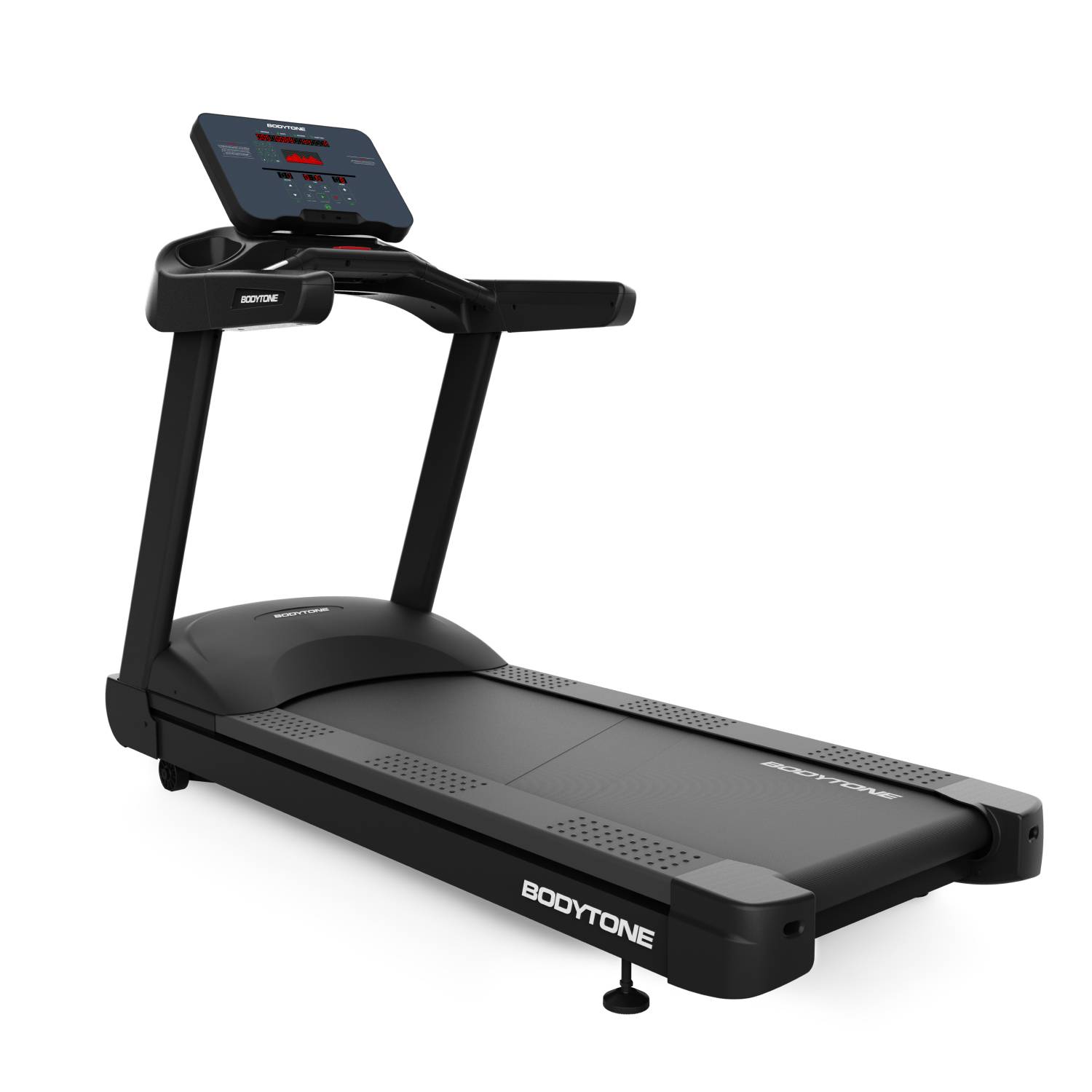
Treadmills. The most intuitive machine in any facility and the one beginners reach for first. A professional treadmill with a properly cushioned deck allows walking and running for staff across the whole fitness spectrum.
Upright and recumbent exercise bikes. Low-impact cardio suitable for employees returning from injury or starting from a low base. Recumbent models, with their supported seating position, are the ones to specify where back comfort is the priority.
Cross trainers. Full-body cardio with no impact on the joints, which makes them the safest default for a mixed-ability population and a popular choice in facilities with no supervising instructor.
Rowing machines. A genuinely full-body movement driven mainly by the legs, with strong involvement of the back and arms. Efficient in terms of floor space and effective for cardiovascular conditioning.
Selectorised strength machines. Guided-path machines are the right answer for unsupervised corporate gyms: the movement is constrained, the load is adjusted with a pin, and the risk profile is far lower than free weights. A compact multi-station covers most of the body in a single footprint. You can review the full range of professional strength training machines and pair it with a selection of professional cardio equipment.
Where floor space is tight, a single multi-station such as the Bodytone FT Multi Jungle training station replaces several individual machines and lets more than one person train at the same time.
Planning the installation
The specification of the machines matters less than the conditions around them. Four factors decide whether a corporate gym is used.
Available space. Every machine needs its own footprint plus safe circulation around it. Plan the layout before ordering, not after delivery. A room that feels cramped will be avoided, and a treadmill placed against a wall with no run-off space is a hazard.
Access. The facility has to be open at the times people can actually use it. Shift patterns, early starts and late finishes all need to be accommodated, otherwise the gym serves one group of employees and excludes the rest. Badge access is usually the simplest solution.
Safety and maintenance. Unsupervised use raises the bar on both. Machines need a documented servicing schedule, clear usage instructions at each station, appropriate flooring under load-bearing equipment, and a defined procedure for reporting a fault and taking a machine out of service.
Communication. An unannounced gym is an empty gym. Launch it properly, explain what is available, run introductory sessions so that beginners know how to use the machines correctly, and keep it visible in internal communications afterwards.
Get these four right and the equipment does its job. Get them wrong and even the best machines become expensive furniture.
What organisations report
The pattern reported by employers who have installed on-site facilities is consistent across sectors.
A technology company that equipped a full training room inside its offices reported that staff using the machines regularly described higher energy levels, better concentration and improved output. The facility became a recruitment argument as much as a wellbeing measure.
A financial services firm built an incentive programme around its equipment, encouraging employees to train during breaks. Participants reported a clear improvement in general wellbeing and in how they performed at work.
A marketing agency scheduled group training sessions during working hours. Staff found the sessions motivating, and the company observed better collaboration and a more productive flow of ideas afterwards.
None of these organisations treated the equipment as a standalone solution. In every case the machines were combined with permission to use them, which is the part that costs nothing and matters most.
Frequently asked questions
How much space does a corporate gym need?
It depends entirely on the number of stations and the mix of cardio and strength equipment. The realistic approach is to start from the room you have, decide how many people should be able to train simultaneously, and specify backwards from there. A layout study before purchase avoids the classic mistake of buying equipment that does not fit its circulation zones.
Do we need professional equipment, or will lighter machines do?
Professional equipment. A corporate gym is a multi-user environment with unpredictable usage patterns and frequently no supervision. Machines built for occasional single-household use will not survive that duty cycle, and their safety margins are not designed for it.
What about employees who have never trained before?
Beginners are the population a corporate gym is really built for, and they are best served by guided-path strength machines and low-impact cardio. Clear instructions on each station and an introductory session at launch remove most of the hesitation.
Does the equipment need servicing?
Yes. Any multi-user facility needs a defined maintenance schedule covering cables, upholstery, running belts, bolts and moving parts. Unsupervised access makes preventive servicing more important, not less.
Turning the investment into results
Professional gym equipment on your premises is a lever on staff health, engagement and productivity, but only when it is specified for commercial use, laid out properly, accessible to everyone and actively promoted. The machines are the easy part; the operating conditions decide the outcome.
If you are assessing what a training room would take in your building, the practical next step is a specification based on your floor plan, your headcount and the way your teams work. Request a quote and we will put together a proposal for a facility sized to your site.
À lire aussi sur le même thème
- Quels exercices ciblent les muscles fessiers tout en minimisant l’activation du tenseur du fascia lata ?
- Entraînement en résistance pour l’athlète d’ultra-endurance
- Découvrez comment renforcer vos fessiers avec les muscles moyen et grand supérieur
- Comment augmenter et améliorer vos performances physiques globales ?