Professional Outdoor Sports Structures: A Guide for Municipalities and Operators
Une structure sportive extérieure professionnelle se distingue par son traitement anticorrosion, son ancrage et sa conformité à la norme EN 16630. Elle doit résister aux intempéries, aux dégradations et à une fréquentation non contrôlée. Le matériau, acier galvanisé ou inox, se choisit selon l'exposition du site.
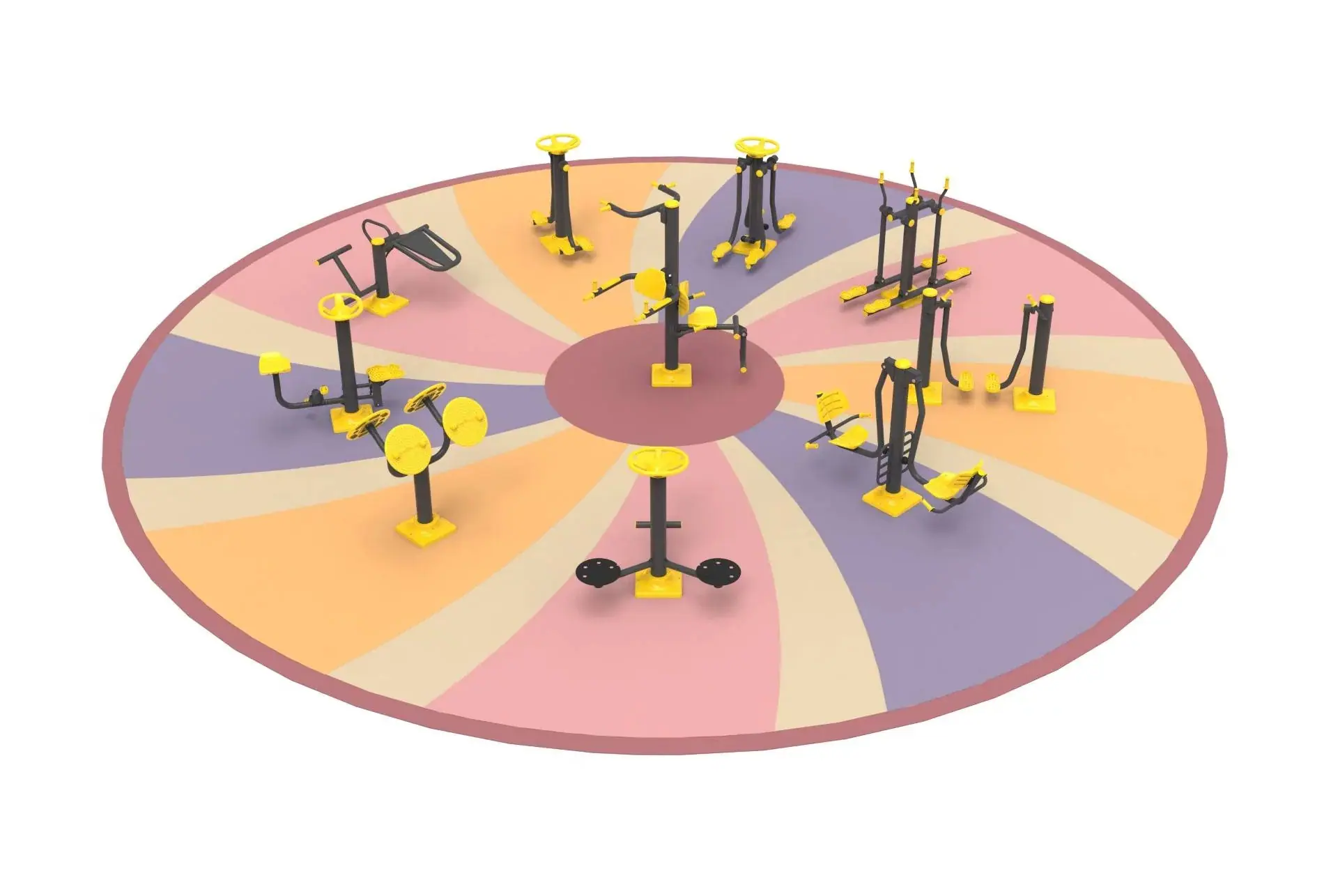
An outdoor sports structure is one of the few pieces of public infrastructure that is used every day, by every age group, at no cost to the user. That is why towns, campsites, holiday resorts, schools, housing associations and clubs keep investing in them. It is also why a poorly specified installation is so visible: an outdoor structure that corrodes, moves in its footings or falls out of certification becomes a liability within two seasons. This guide sets out what separates a professional outdoor sports structure from a consumer product, and how to specify one properly.
What makes a structure genuinely professional
A professional outdoor sports structure is defined by three things, none of which are visible in a photograph.
- Corrosion protection. The finishing system, not the shape of the frame, decides how the installation looks in year seven. Hot-dip galvanised steel is the baseline; stainless steel is specified where exposure is severe.
- Anchoring. The foundation design has to match the ground conditions and the loads generated by users, including misuse. A frame is only as safe as what holds it down.
- Compliance with EN 16630. This is the European standard for permanently installed outdoor fitness equipment for adults. It is the reference a public authority will ask for, and it is not optional in an open-access installation.
Note that EN 16630 covers adult outdoor fitness equipment. Children’s play equipment falls under a different framework: EN 1176-1 for the equipment itself and EN 1177 for the impact-attenuating surfacing beneath it. The two families must never be mixed on a specification, and children’s equipment is never certified to EN 16630.
Why municipalities and operators invest in outdoor sports facilities
An open, supervised-free training space
An outdoor fitness area gives residents and guests a dedicated place to train that does not depend on opening hours, membership or staffing. For a campsite or a hotel, it converts an unused corner of the grounds into a facility guests actually mention in reviews. For a municipality, it serves the part of the population that will never join a gym.
Regular participation
Proximity is the strongest single predictor of whether someone uses a sports facility. A structure placed on an existing walking route, near a car park or beside a school will be used several times a week; the same structure placed at the far end of a field will not. Siting is a specification decision, not a landscaping detail.
Structured and informal competition
Street workout parks, calisthenics rigs and obstacle structures generate their own community. Clubs form around them, and informal competition keeps participation up without any programming cost to the operator.
Physical benefits of outdoor training
Outdoor training delivers the same physiological benefits as indoor training, with a few practical advantages for the operator to communicate:
- cardiovascular conditioning through walking, running and circuit work between stations
- strength and mobility work using body weight and, on equipped stations, guided resistance
- higher energy expenditure over varied terrain compared with a flat indoor floor
- exposure to daylight, which supports the body’s own vitamin D production
Those are the benefits worth putting on a signage panel. What outdoor equipment does not do is remove the weather from the equation: an open-air facility is seasonal in most climates, and usage figures should be planned on that basis rather than on a year-round average.
Mental and social benefits
Outdoor physical activity is consistently associated with reduced perceived stress, improved mood and better concentration. It also has a social dimension that an indoor gym rarely reproduces: an outdoor fitness area is a public space, and people meet there. For a housing association or a municipality, that social function is often the real justification for the budget.
Outdoor training is a complement to health and mental-health care, not a substitute for it. A public facility should be presented as such, and signage should avoid any therapeutic claim.
Choosing the right structures
Start from the users, then the space
How many people will use the area at peak time? What are they doing: strength circuits, calisthenics, rehabilitation, children’s play, or a mix? Only once that is answered does the available footprint become useful information. Measure the usable area, note the safety zones each station requires, and check the access route for maintenance vehicles.
For a general-purpose adult installation, the outdoor gym equipment range covers the standard station types. Where the brief is a walking or running route with stations along it, an outdoor fitness trail is the more appropriate format.
Safety and durability
Check the steel grade and thickness, the finishing system, the bearing type in any moving station, and how fixings are secured against tampering. Ask what the equipment is certified to and ask to see the documentation, not a claim on a web page. In an unsupervised public installation, vandalism resistance is a functional requirement, not a nice-to-have.
Discipline-specific requirements
Each discipline brings its own constraints: bar heights and grip diameters for calisthenics, clear headroom and fall zones for suspended elements, run-up distances for obstacle courses. A street workout rig designed for a club has a different specification from one intended for a school playground.
Choose configurable rather than fixed
Requirements change. A modular rig that accepts additional modules later protects the investment far better than a single fixed structure sized exactly to today’s brief.
The economic case
A well-placed outdoor sports facility does more than serve its users. It supports local events, gives visiting clubs and groups a reason to stay in the area, and contributes to how a town or a resort is perceived. For a campsite or a hotel, the equipment is part of the offer and appears directly in booking decisions. For a municipality, it is one of the lowest cost-per-user pieces of sports infrastructure available, precisely because it needs no staffing and no opening hours.
Set against that, budget realistically for two items that are often forgotten: the surfacing, where the layout requires it, and the annual inspection regime. Both are part of the total cost of the installation.
Frequently asked questions
Which standard applies to outdoor fitness equipment?
EN 16630 applies to permanently installed outdoor fitness equipment for adults. Children’s play equipment is covered by EN 1176-1, with EN 1177 for the impact-attenuating surface.
Galvanised steel or stainless steel?
The choice depends on the exposure of the site. Hot-dip galvanised steel is the standard specification inland. Stainless steel is specified for coastal locations and other aggressive environments.
What maintenance does an outdoor installation need?
A routine visual check, an operational inspection at defined intervals and an annual main inspection, with the frequency set according to the intensity of use and the exposure of the site. Keep the records: they are what an authority will ask for.
Can adult and children’s areas share one structure?
No. They are governed by different standards and different safety zones, and should be specified and installed as separate areas, even when they sit side by side in the same park.
Specifying your project
Send us the site plan, the intended user groups and the exposure of the location, and our team will return a layout, the applicable standards and a costed proposal. Start with our quote request page.
Sources et références
- NF EN 16630 – modules fixes d’entraînement physique de plein air : exigences de sécurité et méthodes d’essai (AFNOR)
- Code du sport, article L322-2 – garanties d’hygiène et de sécurité des établissements d’activités physiques et sportives (Légifrance)