Professional Exercise Equipment for Gyms and Clubs
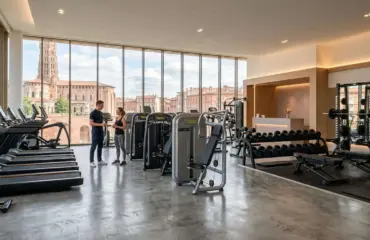
Fitting out a commercial training space has very little in common with buying a machine for a spare room. A gym operator in Manchester, a hotel wellness manager in Lisbon and a municipal sports department all specify against the same three constraints: continuous duty cycles, unsupervised third-party users, and a service life counted in years rather than seasons. This guide sets out how professional exercise equipment is chosen, and what to verify before a purchase order is signed.
What professional exercise equipment actually means
Indoor equipment for commercial use is covered by EN ISO 20957-1 class S. Class S is the studio and club level: it defines the stability, endurance and safety requirements for machines used by people who never read the manual and were never shown how the machine works. Class I is also a professional class, but it exists to make training accessible to users with reduced mobility, not to sit one step above class S in intensity. Equipment sold outside these classes belongs in a private house, not in a facility open to members, guests or pupils.
Outdoor adult equipment is a separate family and follows EN 16630. Where a unit is intended for children, EN 1176-1 applies to the structure and EN 1177 to the impact-attenuating surface beneath it. The two are never interchangeable, and EN 16630 never applies to a children’s unit.
The core equipment families
- Racks, cages and pull-up structures. The backbone of any free-weight area. Wall-mounted rigs save floor space, freestanding cages allow several athletes to train at once, and squat and power racks carry the safety spotters that make unsupervised barbell work possible. Browse the full range of racks and cages.
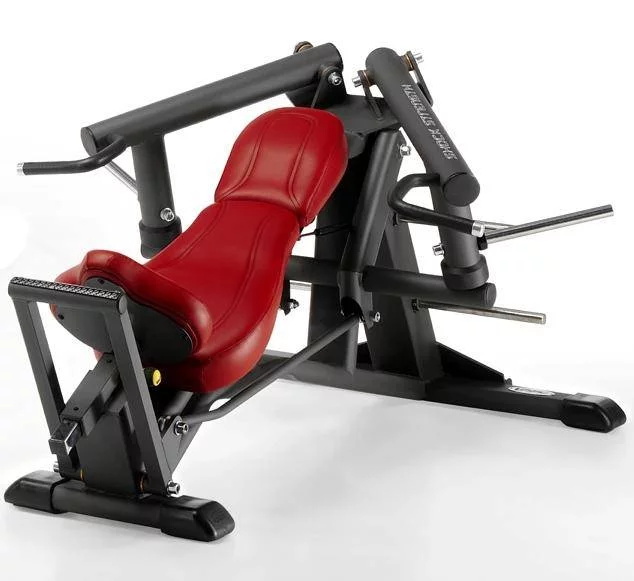
- Selectorised and plate-loaded machines. Selectorised stacks suit mixed-ability membership because the load changes in one movement. Plate-loaded machines suit strength-focused clubs and cost less per station. Both sit within the strength training machines range.
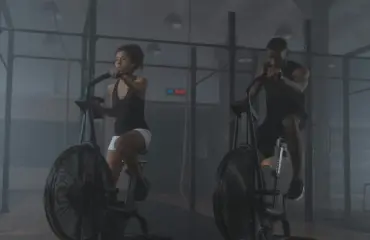
- Cardio. Treadmills, cross trainers, indoor cycling bikes, rowers and ski ergometers. Duty cycle, not top speed, is the specification that matters in a commercial room.
- Free weights and functional accessories. Barbells, bumper plates, dumbbells, kettlebells and storage. Storage is not an optional extra: it is what keeps the floor clear and the insurance valid.
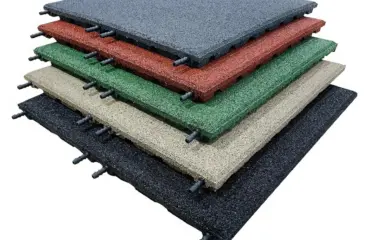
- Flooring. Rubber tiles or rolls under the lifting area, matting under machines, and an acoustic underlay wherever there is an occupied floor below.
Which equipment is genuinely a must-have?
A small facility does not need one of everything. The reliable starting point is a rack or cage, a bench, a barbell with bumper plates, a dumbbell set with racking, one pulley station and two or three cardio machines. That combination covers pushing, pulling, hinging, squatting and conditioning for a mixed membership, and it fits into a floor plan that a larger machine circuit would overwhelm. Everything after that should be driven by what your members queue for, not by what looks impressive in a brochure.
More training capacity without more floor area
Floor area is usually the binding constraint, not budget. Wall-mounted rigs, multi-station gyms and cable crossovers turn one footprint into several simultaneous training positions. A professional Smith machine adds guided barbell work in a space where a free-weight platform would need a wider safety margin. Vertical storage for plates, dumbbells and accessories recovers usable square metres that would otherwise be lost to clutter.
Equipment that works without a coach standing beside it
In a staffed studio a member can be corrected. In a hotel gym, a residential facility or a school room, the equipment has to do that work on its own. Look for clear movement paths, adjustment points that can be reached while seated, pictograms on the frame, and a range of motion that cannot be forced past its safe limit. That is precisely what class S certification is testing for, and it is the difference between a room that runs itself and a room that generates incidents.
Frequently asked questions
Can equipment intended for home use be installed in a commercial gym?
No. If the room is open to members, guests, employees, pupils or residents, the equipment must be certified for that use. Anything else exposes the operator in the event of an incident and will not survive the duty cycle.
Selectorised or plate-loaded?
Selectorised for mixed-ability and high-turnover rooms; plate-loaded where the membership is strength-focused and where cost per training station matters.
Does the floor need to be prepared before delivery?
Lifting zones need shock-absorbing rubber, and any installation above an occupied level needs an acoustic underlay. Both are far cheaper to specify with the equipment than to retrofit afterwards.
Can a room be equipped in stages?
Yes, and it usually should be. Agree the final layout first, then install in phases so that anchor points, power and flooring are right the first time.
Specifying your project
Send us the floor plan, the ceiling height, the expected number of users and the disciplines you want to cover, and we will come back with a layout and a costed equipment list. Request a quote and our team will work through the specification with you.