How to Install an Outdoor Leg Press Machine in Your Town
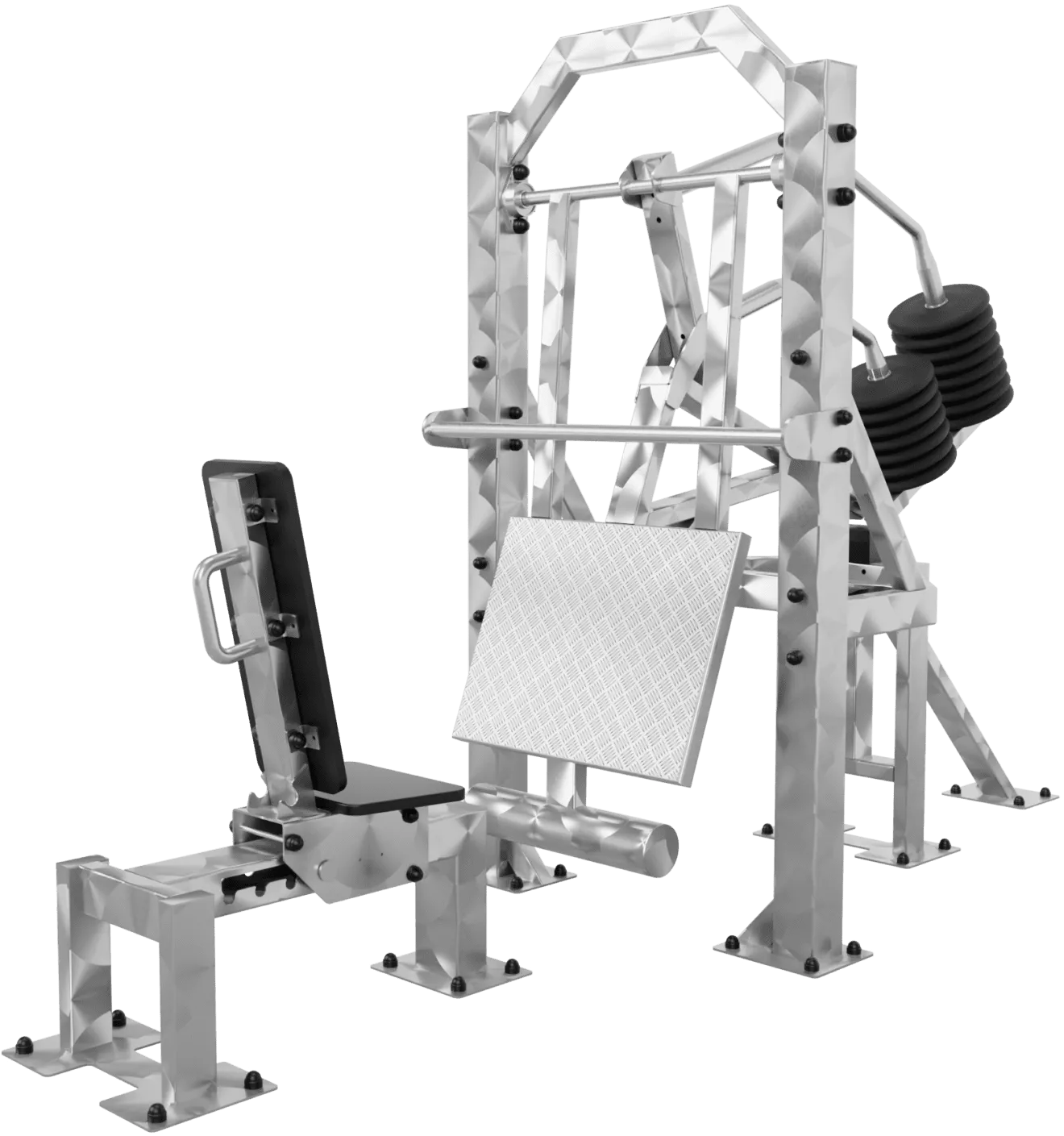
Installing a strength machine such as a leg press outdoors in your municipality is a valuable initiative: it promotes physical activity, public health and the wellbeing of residents. A project of this kind is both structuring and unifying. It adds value to the urban space while making sport accessible to everyone. Here is a practical, step by step guide to getting the installation right.
1. Understand the equipment: the outdoor leg press
Before anything else, the right machine has to be chosen.
- The leg press targets the thighs, the glutes and the muscles of the lower body effectively.
- The machine must be designed for outdoor use: robust structure, stainless materials, anti-corrosion treatment.
- Give priority to equipment that complies with the European safety standards, in particular EN 16630 for outdoor fitness equipment.
A well chosen machine guarantees durability, safety and training effectiveness at the same time. On coastal sites and in towns that salt their roads in winter, a stainless steel outdoor strength machine is what keeps the maintenance budget under control over the life of the installation.
2. Check the local rules before you plan anything
Before any installation:
- Talk to the planning department of your municipality or of the wider local authority in order to identify the areas where this type of development is permitted, obtain the authorisations required for works in a public space, and comply with the accessibility, safety and planning rules that apply where you are.
- It is often worth involving a qualified sports coach or a specialist in sports facility design so that the project matches local needs rather than a generic layout.
Permitting procedures, the thresholds that trigger them and the accessibility requirements are set nationally and differ from one country to another, so the applicable national and local regulations are the reference here rather than any single procedure.
3. Choose a strategic location
The choice of location is decisive.
- Favour busy public spaces: parks, urban gardens, promenades or existing fitness trails.
- Make sure the ground is flat, stable and well drained.
- Make sure the spot is easily accessible to the public.
- Make sure there is enough space around the machine to rule out any risk of collision.
A good location encourages regular use by a wide range of users. Placing a single machine next to an existing route, rather than in an empty corner of a park, is usually the difference between a station that is used daily and one that is photographed at the opening and then forgotten.
4. Prepare the ground
Depending on the site, several preliminary works may be needed.
- Levelling the ground to guarantee stability.
- Laying a concrete slab or an impact absorbing surface such as outdoor sports flooring where required.
- Checking the drainage system so that water cannot stand around the base.
- Clearing a safety perimeter of at least 1 to 2 metres around the machine.
A properly prepared installation guarantees safety, comfort in use and a long service life for the equipment.
5. Install the leg press
Once the ground is ready:
- Follow the manufacturer’s assembly instructions to the letter.
- Check the fixing of the ground anchors.
- Check that the moving parts are correctly assembled.
- Check that the adjustable elements work for users of every size.
Using a certified professional for the installation is a sound decision: it is what makes the result verifiably compliant with the technical and safety standards rather than merely assembled.
6. Put up instructional signage
Clear and accessible signage is what guarantees correct use of the machine.
- Safety and operating instructions.
- Illustrations of the exercises that can be performed on the leg press.
- An explanation of the muscle groups involved.
- Good practice advice: warm-up, breathing, posture, stretching.
This signage supports the independence of users and reduces the risk of incorrect use, which matters all the more on an unsupervised site.
7. Programme activities around the equipment
To anchor the equipment in the daily life of residents:
- Offer outdoor strength sessions led by a qualified coach.
- Organise themed events: an introduction to circuit training, postural conditioning, muscle strengthening.
- Integrate the machine into the health and sport programmes your authority already runs.
Support from a professional strengthens user buy-in and encourages the community to take collective ownership of the equipment.
8. Maintain the machine and monitor its use
Proactive management of the equipment is essential.
- Carry out regular inspections: fixings, corrosion, wear of moving parts.
- Measure footfall and the real usefulness of the machine.
- Adapt or extend the installation if needed, by adding complementary equipment or modernising what is there.
- Prepare an annual maintenance plan with specialist professionals.
Rigorous follow-up is what keeps use safe over time, and it is also the evidence base you will need the next time the budget for outdoor strength machines has to be defended.
Frequently asked questions
Which standard applies to an outdoor leg press?
EN 16630, the standard for permanently installed outdoor fitness equipment for adults. It is the reference to name in the specification and to check on the offer you receive.
How much space has to be kept clear around the machine?
A safety perimeter of at least 1 to 2 metres around the machine, clear of obstacles, in addition to a flat, stable and well drained base.
Does the machine need a concrete slab?
Depending on the site, a concrete slab or an impact absorbing surface such as rubber tiles may be required. The drainage has to be checked in both cases so that water does not stand around the anchors.
Who should carry out the installation?
The manufacturer’s assembly instructions must be followed exactly, and calling on a certified professional is the reliable way to obtain an installation that meets the technical and safety standards.
Conclusion
Installing an outdoor leg press is a structuring investment that serves public health, social cohesion and the quality of the urban environment. A project of this kind answers current prevention priorities, adds value to the public realm with durable and genuinely useful equipment, and gives residents access to physical activity that is free, safe and inclusive.
With careful planning, professional grade equipment and the support of the community, an ordinary urban space can genuinely be turned into a fitness hub open to everyone. Send us the plan of the site and the profile of the users you serve, and our team will return a layout, an equipment list and a budget. Request a quote to start.
Réalisations documentées
- Dalles et sols sportifs : livraisons documentées – plusieurs chantiers
- Sol sportif extérieur, square Georges-Vallerey – Taverny (95)
- Functional Rig inox – installations sur trois continents
- iGreenMill, tapis de course extérieur – installations sur trois continents