Outdoor Fitness Trail Manufacturer for Towns and Cities
Light In Fitness fabrique et installe des parcours santé pour les villes, conformes à la norme EN 16630. L'offre comprend l'étude d'implantation, la fourniture des agrès, la signalétique et la pose. La commune reste exploitante et doit tenir un registre daté des contrôles.
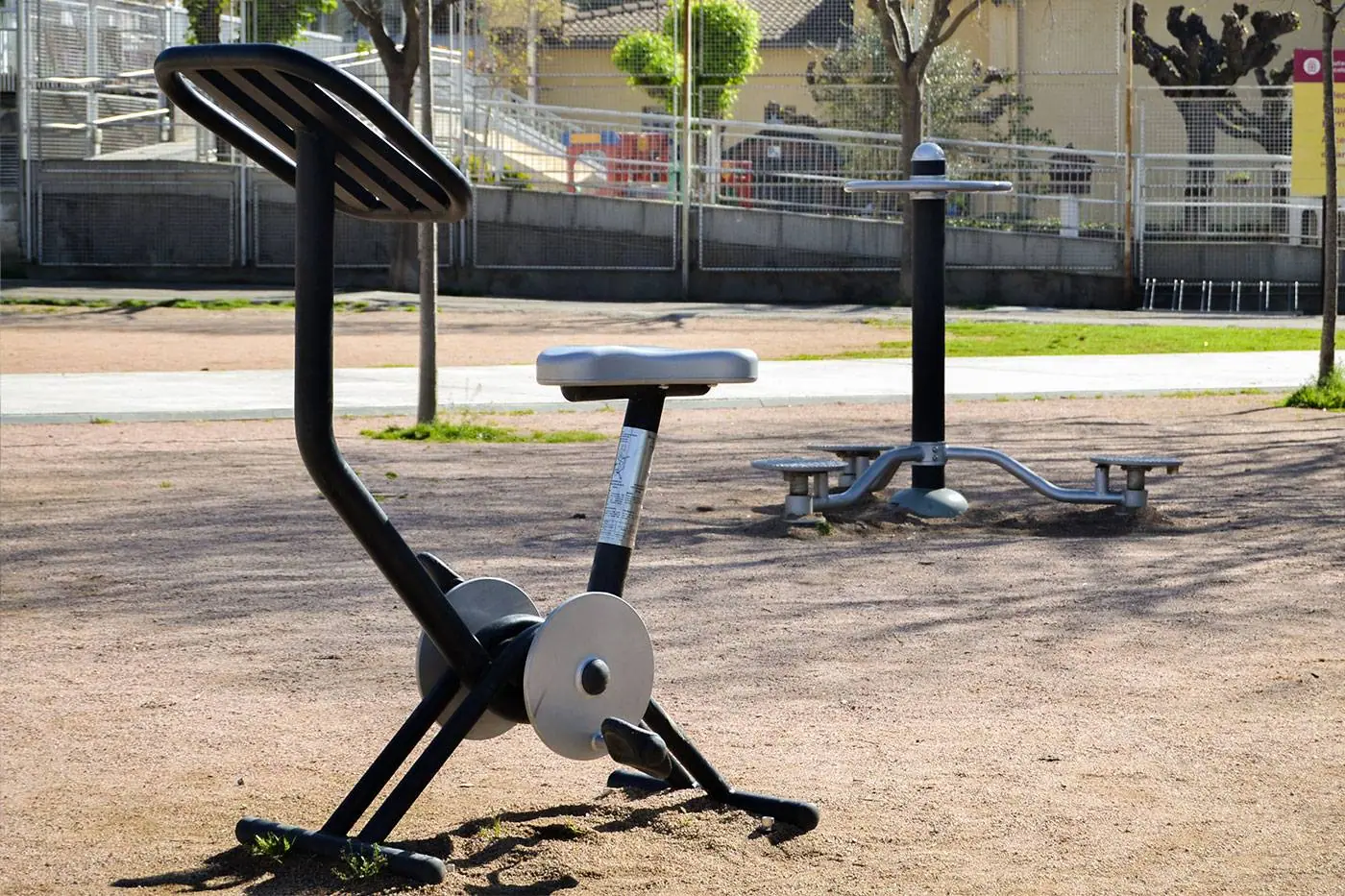
Light In Fitness manufactures and installs outdoor fitness trails for towns and cities, built to EN 16630. The scope of supply covers the siting study, the exercise stations themselves, the user signage and the installation. Once the trail is handed over, the local authority remains the operator: it is responsible for use of the site and must keep a dated record of its inspections. This article sets out what a municipal fitness trail delivers, what distinguishes a professional installation, and what a purchasing department should check before it goes to tender.
Why cities install outdoor fitness trails
Residents of dense urban areas rarely have easy access to a space where they can train outdoors. An outdoor fitness trail answers that directly: a sequence of anchored stations, placed in a green space or along a walking route, that anyone can use during daylight hours without booking and without a subscription. For the authority, it is a sports facility with no reception desk, no staffing rota and no membership system to run.
The benefits fall into five groups. Physical condition first: a well-composed trail combines pulling, pushing, lower-body and cardiovascular stations so a full session is possible on one circuit. Open-air practice second: training outdoors, in contact with green space, has an effect on wellbeing that an indoor room does not reproduce. Accessibility third: stations are specified for a wide range of fitness levels, from first-time users to regular athletes, and they are usually sited close to housing so people reach them on foot. Cost is the fourth: use is free at the point of delivery, which puts training within reach of residents who would not join a commercial gym. Social contact is the fifth, and it is the one operators consistently underestimate: a trail that is used becomes a meeting point, and that has its own value for a neighbourhood.
What distinguishes a professional installation
The difference between equipment that lasts fifteen years in a public park and equipment that is fenced off after three winters comes down to a handful of specification points.
- Materials. Stainless steel and treated timber are chosen for weather resistance and for corrosion behaviour in an unsupervised outdoor setting. The finish matters as much as the section: an untreated weld is where failure starts.
- Exercise coverage. A credible trail includes parallel bars, elliptical walkers, step stations and wall bars so the circuit works the whole body rather than repeating the same movement pattern under different names.
- User safety. Non-slip surfaces, ergonomic grips and guards on moving parts are designed in, not retrofitted. Fall zones and clearances between stations follow the same logic.
- Maintenance. Corrosion-resistant materials and easily cleaned surfaces keep the running cost predictable under heavy use.
- Configuration. The layout is adapted to the plot actually available and to the visual character of the site, not the other way round.
Our fitness trail stations and the wider outdoor fitness trail range are specified on that basis, and an accessible outdoor gym layout lets wheelchair users train on the same circuit as everyone else rather than on a separate token station.
Compliance and the operator’s duties
Outdoor adult fitness equipment is covered by EN 16630. The standard governs the equipment, its anchoring and the space around it, and the manufacturer issues the corresponding documentation for the exact references supplied. What it does not do is transfer responsibility for the site: once installed, the authority operates the trail. In practice that means a routine visual check, a periodic detailed inspection, and a dated written log of both. Where a children’s play area adjoins the trail, that area falls under EN 1176-1 for the equipment and EN 1177 for the impact-attenuating surface. The two frameworks are separate, and children’s equipment is never certified to EN 16630. Whatever your national regulations add for a publicly accessible facility applies on top.
FAQ
What does a city gain by installing an outdoor fitness trail?
A publicly accessible sports facility that improves physical condition, allows open-air exercise, is usable by all fitness levels, is free at the point of use, and creates social contact between residents. It needs no staffing rota to operate.
How can one trail suit every fitness level?
Because the stations offer graded versions of the same movement. A beginner and an experienced user work on the same equipment at their own pace and load, which is why body-weight and lever-based stations are preferred over fixed weight stacks outdoors.
What are the trails made of?
Durable, weather-resistant materials: stainless steel and treated timber. Both are selected for corrosion resistance and for their behaviour on an unsupervised site.
How is user safety handled?
Through non-slip surfaces, ergonomic grips and guards that reduce the risk of injury, combined with correct spacing between stations and the anchoring specified for the ground conditions.
Can a trail be installed on any type of ground?
The trails adapt to a wide range of sites: parks, public gardens, residential areas and walking routes. The anchoring solution is chosen for the ground actually present, which is why the siting study comes before the equipment list.
Can the trail be customised?
Yes. The composition is adjusted to the space available, the audience targeted and the visual requirements of the site, so no two municipal trails need to be identical.
Planning your trail
A municipal fitness trail is a small project with a long life, and most of its value is decided at the siting stage. Send us the plot dimensions, the ground type and the audience you want to reach, and we will come back with a station layout, the applicable EN 16630 documentation and a costed proposal. Request a quote and our team will work through the specification with you.