Which Strength Machine Is the Most Complete? The Multi-Station Answer

Buyers ask the question in almost the same words every time: if we can only put in one strength machine, which one covers the most ground? For a hotel fitness room, a corporate gym, a residential development, a small club or a school, the honest answer is the multi-station gym. It is the single piece of equipment that lets one user work the whole body without changing station, and it does so in a defined footprint with no loose weights to manage.
What a multi-station actually covers
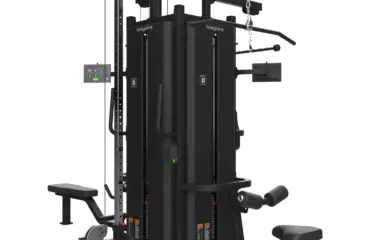
A multi-station combines several guided workstations around a shared frame and one or more weight stacks. In a typical configuration a user can train the chest, the back, the shoulders, the arms, the abdominals and the legs in sequence, moving from one seat to the next and changing resistance with a pin.
- Chest press and pec movements for the pectorals and front shoulder.
- Lat pulldown and seated row for the back and the biceps.
- Shoulder press and cable work for the deltoids and trapezius.
- Leg extension and leg curl for the quadriceps and hamstrings.
- Low pulley and high pulley for arms, trunk and glute work.
That breadth is the whole point. Where a single function machine serves one movement pattern, the multi-station gym serves a complete session for a beginner and a maintenance session for an experienced user, with the same adjustment logic throughout.
Why operators choose it
| Constraint | How the multi-station answers it |
|---|---|
| Floor area | One frame replaces four to six separate machines, with a single circulation zone around it. |
| No supervision on site | Guided trajectories and pin loading remove the two main sources of accident: dropped weights and unsupported free movements. |
| Mixed user levels | Adjustable seats, pads and stack increments serve a first time user and a regular trainer without reconfiguration. |
| Maintenance | One frame, one set of cables and pulleys to inspect, one service visit instead of several. |
| Budget | Lower total cost than the equivalent line of individual stations, for the same coverage of the body. |
Where the limits are
A multi-station is the most complete machine, not the most complete gym. Two users cannot train the same station at once, so throughput becomes the binding constraint above a certain number of members. Loads are also capped by the stack, which matters for a strength focused population. From that point, the right move is a line of dedicated strength training machines plus free weights, with the multi-station kept for circuits and induction sessions.
Cardio is a separate question entirely. Treadmills, cross trainers and bikes are not part of a multi-station and should be budgeted as their own line, whatever the sales copy of a given range suggests.
How to specify one for professional use
Three points decide whether a multi-station survives commercial duty.
Standard. Indoor equipment for professional use is specified to EN ISO 20957-1 class S. Ask for the declaration in writing. Class I is a professional class with inclusive access, not a step above class S, and should be requested when wheelchair users are part of your population.
Frame and cable quality. Look at the section of the uprights, the welding, the cable diameter and the pulley bearings. These are what fail first on a station used forty hours a week.
Stations and stack sizing. Count the workstations against your peak occupancy, and check the stack increments: steps that are too large stop a beginner progressing.
If you are building the whole room rather than adding one machine, our guide on how to equip a gym covers zoning, flooring and the order in which to buy.
Frequently asked questions
Is a multi-station enough for a hotel fitness room? For most hotels, yes, paired with two or three cardio machines and a mat area. It gives guests a complete strength session with no supervision required.
How many people can use one at the same time? Depends on the configuration: a single stack unit serves one user at a time, while multi stack frames allow two to four simultaneous users on different stations.
Does it replace free weights? No. It replaces the need for free weights in facilities that cannot supervise them. Where coaching is available, guided and free work complement each other.
What about beginners? The multi-station is the most beginner friendly strength equipment there is, because the movement path is fixed and the load changes with a pin.
Choosing the right configuration
The most complete machine is the one that matches your room, your supervision level and your user numbers. Tell us the floor area, the ceiling height and the profile of your users, and we will propose the multi-station configuration that fits, with the class S declaration attached. Request a quote to start.