The Complete Guide to the Leg Press Machine
La presse à cuisses permet de charger lourdement quadriceps et fessiers en limitant la compression du rachis, contrairement au squat barre. Le réglage du dossier et la position des pieds modifient la répartition entre quadriceps, fessiers et ischio-jambiers. La descente ne doit pas provoquer de décollement du bassin.
The leg press is one of the most effective exercises for building lower-body strength and size while keeping the load off the spine. For a gym operator or a coach, it is also one of the most requested stations on the floor. Understanding the exercise, the machine formats available and the mistakes members make is what allows a facility to programme it safely and to buy the right hardware.
Why the leg press belongs in a training programme
The leg press allows a user to:
- load the legs heavily with a reduced injury risk compared with the free barbell squat
- target the quadriceps, glutes, hamstrings and calves according to foot placement
- train without a spotter, thanks to the guided path of motion
- build lower-body stability and improve posture
It is a core exercise for anyone who wants strong, well-conditioned and functional legs, and it is one of the few heavy lower-body movements a member can perform alone without supervision.
Muscles worked by the leg press
| Muscle | Location | Role in the exercise |
|---|---|---|
| Quadriceps | Front of the thigh | Prime mover of the push |
| Glutes (gluteus maximus) | Buttocks | Hip extension, above all with a high foot position |
| Hamstrings | Back of the thigh | Assist the push, above all with a high and wide stance |
| Calves (gastrocnemius, soleus) | Back of the lower leg, below the knee | Stabilisation, slight activation at the end of the movement |
The leg press is therefore a compound exercise that trains the whole lower body in a single movement, which is what makes it so efficient in a busy circuit.
The four leg press formats
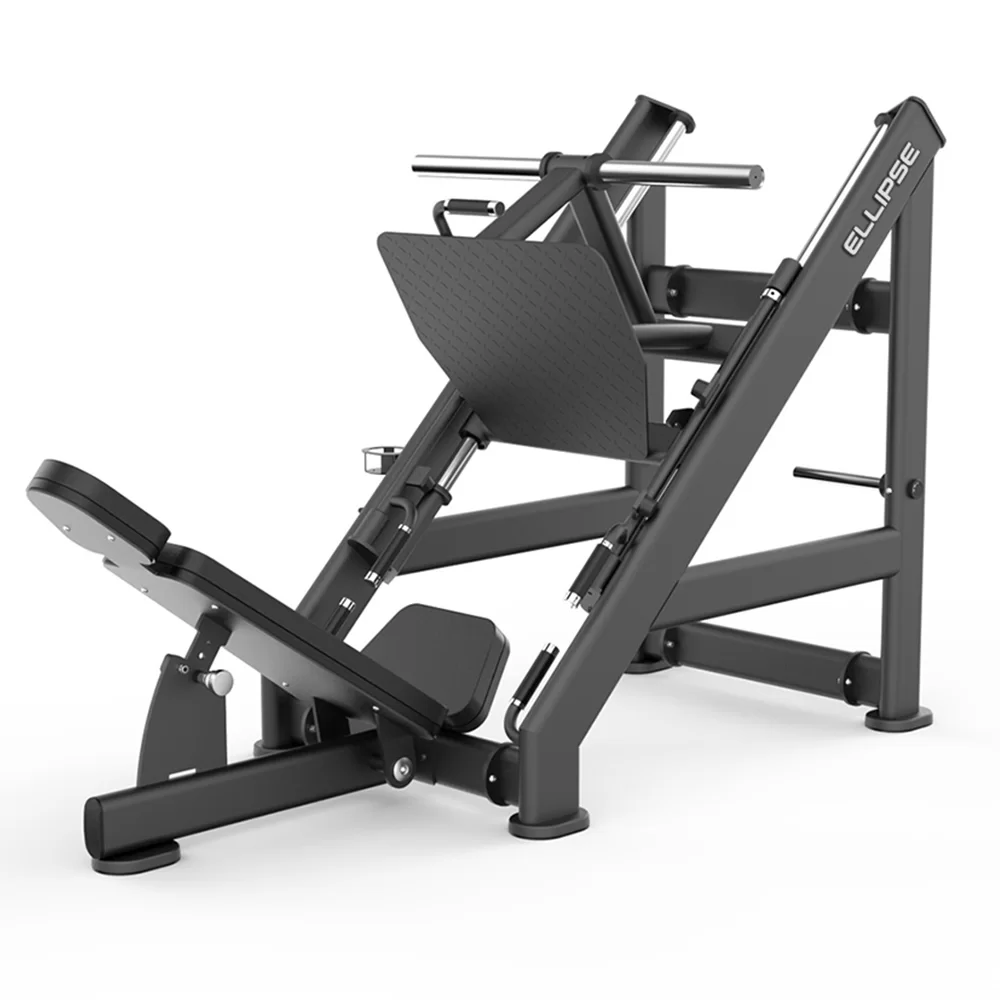
1. The 45-degree plate-loaded leg press
This is the classic and the most effective version:
- plates are loaded on each side of the carriage
- gravity acts fully on the load thanks to the angle
- it allows very heavy loading with a good range of motion
Best suited to muscle development and strength work, bodybuilders and strength and conditioning coaches. Facilities specifying this format will find the range in our plate-loaded machines category.
2. The horizontal leg press (cable or selectorised stack)
- the weight travels horizontally, usually through a pulley system or a guided stack
- gravity has less effect, and the effort feels different
- it is gentler on the joints and the load is adjusted in seconds
Best suited to beginners, rehabilitation work, muscular endurance and mainstream fitness clubs where turnover between members matters. This is typically a selectorised machine, which is why it is the format most often chosen for a busy induction circuit.
3. The hack squat
- inclined position with the back supported and the shoulders under the pads
- it reproduces a squat, but with a guided path and a protected back
- it loads the quadriceps hard
Best suited to intense quadriceps work and as a squat alternative for users with back problems.
4. The vertical leg press
- the user pushes the load straight upwards
- the load feels maximal and the movement is very intense
- it is less common in modern facilities
Best suited to advanced users looking for a different stimulus. It also has a real advantage for operators short on floor space, which is why the vertical leg press keeps its place in compact training rooms.
How to perform the leg press correctly
Starting position
- Sit in the machine with the back and glutes firmly against the backrest.
- Place the feet on the platform, roughly shoulder-width apart.
- Keep the feet flat, toes turned slightly outwards (10 to 15 degrees).
- Release the load by disengaging the safety catches.
Performing the movement
- Lowering phase: bend the knees under control while breathing in. Lower until the knee reaches at least 90 degrees, without the lower back lifting off the backrest.
- Pushing phase: drive through the heels and the middle of the foot while breathing out. Extend the legs almost fully, without locking the knees.
- Repeat for the required number of repetitions.
- Re-engage the safety catches before getting out of the machine.
Foot placement and muscles targeted
| Foot placement | Area mainly targeted |
|---|---|
| Feet low on the platform | Quadriceps (front of the thighs) |
| Feet high on the platform | Glutes and hamstrings |
| Wide stance | Adductors (inner thighs) |
| Narrow stance | Outer quadriceps (vastus lateralis) |
Coaching points that make the difference
- Keep the back flat: never let the lower back lift off the backrest, above all at the bottom of the movement.
- Do not lock the knees: keep a slight bend at the top to protect the joint and maintain muscular tension.
- Control the descent: two to three seconds of eccentric phase to maximise the training effect.
- Breathe correctly: in on the way down, out on the push.
- Vary foot placement: change it regularly to work every area of the lower body.
- Progress in steps: add weight gradually, not at every session.
Common mistakes to avoid
| Mistake | Risk | Fix |
|---|---|---|
| Lower back lifting off the backrest | Lumbar injury | Reduce the range of motion or the load |
| Fully locking the knees | Joint stress, risk of injury | Keep a slight bend at the top |
| Bouncing at the bottom | Loss of control, injury | Lower under control and pause briefly |
| Too much weight, shortened range | Ineffective set, ego lifting | Load less and go deeper |
| Poor foot placement | Knee stress, muscular imbalance | Adjust to the goal and the user’s build |
Benefits of the leg press
- Lower-body strength: it allows heavy loading and steady progression on the legs.
- Hypertrophy: an excellent stimulus for building the quadriceps, glutes and hamstrings.
- Safety: a guided path, no spotter needed, less risk of a fall or of poor technique than in the free squat.
- Accessibility: it suits beginners and advanced users alike, with adjustable loading.
- Back protection: the back stays supported, which reduces lumbar stress compared with free movements.
- Versatility: by varying foot placement, different areas of the lower body can be targeted.
Leg press versus squat: complementary, not competing
| Criterion | Leg press | Free barbell squat |
|---|---|---|
| Load possible | Very high | High, but limited by the back and by technique |
| Safety | High, guided path | Requires good technique and possibly a spotter |
| Stabiliser work | Low | High |
| Load on the back | Very low | Significant |
| Functional transfer | Moderate | High |
The recommendation is to programme both. The squat for functional work and the stabilisers, the leg press to load heavily in safety and to finish the legs. A well-equipped strength floor carries at least one of each.
Frequently asked questions
What range of motion should be used?
Lower until the thighs are at least parallel to the platform, which corresponds to about 90 degrees at the knee, without the lower back lifting off the backrest.
How many sets and repetitions?
- Strength: 4 to 6 repetitions, 4 to 5 sets, heavy load
- Hypertrophy: 8 to 12 repetitions, 3 to 4 sets, moderate load
- Endurance: 15 to 20 repetitions, 2 to 3 sets, light load
Can the leg press be used by someone with back problems?
Yes, and that is precisely one of its advantages: the back stays supported. In the case of a diagnosed condition, the user should seek the opinion of a health professional first.
Horizontal press or 45-degree press?
The 45-degree press is more effective for strength and mass. The horizontal press is gentler and better suited to beginners or to rehabilitation.
Specifying a leg press for your facility
The right choice depends on your members, your floor space and your ceiling height, not on the specification sheet alone. Tell us how the station will be used and how much space you have, and we will propose a configuration through our quote request page.