Leg Extension Machine: The Complete Guide for Gym Operators
La machine leg extension isole les quadriceps en extension du genou, sur une trajectoire guidée. Le réglage de l'axe de rotation au niveau du genou conditionne la sécurité du mouvement. Elle complète la presse à jambes et le squat, sans les remplacer pour le développement global.
The leg extension is one of the few machines that appears in almost every commercial gym floor plan, from a 200-member independent club to a hotel wellness suite or a rehabilitation centre. It is simple to supervise, easy for beginners to understand and, correctly specified, it lasts for years of continuous use. This guide is written for the people who buy it: club managers, hotel and campsite operators, local authorities, schools, clubs and clinics who need to know what the machine really does, how to specify it for professional use, and where it fits in a strength line-up.
What a leg extension machine actually trains
The leg extension isolates knee extension. That single movement is driven by the quadriceps group at the front of the thigh, and that is the muscle group the machine loads. This precision is the whole point of the station: unlike a squat or a leg press, nothing else contributes to the lift, so the load reaches the target muscles directly and the effort is easy to measure from one session to the next.
Because the movement is guided, the resistance profile stays consistent whatever the user’s technique. For a gym operator that means two things. First, beginners can train the front of the thigh safely without needing a coach beside them at every repetition. Second, a physiotherapist or a strength coach can prescribe a very specific load on a very specific joint angle, which is why the station is standard equipment in rehabilitation rooms and in athletic preparation.
It is worth being clear about what the machine does not do. Knee extension does not load the hamstrings at the back of the thigh, and it does not load the glutes. Those muscle groups are trained by hip extension and knee flexion movements, which means a leg curl station, a hip thrust, a deadlift or a squat rack. A strength area built around a leg extension alone will be unbalanced, so the machine should always be planned alongside the stations that cover the posterior chain.
How the machine is set up and used correctly
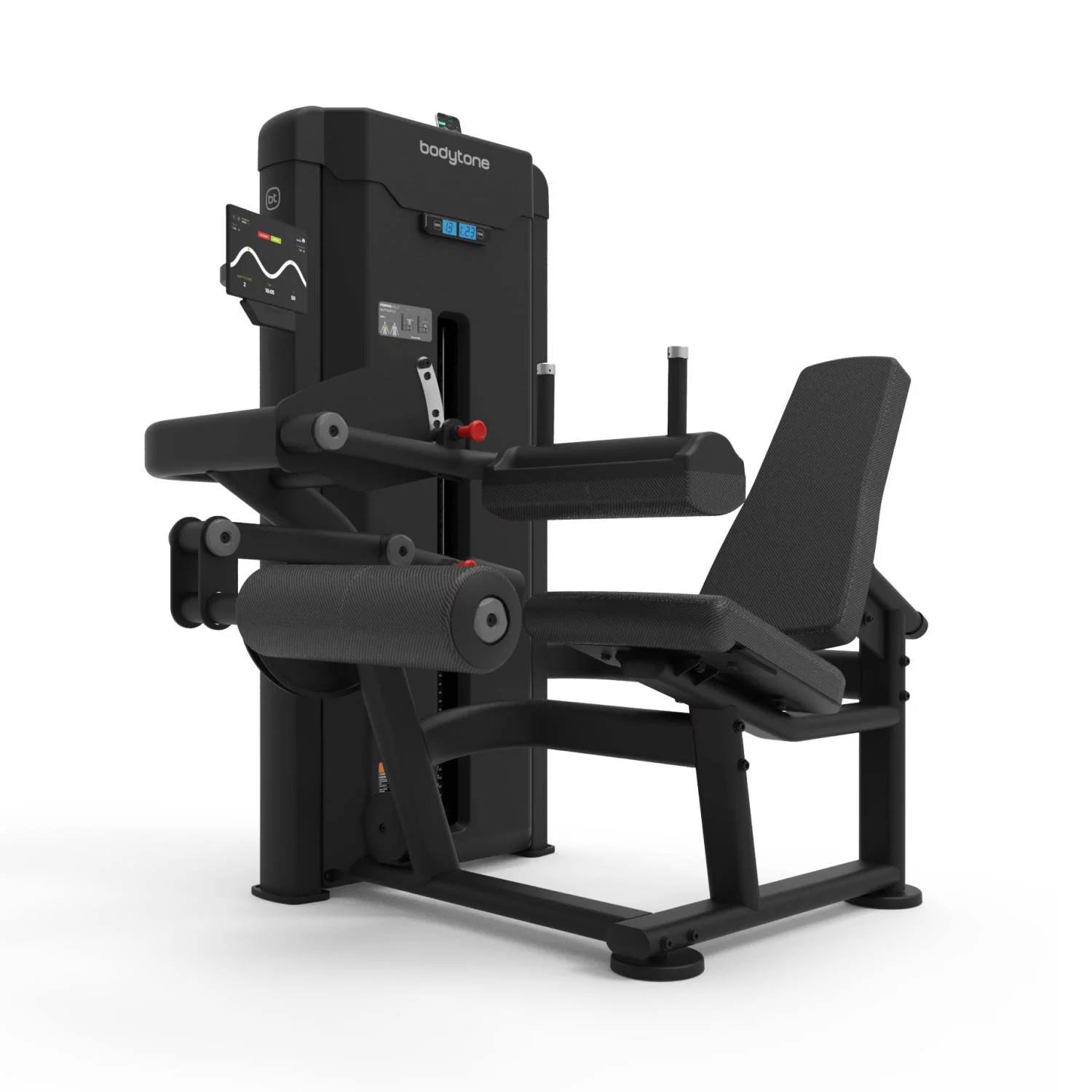
Almost every problem reported with this station comes from a single adjustment: the axis of rotation. The pivot of the movement arm must line up with the axis of the user’s knee. If the seat is too far forward or too far back, the load is applied at the wrong lever and the user feels it in the joint rather than in the muscle. On a professional machine the seat depth or the backrest is adjustable precisely so that a 1.60 m and a 1.95 m user can both align correctly in a few seconds.
The second adjustment is the shin pad. It should sit just above the ankle, on the lower shin, never across the foot. From there the user sits with the back flat against the backrest, extends the knees under control, holds briefly at the top and returns slowly to the start position rather than letting the weight stack drop.
Range of motion should be comfortable rather than maximal. Most professional machines offer a start-position adjustment so the user can shorten the range when a knee is sensitive. If a user reports pain rather than muscular effort, the correct response is to reduce the load and check the alignment, not to push through.
Why the station earns its floor space
For an operator, the leg extension delivers a lot for a small footprint. It builds quadriceps strength, which underpins running, jumping and cycling performance and, just as importantly for a general membership, everyday movements such as climbing stairs or standing up from a chair. Stronger quadriceps also help protect the knee joint during more demanding training, which matters when a large part of your membership is not supervised at all times.
It is also one of the easiest machines to introduce a new member to. A single instruction card and a two-minute demonstration are usually enough, which reduces the induction load on your floor staff. And because the movement is isolated, progress is visible quickly, which supports retention in the first months of a membership.
Specifying a leg extension for professional use
Equipment installed in a facility open to members, guests or the public is not the same product as a home machine. The reference for indoor stationary training equipment is EN ISO 20957-1, and the level to ask for is class S, the class intended for professional and commercial use with unsupervised access. Anything described as semi-professional is out of scope for a club, a hotel gym or a public facility.
Beyond the class, four points separate a machine that survives ten years of use from one that does not:
- Frame and welds. A heavy steel frame with continuous welds and a durable powder-coated finish, sized for the loads it will actually see.
- Adjustments. Seat, backrest, shin pad and start position adjustable without tools, so the machine fits your whole membership rather than the average of it.
- Weight stack or plate loading. A selectorised stack suits mixed memberships and busy circuits; a plate-loaded version suits strength-focused gyms and outdoor or heavy-duty installations.
- Upholstery and cables. Commercial-grade upholstery that stands up to daily cleaning products, and cables or belts with a documented replacement part supply.
The full range of guided stations is set out in our strength training machines section, and the stack-loaded versions specifically under selectorised machines. A typical club specification is a model such as the Bodytone Forza FB52 leg extension, which combines a selectorised stack with tool-free adjustment.
Precautions and supervision
The leg extension is a safe station when it is set up properly, but three habits are worth reinforcing with your members and your instructors. Avoid loading the machine so heavily that the user has to swing the torso to start the movement. Avoid a violent lock-out at the top of the range. And treat knee pain as a stop signal rather than a training sensation, with a referral to a coach or a clinician.
On the operator side, the maintenance routine is short: check the shin pad and seat locking pins weekly, inspect cables, belts and pulleys monthly, and keep the weight stack guide rods clean and lubricated. Log the checks. In most European jurisdictions the operator of a facility open to the public is responsible for the condition of the equipment, and a written maintenance log is the simplest way to demonstrate that the obligation has been met.
Alternatives and complementary stations
The leg extension complements rather than replaces compound work. A leg press or a squat rack loads the quadriceps together with the glutes and the hamstrings under a much higher total load, and remains the backbone of a lower-body area. Free-weight squats and lunges add balance and coordination demands that no guided machine reproduces. Bodyweight work and resistance bands cover the same movement pattern where space or budget is limited, or where a rehabilitation protocol calls for very light loading.
In practice, a balanced lower-body zone in a commercial gym pairs the leg extension with a leg curl for the hamstrings, a leg press or a squat rack for the compound pattern, and a hip-dominant station for the glutes. That combination covers every major muscle group of the lower limb and keeps queues moving at peak hours.
Frequently asked questions
Does the leg extension work the hamstrings and the glutes? No. It isolates knee extension, which loads the quadriceps. Hamstrings and glutes need knee flexion and hip extension movements, so plan a leg curl and a hip-dominant station alongside it.
Selectorised stack or plate loaded? A selectorised stack is faster between users and better suited to mixed memberships and circuits. A plate-loaded version gives a different loading feel, is simpler mechanically and is often preferred in strength-focused gyms.
Is a class S machine really necessary for a small hotel gym? Yes. The class is defined by the type of access, not by the number of users. As soon as the equipment is available to guests without permanent supervision, class S under EN ISO 20957-1 is the level to specify.
How much space should I allow? Allow the machine footprint plus a clear access corridor on the entry side and enough clearance behind for the weight stack and for circulation. Our team sizes this on your own floor plan at the quotation stage.
Planning your strength area
A leg extension is a small decision inside a bigger one: how the lower-body zone of your facility is laid out, which stations sit next to each other and how many users you need to serve at peak time. Send us your floor plan, your membership profile and your budget, and we will come back with a specified line-up, drawings and a costed proposal. Request a quote and our team will handle the technical selection with you.