Professional Chest Press Machines: How to Choose for Your Facility
The chest press is one of the few machines that every category of facility ends up installing. It is the first strength station a beginner will use without supervision, it absorbs a large share of upper-body volume on a busy floor, and it removes the spotting requirement that makes the bench press awkward in an unstaffed room. That combination makes it a default purchase, which is exactly why it is worth specifying properly rather than ordering the first model in the catalogue. This guide is for gym owners, hotel and residence operators, clubs, rehabilitation centres, armed forces and local authorities choosing chest press equipment for a professional installation.
What the chest press actually trains
The movement is a horizontal push. The prime movers are the pectoralis major, the anterior deltoid and the triceps, with the serratus anterior stabilising the shoulder blade. It is worth being precise with members about this, because the machine is often credited with more than it does: it is a pushing movement and it does not train the biceps, which work in pulling patterns. A programme built only on presses produces a predictable imbalance, which is why the chest press belongs next to a rowing or pulldown station rather than on its own.
The same caution applies to posture claims. Pressing strength alone does not correct a rounded upper back; that comes from horizontal pulling, thoracic mobility work and the time members spend away from the gym. Position the chest press as what it is, a safe and productive pushing station, and let the pulling equipment do the postural work.
The three families of chest press machine
Almost every model on the market falls into one of three groups, and the right choice depends on who uses your floor.
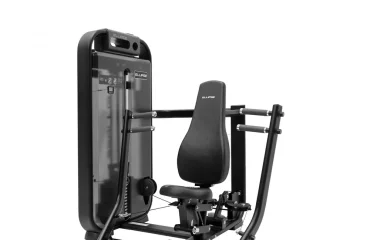
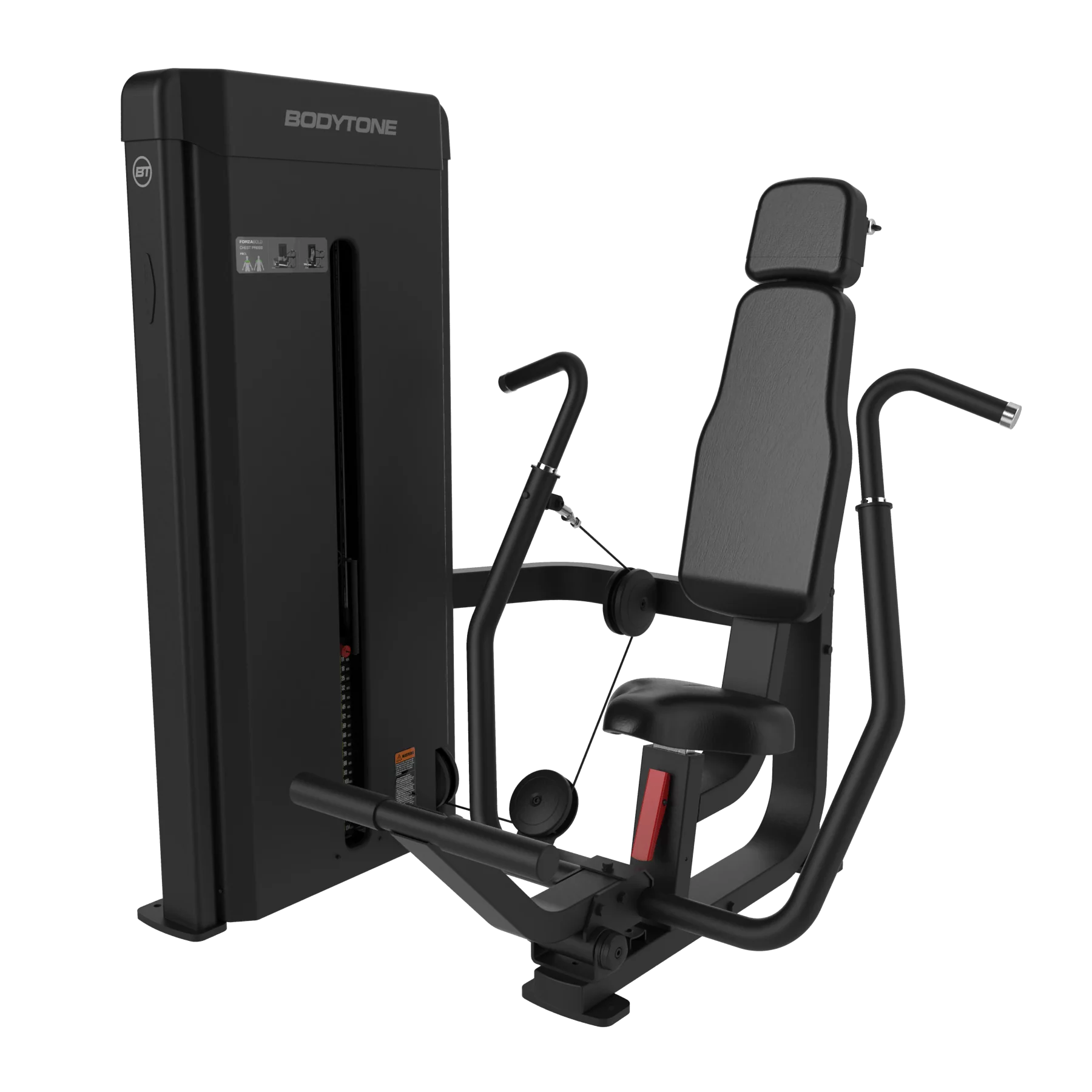
- Selectorised chest press. Weight stack with a pin. Fastest weight change, guided path, minimum instruction required. This is the workhorse for high-turnover floors, hotels, residences and any room with beginners or limited supervision. See the selectorised machines range.
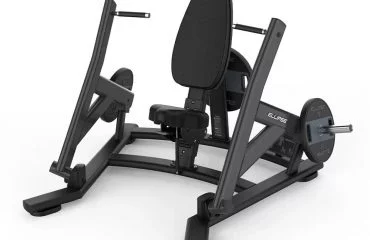
- Plate-loaded chest press. Loaded with olympic discs, usually with independent arms. Higher perceived load ceiling, stronger feel, favoured by experienced members and cross-training facilities. It costs less per station than a stack machine but needs disc storage next to it. See the plate-loaded machines range.
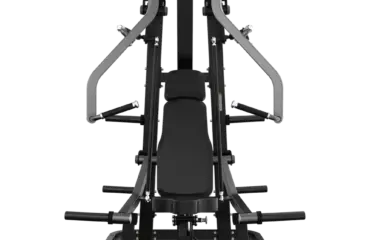
- Converging and iso-lateral models. The arms travel inward as they extend, following the natural line of the movement, and each arm works independently so a stronger side cannot compensate for a weaker one. Particularly relevant in rehabilitation and in any facility working with asymmetries.
Our full chest press machines selection covers all three, in incline, decline and horizontal versions.
Specifying for a professional installation
Whatever the model, equipment installed in a facility open to users must be certified to EN ISO 20957-1 class S, the professional class for indoor equipment. Equipment intended for private use has no place on a commercial, hotel, club or municipal floor: the duty cycle, the insurance position and the liability are all different.
Beyond the certification, five points decide whether a chest press is right for your room:
- Footprint and access. Check the machine footprint and the clearance a user needs behind and beside it, not just the frame dimensions. A station users cannot enter comfortably will be avoided.
- Adjustment range. Seat height and back pad adjustment determine how many body types the station serves. On a mixed public floor this matters more than the maximum load.
- Upholstery and finish. High-frequency use destroys thin padding and cheap stitching first. Ask what the upholstery is rated for and how it is replaced.
- Loading system. Stack machines suit fast rotation between users; plate-loaded suits heavier, slower training and a lower purchase price per station.
- Service and parts. Confirm spare parts availability and the warranty terms in writing before ordering, since they vary by range.
Chest press or bench press on a commercial floor?
This is the recurring question, and the answer is rarely one or the other. The bench press trains stabilisation across the whole upper body and stays essential for strength-focused members, but it needs a spotter or a rack with safety arms, a clear zone around it, and flooring rated for dropped bars. The chest press machine removes those constraints: a member can train close to failure alone and in safety, which is decisive in a hotel gym, a residence, a corporate room or any facility without permanent supervision.
Most well-planned facilities install both, and size the ratio by audience. A staffed performance gym leans towards racks and benches; a hotel, residence, municipal or corporate room leans heavily towards guided stations, with the chest press among the first three machines specified.
Programming the station for your members
For beginners, three sets of ten to twelve repetitions with a light load and one to two minutes of rest builds the movement pattern before the load. The priority is a controlled range with elbows not locked out and the back pad supporting the spine throughout.
For intermediate and advanced members, four to five sets of eight to ten repetitions at a heavier load works well, and pairing the chest press with an antagonist pulling exercise such as a seated row keeps the session balanced and shortens it. Whatever the level, the station belongs inside a full-body programme rather than being trained in isolation.
Which muscles does a chest press machine work?
Pectoralis major, anterior deltoid and triceps, with the serratus anterior stabilising. It does not train the biceps, despite a common belief to the contrary.
Selectorised or plate-loaded for a new facility?
If your members are mostly beginners or your room is unsupervised, start selectorised. If you serve experienced strength-training members or run a cross-training floor, plate-loaded gives more load per euro invested. Facilities above a certain size usually install both.
Is a chest press machine suitable for rehabilitation?
Guided and iso-lateral models are widely used in rehabilitation settings because the path is controlled and each side loads independently. The programme itself must be set by the clinical team; the equipment simply has to allow fine load increments and easy access.
How much space should we allow per station?
Use the manufacturer footprint plus a circulation allowance around it, and check the entry side is not blocked by another machine. Send us your floor plan and we will position the station properly rather than estimating.
Specify your chest press with our team
Tell us the surface area, the profile of your users and the machines already installed, and we will propose the chest press configuration that fits, with dimensions, load range and lead time. Request a quote and our team will come back with a specification for your project.