Vertical Leg Press: Why and How to Use It in Your Gym
La vertical leg press place l'utilisateur allongé sous une charge guidée verticalement, ce qui réduit l'emprise au sol par rapport à une presse inclinée. Elle sollicite quadriceps, fessiers et mollets sur une poussée guidée, adaptée aux publics non encadrés. Son format compact la rend pertinente en studio et en espace contraint.
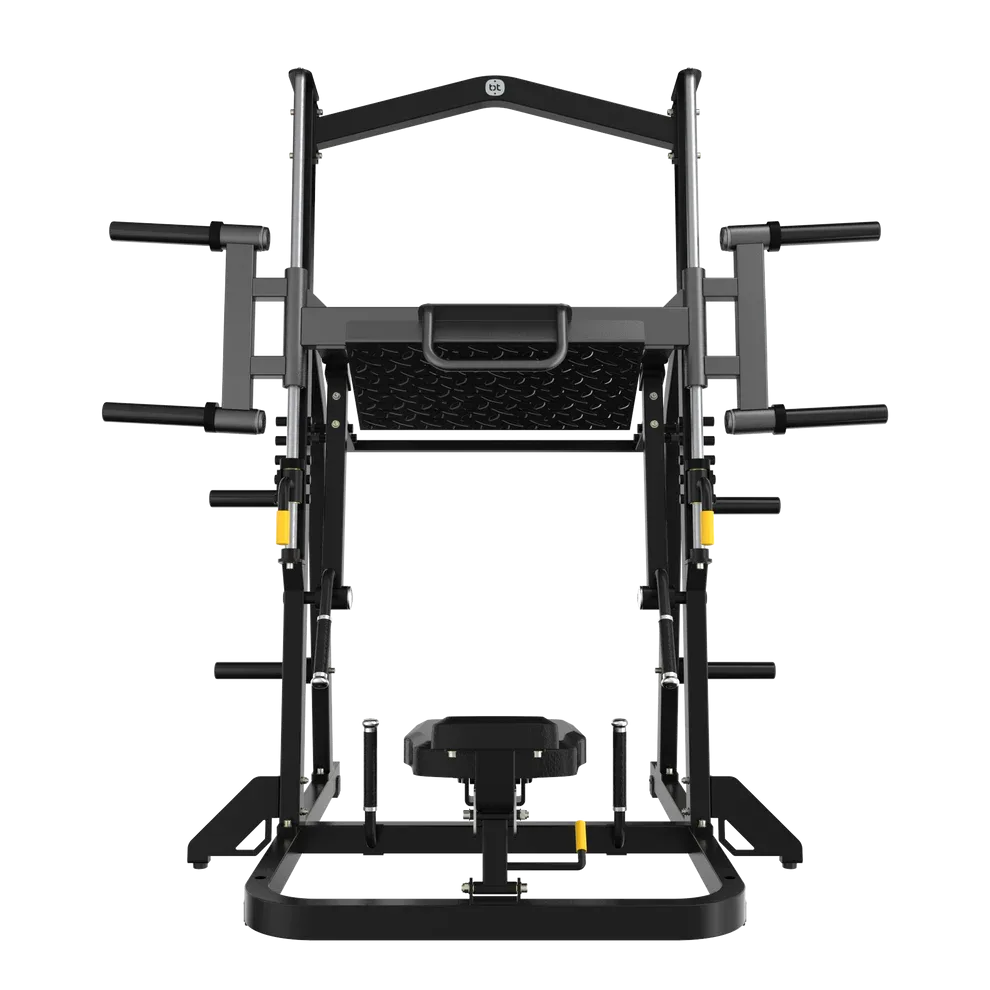
The vertical leg press places the user lying beneath a load that travels straight up, which cuts the floor space needed compared with an inclined press. It loads quadriceps, glutes and calves on a guided pushing path suited to unsupervised members, and its compact format is what makes it relevant in studios and on floors where space is the binding constraint. This guide covers why an operator installs one and how to coach members on it.
Why put a vertical leg press on the floor
Footprint
A 45 degree press needs a long rail run and clearance behind it. The vertical design puts the same movement into a fraction of that area, which is the reason it appears in studios, hotel gyms, corporate facilities and any room where a lower-body station has to justify every square metre.
Guided loading without a spotter
The path is fixed and the safety catches are within reach under load, so a member can train the legs heavily without assistance. On floors with limited coaching capacity, that is the difference between a station that gets used and one that sits idle.
A usable progression for every level
Load is added in plates without any balance demand, so the same station serves a member in their first month and one working at heavy loads. That range of use per square metre is what makes it a sound purchase for a mixed membership.
Which muscles it loads
Primarily the quadriceps, the glutes and the hamstrings, with the calves involved depending on foot placement. Foot position on the platform shifts the emphasis, which is what gives one station several training uses:
- Feet higher: more glute and hamstring involvement.
- Feet lower: emphasis moves to the quadriceps.
- Feet wider: brings in the adductors and inner thigh.
- Feet parallel and shoulder width: the neutral, quadriceps-centred position.
Whatever the placement, the knees must track in line with the toes. That is the non-negotiable part.
How to use it: the coaching sequence
Starting position
Back flat against the support, with no gap at the lower back. Feet on the platform at about shoulder width, heels firmly planted – the drive comes through the heels, not the toes. Knees aligned with the feet and not falling inwards.
Warm-up
Five to ten minutes of light cardio, mobility work for hips, knees and ankles, then one or two very light sets on the machine itself before the working sets.
The repetition
Release the safety catch. Lower slowly by bending the knees, keeping the pelvis in contact with the seat – the moment the hips lift, the range has gone too far. Aim for around 90 degrees of knee flexion, adjusted to the member mobility. Drive back up through the heels with the trunk braced, and stop short of locking the knees hard at the top.
Because the position is vertical, range control matters more here than on an inclined press: a member who drops too deep loads the lower back rather than the legs. Bouncing out of the bottom position is the fault to correct on sight.
Sets and repetitions
For hypertrophy and general conditioning, three to four sets of eight to fifteen repetitions. For strength work, four to six sets of four to eight repetitions with heavier loading, provided execution stays clean. Rest sixty to one hundred and twenty seconds depending on intensity.
What to check when specifying one
- Build standard: for indoor commercial use, specify equipment built to EN ISO 20957-1 class S.
- Safety catches: several positive stop positions the member can engage from under load without help. On an unsupervised floor this decides whether the station is usable at all.
- Platform size: large enough for the foot placements above. A small platform removes most of the training variety the station offers.
- Back support: padding and angle that keep the lumbar spine supported through the full range.
- Parts chain: bearings, cables and upholstery are the wear items. Get the parts list and its lead time before ordering.
Frequently asked questions
What is a vertical leg press for?
It trains guided leg pushing to build lower-body strength and muscle, in a footprint far smaller than an inclined press and with more stability than free-weight alternatives.
Is it suitable for beginners?
Yes, with an induction covering back contact, foot placement and range. The guided path removes the balance demand, which is what makes it accessible from the first session.
How deep should the movement go?
To around 90 degrees of knee flexion, and never past the point where the pelvis leaves the seat. On a vertical machine that limit matters more than on any other press.
Does it replace the squat or the 45 degree press?
No. It is the compact alternative when floor space is the constraint, and a complement when it is not. A full lower-body zone carries more than one pushing option.
Browse the vertical leg press range and the plate-loaded machines, or request a quote for a complete lower-body zone.