Plate-Loaded Seated Dip Machine: The Professional Guide
Equipping a gym floor is a series of trade-offs between footprint, throughput and the range of members a machine can actually serve. The plate-loaded seated dip station is one of the pieces that resolves several of those trade-offs at once: it takes a movement that most members cannot perform on parallel bars, puts it on a guided path with a supported seat, and lets the load be set precisely with Olympic plates. This guide covers what the machine trains, how it is built, and what to look at before it goes on a purchase order.
Seated dip machine: what it is
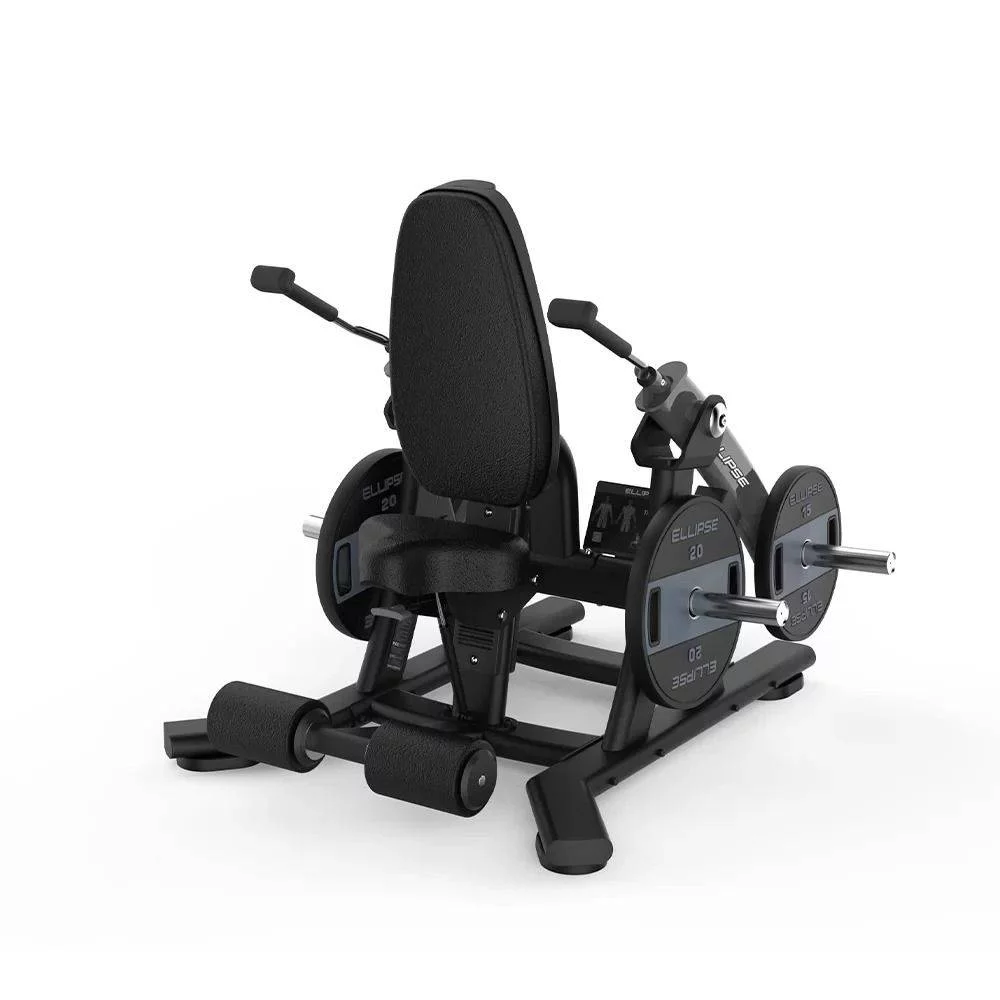
A plate-loaded seated dip machine is designed to work the upper body pressing chain from a seated, stabilised position. The user sits with the back supported, grips two handles at the sides of the body and presses down against the resistance until the arms are extended. An adjustable seat sets the starting angle at the shoulder, padded support pads hold the body in place through the movement, and Olympic plates loaded on horns provide the resistance, adjusted plate by plate to the user in front of the machine.
Unlike a selectorised station, there is no weight stack: the load is visible, and the resistance profile comes from the geometry of the arm and the leverage designed into it. That is the reason plate-loaded stations remain popular in strength-focused clubs, cross-training boxes and performance facilities, where users want to know exactly what they are pressing.
Key features to look for
- Adjustable seat, so the station fits users of different heights and limb lengths.
- Padded support pads that keep the torso stable throughout the movement.
- Olympic plate loading, so resistance can be set in fine increments.
- Heavy-gauge steel frame, sized for continuous commercial duty rather than occasional use.
- Ergonomic handles with a grip diameter and angle that stay comfortable under load.
- A compact footprint, which matters when the strength area has to deliver a given number of stations per square metre.
Which muscles the seated dip actually trains
The seated dip is a pressing movement, and it loads the pressing muscles: the triceps brachii above all, then the sternal portion of the pectoralis major and the anterior deltoid, with the scapular stabilisers working to hold the shoulder in place. It is not a pulling exercise and it does not train the latissimus dorsi or the mid-back; those belong to a lat pulldown or a row station. Getting this right matters when you are building a balanced equipment line, because a gym floor stocked entirely with pressing stations leaves an obvious gap.
Why operators install one
Six arguments come up repeatedly when clubs specify this station:
1. Upper-body strength. The dip is one of the most effective triceps and chest exercises available. On a machine, it can be performed under control, with the range of motion bounded and the risk of a failed repetition largely removed.
2. Accessibility. On parallel bars, the entry load is the user’s own bodyweight, which excludes a large share of the membership from day one. A plate-loaded station starts far lower, so beginners and returning members can train the same movement pattern from their first session.
3. Shoulder stability. The movement recruits the stabilising musculature around the shoulder in a supported position, which is useful both in general conditioning and in supervised reconditioning work.
4. Progressive overload. Because the load is set with plates, increments can be small and precise, which is exactly what hypertrophy programming needs.
5. A range that suits every level. The same station serves a first-time member and an experienced lifter, which is what makes it worth the floor space in a mixed-membership club.
6. Controlled technique. A guided path limits the technical errors that make free-weight dips risky for unsupervised users, an argument that carries weight in facilities with limited coaching cover.
What to check before you buy
Any machine installed in a club, a hotel gym, a corporate facility or a municipal centre is used continuously by users who did not read the manual. That is the definition of professional duty, and it is covered by EN ISO 20957-1 class S, the class for equipment intended for commercial use. Class S is what belongs in your specification; it is also the frame of reference your insurer will expect.
Beyond the standard, four points separate stations that last from stations that do not: the wall thickness and section of the steel frame, the quality of the bearings and bushings at the pivot, the density and the covering of the upholstery, and the availability of spare parts several years after purchase. Ask for the frame warranty and the upholstery warranty separately, because they are rarely the same.
The station sits naturally alongside the rest of a plate-loaded machine line, and complements the chest press machines that cover the horizontal pressing pattern. For a unilateral variant with independent arms, see the Etenon R5304 unilateral triceps dip.
Frequently asked questions
What is the difference between bar dips and seated machine dips?
Bar dips are performed on parallel bars with bodyweight as the load, so the user has to stabilise the whole body and the entry load cannot be reduced. Seated machine dips are performed from a supported seat with a selectable plate load, which keeps the same pressing pattern while removing the stabilisation demand and letting the resistance be set below bodyweight.
How long before members see results?
That depends on the starting level, on training consistency and on nutrition. With regular use, most users notice gains in strength and muscle tone within four to six weeks.
How many sets and repetitions?
Sets and repetitions depend on the user’s level and objectives. A common starting point is two to three sets of ten to twelve repetitions, with the intensity increased progressively. Members should ask a qualified instructor for programming adapted to their own situation.
Is the machine suitable for beginners?
Yes. Because the resistance is set with plates, a beginner can start with a light load and increase it as they progress, which is precisely what a bodyweight dip on parallel bars does not allow.
What are the alternatives?
Assisted dip and pull-up stations, bench dips and free-weight dips on parallel bars all cover the same movement pattern with different levels of assistance and stabilisation demand. Most well-equipped floors carry more than one of them.
Specifying your strength line
A seated dip station is rarely bought on its own. It is one position in a line that has to cover every movement pattern, fit the available floor area and match the profile of the membership. Send us your floor plan and your member profile and our team will propose a layout and a costed equipment list: request a quote.
Réalisations documentées
- Cage street workout ultime, Carcassonne – armée française
- Cage street workout ultime, Tahiti – armée française, Polynésie
- Cage SP Max, centre EPIDE de Combrée – établissement public d’insertion
- Cage SP Max, lycée Saint-Bénigne de Dijon – établissement scolaire