Bodytone Cable Pulley Machines: Specifying Cable Stations for a Commercial Gym
Ask a club manager which machine earns back its floor space fastest and the answer is rarely the one with the biggest badge on it. More often than not, it is the cable station. A single Bodytone cable pulley unit covers pressing, pulling, rotation and rehabilitation work for members of every level, which is exactly why it belongs in the first wave of an equipment plan rather than the last. This guide is written for the people who sign the purchase order: club owners, cross-training box operators, hotel and campsite managers, local authorities, schools, sports clubs and rehabilitation centres.
What a cable pulley station actually is
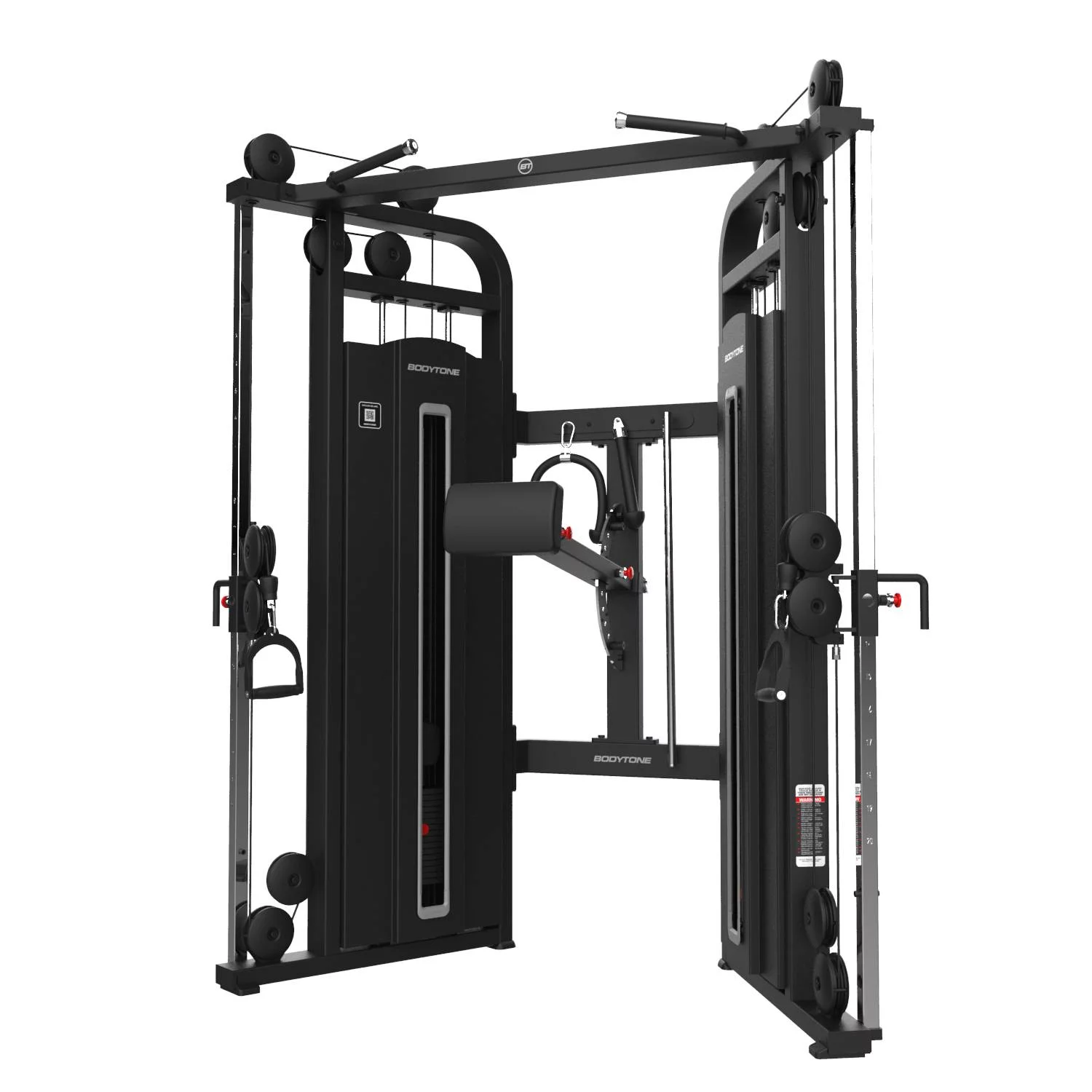
A cable pulley station is a deceptively simple assembly: a weight stack, a cable routed over one or more pulleys, and an attachment point at the working end. Handles, straight bars, rope grips and ankle straps clip on and off in seconds, and the pulley height is adjustable so the same column serves a seated row and an overhead triceps extension without any change of station.
What matters mechanically is that the cable keeps tension on the muscle through the whole range of movement, not only at the point where a free weight happens to be fighting gravity. That continuous tension is the reason cable work transfers so well to real movement patterns, and it is also why a cable column suits a mixed membership: the same machine that a first-week beginner uses at the lightest setting is the one an experienced lifter uses at the top of the stack.
The Bodytone range covers the whole span, from a compact dual-pulley personal trainer column to a multi-station crossover built for a busy free-weight floor. You can see the full range on our Bodytone cable crossover page.
Why cable resistance belongs on a commercial strength floor
Three arguments carry the business case, and none of them is about aesthetics.
Throughput per square metre. A selectorised machine does one job. A cable column does dozens. On a floor where every square metre has to justify itself, that ratio is what decides whether a facility can offer a complete strength offer in the space available, or has to send members elsewhere for half of it.
Member breadth. Cable work is the easiest strength modality to introduce to a nervous beginner, because load is adjusted in a second and the movement path is guided by the cable rather than by the user having to stabilise a loaded bar. The same station then scales all the way up. Facilities with a wide age range, or with a rehabilitation or return-to-sport population alongside their regular members, get more out of a cable column than out of almost anything else they can buy.
Retention through variety. Members leave when their programme goes stale. A cable station is the cheapest insurance a club has against that: an instructor can rebuild a member’s whole programme on the same piece of equipment without adding a single machine to the inventory.
Matching the configuration to your facility
The specification question is not which machine is best, but which configuration matches the traffic and the space you actually have.
Single or dual-pulley personal trainer columns. These are the right answer for hotel and residential fitness rooms, small studios, personal training suites and any space where the machine has to replace several single-function units. The Bodytone FCPT personal trainer cable station is the reference model in this format: two independent stacks, adjustable pulley heights and a footprint that fits where a pair of selectorised machines would not.
Multi-station crossovers. Once you are equipping a club floor where several members need the equipment at once, the calculation changes. A seven or ten-station crossover lets a group train simultaneously without queueing, and it consolidates what would otherwise be a scattered set of columns into one structure with one set of anchor points.
Rehabilitation and mixed-use rooms. Rehabilitation centres, armed forces facilities and clubs running return-to-sport work need fine load increments and a clear working area around the user. Our cable stations category groups the units built for that use.
Standards, build quality and what to check before you sign
Equipment installed in a facility that is open to members, staff, guests or the public is professional equipment, and the applicable reference for indoor stationary training equipment is EN ISO 20957-1, class S. Ask for that in writing. It is not a marketing line: it governs the structural testing the frame has been through, and it is the first thing an insurer or a safety inspector will look for.
Beyond the standard, four things separate a cable station that lasts a decade from one that does not.
- Cable and pulley quality. The cable and the pulley bearings are the wear parts on this type of machine. Ask what they are rated for and how they are replaced.
- Frame construction. Steel section, weld quality and the finish applied to it determine whether the structure still tracks true after years of loaded use.
- Spare parts availability. A cable station out of service for six weeks waiting for a part is a machine that has stopped earning. Confirm the supply chain before you order, not after.
- Serviceability. Pulleys, cables and upholstery should be replaceable by your own maintenance staff with ordinary tools. Anything that requires the manufacturer on site is a recurring cost.
Installation, footprint and floor preparation
A cable station needs more than its own base area. It needs the working envelope around it: the space a user occupies when they step back into a cable fly, a rotation or a lunging pull. Laying out a floor to the base dimensions alone is the single most common planning error we see, and it is the one that cannot be fixed after installation.
The floor underneath matters as well. Cable stations concentrate load on a small number of anchor points and, on a floor shared with free weights, the surface has to cope with dropped plates nearby. Choose the flooring at the same time as the equipment rather than afterwards, and follow the manufacturer’s anchoring instructions for the model concerned rather than a generic rule.
Finally, plan for attachments. Handles, ropes and bars that live on the floor get lost, damaged and become a trip hazard. A wall rack or storage column next to each station keeps the area usable and protects the accessories you have paid for.
Getting the equipment used once it is installed
Buying well is half the return; the other half is what your team does with the machine.
Progressive overload. Members make progress when the demand rises over time. Cable stations make that easy to manage because the increment is a pin, not a plate change, and staff can set a clear progression for a member in a way that is realistic to follow.
Exercise variety. The station only delivers its value if instructors know what it can do. A half-day of staff training on cable programming does more for utilisation than any amount of additional hardware.
Tracking. Members who record what they lift keep coming back. Whether that is an app, a card or a whiteboard matters far less than whether the habit exists at all.
Warm-up and recovery. Induction should cover both. Facilities that skip this see more minor injuries, more complaints and more dropped memberships, and none of that is a fault of the equipment.
Specification mistakes that cost money
Buying on headline price alone. A cable column that is out of service, or that has to be replaced in four years, costs far more than the difference on the invoice.
Undersizing the station. Facilities routinely specify one column where the member count needs two. The queue that results is invisible in a spreadsheet and very visible in a member survey.
Ignoring the working envelope. See above. It is worth repeating because it is the error that gets designed into a floor plan and discovered on the day of installation.
Leaving staff untrained. An unused capability is a wasted budget line.
Frequently asked questions
What is a Bodytone cable pulley station?
It is a strength machine built around a weight stack, a cable and one or more adjustable pulleys, with interchangeable handles and bars. It allows a wide range of pressing, pulling and rotational exercises on a single frame, with continuous tension through the movement and load adjusted by a pin.
Is a cable station suitable for a small facility?
Yes, and it is often the best single purchase a small facility can make. A dual-pulley personal trainer column replaces several single-function machines in a footprint that a hotel fitness room, a residential gym or a small studio can accommodate.
Which standard applies to this equipment?
Indoor stationary training equipment for professional use is covered by EN ISO 20957-1, class S. Any equipment installed where members, guests, staff or the public will use it should be supplied and documented to that class.
How many cable stations does a club floor need?
That depends on your peak occupancy and your programming, not on your total membership. The useful question is how many members are on the strength floor at your busiest hour and how much of your programming routes through cables. We size this with you as part of the quotation.
Specifying your own installation
A cable station is one of the few purchases in a fitness facility that is almost impossible to over-specify, because the capability scales with the membership rather than sitting idle. The decisions that matter are the configuration, the working envelope you allow around it, the class of equipment you insist on, and whether your team is trained to use what you have bought.
Send us your floor plan, your peak occupancy and the population you serve, and we will come back with a configuration and a costed proposal. Request a quote and we will work through it with you.