Professional Leg Press Machine for Gyms and Clubs
La presse à jambes permet de charger quadriceps, fessiers et ischio-jambiers en limitant la compression du rachis. La position des pieds sur le plateau modifie la répartition entre ces groupes musculaires. La descente ne doit pas provoquer de décollement du bassin du dossier.
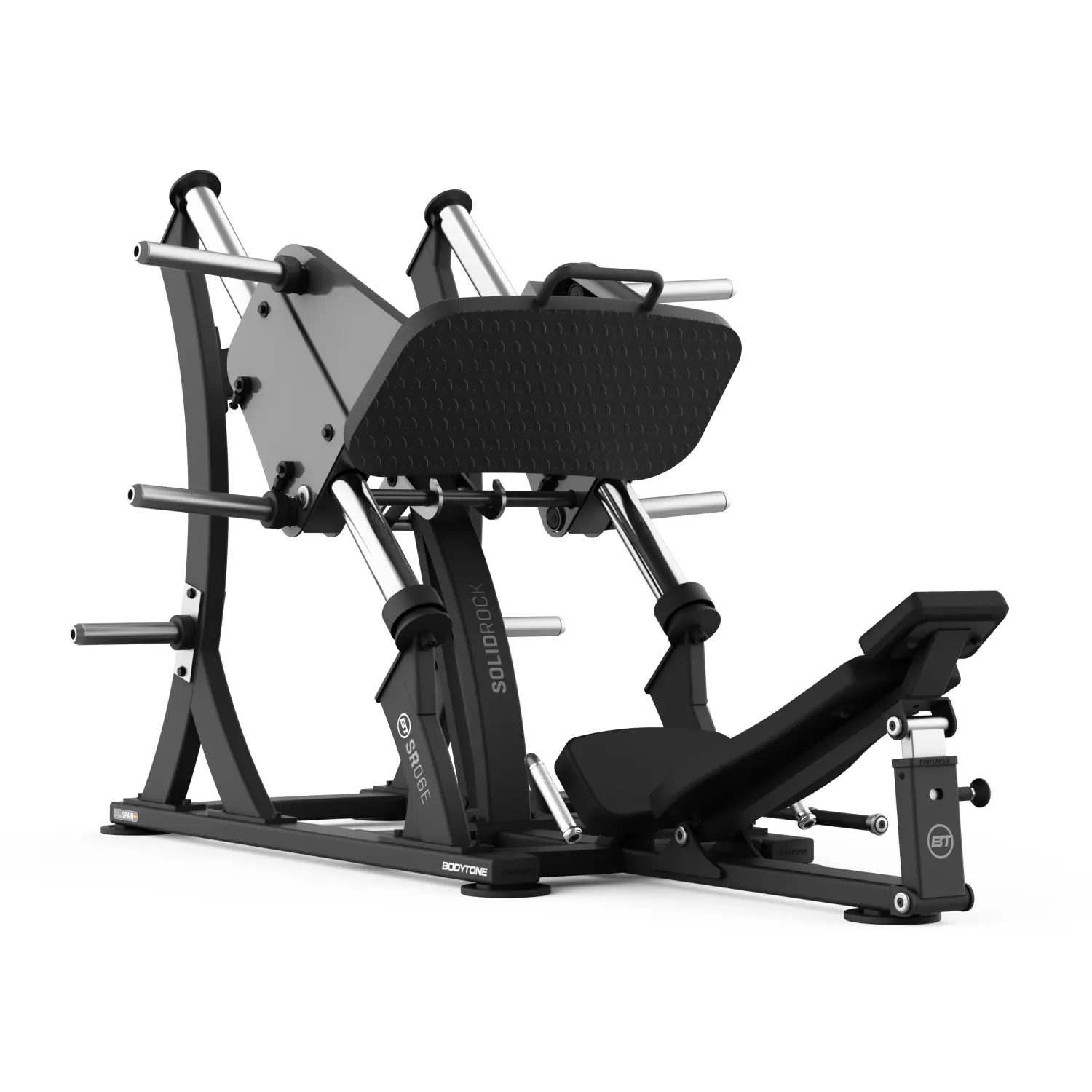
The leg press loads the quadriceps, glutes and hamstrings while limiting compression of the spine, which is why it belongs on almost every commercial strength floor. Foot position on the plate shifts the balance between those muscle groups, and the descent should never lift the pelvis off the backrest. For an operator, though, the interesting questions come earlier: which format suits the floor, what loading system fits the membership, and what separates a machine that survives ten years of continuous use from one that does not.
What the leg press does on a commercial floor
The leg press is a lower-body machine built around a guided pushing movement. The user sits or lies against a supported backrest and extends the legs against a loaded plate. Because the trunk is supported throughout, the axial load carried by the spine is far lower than in a barbell squat, which makes the machine usable by a much wider range of members: beginners who are not ready to squat under a bar, older members, and users in a supervised return-to-activity or rehabilitation programme.
That breadth is exactly why it earns its floor space. A single leg press serves the strength-focused member adding load and the new member building basic leg strength, without either needing supervision to use it safely. On a busy floor it is one of the highest-traffic stations you will install, which is also why build quality matters more here than almost anywhere else.
Choosing the right format
Leg presses come in several distinct formats, and the choice is driven by floor space and by the profile of your members rather than by preference.
The 45-degree inclined press is the reference format for strength-oriented clubs. The user pushes a plate-loaded carriage up an inclined rail, which allows very high loads and gives an unmistakable visual presence on the floor. It is the longest of the formats and needs a clear approach on both sides for loading and unloading plates.
The horizontal or seated press is the compact answer. The user sits upright and pushes horizontally, so the machine occupies a rectangular footprint that lines up neatly in a row of selectorised stations. Selectorised versions with a weight stack are far quicker to adjust between users, which matters at peak hours and in clubs where most members will not handle loose plates.
The vertical press uses gravity directly and takes up the smallest floor area of the three, at the cost of a more demanding entry and exit position. It suits experienced users and floors where space is genuinely tight.
Finally, combined leg press and hack squat units deliver two exercises from one footprint. They are an efficient answer for small clubs and hotel or corporate facilities, provided the changeover between the two configurations is quick enough not to create a queue.
If you are still narrowing the field, the full range sits in our plate-loaded machines and strength training machines categories, where each format can be compared on load capacity and footprint.
Foot position and the muscles worked
One of the machine’s strengths is that a single station trains several muscle groups depending on where the user places the feet on the plate. The mechanism is straightforward: moving the feet changes the range of motion at the hip relative to the knee, and therefore which joint does most of the work.
A low foot position, with the feet near the bottom of the plate, increases the range of motion at the knee and places the emphasis on the quadriceps at the front of the thigh.
A high foot position, with the feet near the top of the plate, increases hip flexion and shifts more of the work onto the glutes and the hamstrings at the back of the thigh.
A wider stance recruits the adductors and the glutes more strongly, while a narrow stance concentrates the effort on the quadriceps, particularly the outer portion.
For calf work, the user places only the balls of the feet on the plate with the heels unsupported and works through ankle extension and flexion, keeping the knees only slightly bent rather than locked.
Two points are worth putting on an instruction placard. The knees should never be locked out at the top of the movement, and the descent should stop before the pelvis lifts away from the backrest, since that is the moment the lower back starts taking load the machine was designed to remove. Members starting a new exercise should check with a health professional or a qualified coach first.
Why professional grade is not optional
A leg press on a staffed floor is used continuously, often at heavy loads, by users of every level. Specify equipment certified to EN ISO 20957-1 class S, which is the class covering equipment intended for professional and commercial use. The relevant differences are structural: frame section and welding, linear guidance that stays smooth under eccentric load, bearing quality, backrest and seat padding density, and the mounting of the foot plate itself.
Two features deserve specific attention at specification stage. The first is the safety stop system, which lets a user rack the carriage from a loaded position without assistance; the number of catch positions determines how well the machine adapts to different body sizes. The second is seat and backrest adjustment, since a machine with a limited adjustment range simply excludes part of your membership.
Movement quality is the other reason to buy at this level. A smooth, quiet mechanism keeps a heavy station usable next to other equipment without dominating the room acoustically, and a machine that feels precise under load is one members will actually queue for.
Fitting it into the floor plan
Plan the surrounding space, not just the machine footprint. A plate-loaded press needs clearance on both sides for loading and for weight tree access, and enough room behind for a user to enter and leave the seat without walking through an adjacent station. Plate storage should sit within arm’s reach of the carriage; when it does not, plates end up on the floor around the machine and the area becomes a hazard.
Floor build-up matters too. A heavy press with a plate-loaded carriage transmits load and noise into the structure, so it should stand on flooring rated for the weight rather than on a general-purpose surface. Two machines worth comparing as starting points are the TITAN Olympic leg press for a plate-loaded 45-degree layout and the Bodytone SRX54 vertical leg press where floor area is the binding constraint.
Frequently asked questions
Plate-loaded or selectorised?
Plate-loaded machines reach higher loads, cost less for a given build quality and have fewer moving parts to service. Selectorised machines with a weight stack are faster to adjust and better suited to clubs with a broad membership, mixed-ability floors and busy peak hours. Many clubs install one of each.
Can the leg press replace the squat?
It complements it rather than replacing it. The guided path and supported trunk remove the stabilisation demand of a free squat, which is precisely what makes the leg press accessible and also what makes it a different exercise. Most strength floors carry both.
What maintenance does a leg press need?
Regular inspection of the linear guides and their lubrication, checking the safety catches operate cleanly, verifying the condition of the upholstery and the fasteners, and confirming the foot plate mounting is secure. Write the frequency into your maintenance schedule rather than waiting for a member to report a problem.
Is the leg press suitable for rehabilitation settings?
It is widely used in supervised return-to-activity work because the load can be graduated finely and the trunk is supported throughout. The specification points that matter in that context are a wide seat adjustment range, a low minimum load increment and easy entry and exit.
Conclusion
A leg press is a long-life asset and one of the most heavily used stations you will buy. The decisions that determine whether it still performs in ten years are made at specification stage: the format that matches your floor plan, a loading system that matches your membership, class S construction and a safety system your members can operate without help.
Our team specifies leg presses as part of complete strength floor layouts, so the machine you choose fits the space, the plate storage and the flooring around it. Request a quote and we will work through the options with you.