Free Weights and Plate-Loaded Machines for Gyms
The free-weight and plate-loaded area is the part of a gym that ages best and disappoints most often. It ages well because barbells, plates, benches and racks stay relevant for decades. It disappoints when it is specified as a shopping list rather than as a zone, with too little floor space, no storage and a layout that makes supervision impossible. This article looks at what belongs in that area, what it actually delivers for the operator, and how to plan it in a professional facility.
Free weight and plate-loaded: two related but distinct categories
Free weight equipment is equipment where the load is not attached to a guide: barbells, dumbbells, kettlebells, plates and the benches and racks that support them. The user controls the trajectory entirely, so the stabilising muscles work alongside the prime movers.
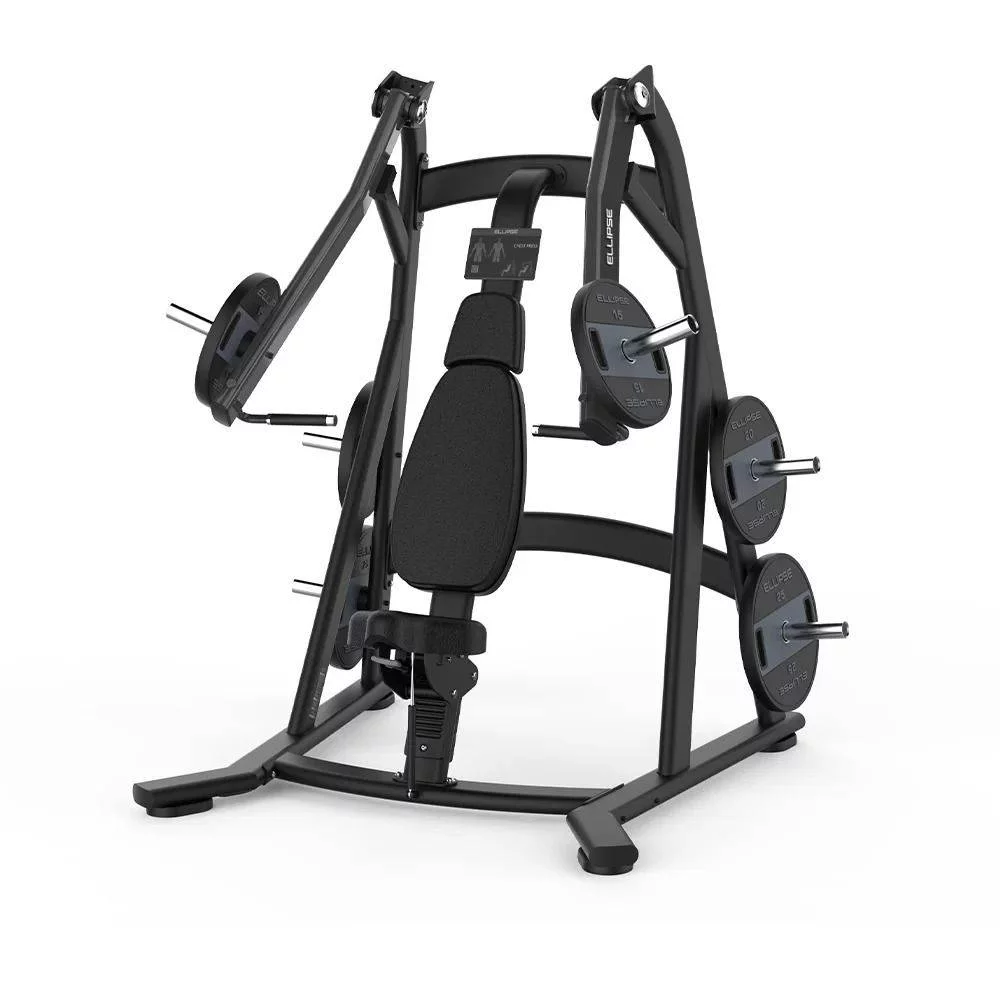
Plate-loaded machines are different. The load is provided by Olympic discs on loading pins, but the movement itself runs on a guided path defined by the machine. They combine the loading feel and the load range of free weights with the trajectory control of a machine, which is why they sit between the two worlds and are often the most productive part of a strength area.
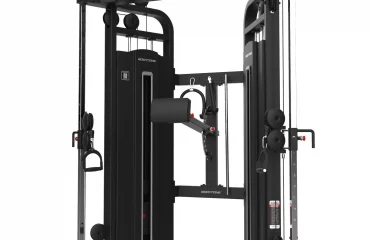
It is worth being precise here, because two families are regularly filed under free weights and do not belong there. A Smith machine is a barbell running in fixed rails: the load is discs, but the path is guided, so it is a guided machine with a free-weight feel. Cable stations are guided resistance too, with the load carried by a stack or by plates and transmitted through pulleys. Both are useful, both belong in a complete room, and neither replaces a genuine free-weight zone. Confusing the categories at specification time is how a room ends up without a single barbell.
What the area delivers for the operator
Recruitment of stabilising muscles is the technical argument. Because nothing guides the bar, the body has to control the path, which trains coordination and transfers well to sport and to everyday effort. Rehabilitation and return-to-sport programmes use that property deliberately, in the later phases and under supervision.
Range of exercise is the operational argument. A rack, a bar, a set of plates and a bench cover squat, deadlift, bench press, overhead press, row and dozens of variations. No other family of equipment covers so much ground per square metre of investment.
Cost per station is the financial argument. Free-weight stations are among the least expensive to install in absolute terms, and they scale: adding load means adding plates, not machines. In exchange they demand more space, more storage and more supervision than a guided circuit, which is where the real cost sits.
The equipment families to plan for
Barbells and plates
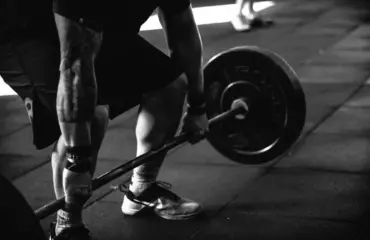
The bar is the backbone of the area. Specification covers knurling, sleeve rotation, shaft diameter and rated load, and the choice of bumper plates or cast discs follows the intended use: lifting and dropping requires bumpers and a platform, general strength work does not. Our professional Olympic barbells range covers the usual configurations for commercial rooms.
Dumbbells and kettlebells
Fixed dumbbell sets serve the widest audience, because nothing has to be assembled and nothing gets lost. Kettlebells add swings, cleans and carries and take almost no floor space. Both need a rack or a stand of their own: a set stored on the floor becomes a trip hazard within a week.
Racks, cages and benches
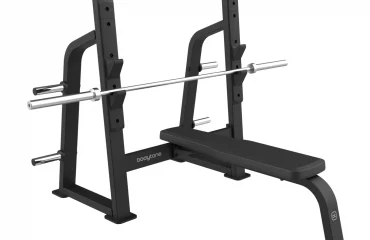
Racks and power cages are the safety infrastructure of the zone. Adjustable safeties, solid uprights and correct anchoring are what allow a user to fail a lift without consequence. Benches follow the same logic: pad density, stability and adjustment range decide whether the station is usable by everyone. See our racks and power cages for the configurations used in commercial rooms.
Plate-loaded machines
Plate-loaded stations extend the area without extending the supervision burden, since the path is guided while the loading stays familiar. They suit performance zones and rooms with trained users, and they are usually specified alongside the racks rather than instead of them. Our plate-loaded machines cover the main pressing, pulling and leg movements.
Planning the zone in a professional facility
Space is the first constraint and the one most often underestimated. Every rack needs clearance for the bar, for the lifter and for someone walking past, and a deadlift or lifting area needs a defined footprint that nothing else crosses. A zone that is too tight is not merely uncomfortable, it is unsafe.
Flooring is the second. Free-weight areas need a floor sized for impact and for point loads, with a heavier specification under racks and lifting platforms than under the rest of the room. This is a structural decision taken with the layout, not a finish chosen at the end.
Storage is the third, and it is the one that determines whether the zone still looks like the day it opened after six months. Every plate, bar, dumbbell and kettlebell needs a defined home within a few steps of where it is used. Without that, the area degrades quickly and the risk of injury rises.
Supervision is the fourth. A free-weight zone should be visible from the reception or the instructor position, and it should be placed so that beginners are not funnelled through it on their way to the cardio area. Where the audience is mixed and unsupervised, the sensible answer is to reduce the free-weight zone and extend the guided offer rather than hope for the best.
How to arbitrate for your facility
For hotels, campsites and residences, a compact selection of dumbbells with a rack, one or two adjustable benches and a small guided offer is usually the right level. A full lifting area serves nobody there and creates a liability.
For clubs and training centres, the free-weight zone is a differentiator and should be sized on peak attendance: number of racks first, then bars and plates, then benches, then plate-loaded stations to absorb the overflow.
For performance, military and return-to-sport facilities, the zone is the core of the programme, and specification moves towards heavier bars, bumper plates, platforms and racks with generous safety adjustment.
Frequently asked questions
Are free weights better than guided machines?
They are not better, they are different. Free weights recruit stabilisers and cover more movement patterns; guided machines are faster to use, safer without supervision and better for high user flow. A complete facility uses both, in proportions that follow the audience.
Is a Smith machine free-weight equipment?
No. The bar is loaded with discs but it runs in fixed rails, so the trajectory is guided. It is a useful piece of equipment, particularly for unsupervised pressing and squatting, but it does not replace a rack and a barbell.
How much space does a free-weight area need?
More than the equipment footprint suggests. Clearance around each rack, a circulation route that does not cross the lifting axis and a defined storage position for every item all have to be drawn on the plan. The right figure comes from the layout, not from a catalogue.
What flooring is required?
A specification sized for impact and point loading, heavier under racks and lifting positions than in the rest of the room. It protects the slab, limits noise transmission to neighbouring spaces and keeps benches and racks stable.
Plan your strength area with us
A free-weight and plate-loaded zone is a layout question before it is a purchasing question. Tell us the surface available, the audience and the level of supervision, and our team will propose a coherent configuration with the flooring and storage that go with it. Request a quote and we will come back with a costed plan.