Fitness Trail Equipment: The Complete Guide
A fitness trail is the most cost-effective way to bring structured physical activity to an open site. A walking or running loop, a series of stations along it, clear instruction panels, and a facility that works for a retired resident at nine in the morning and for a rugby club at seven in the evening. This guide covers the equipment families, what each one is for, how the standards apply, and the specification mistakes that cost operators money.
The five families of fitness trail equipment
Every well-designed circuit draws on five families. A trail that uses only one of them looks cheap on paper and empties out within a season.
Cardio stations
These improve cardiovascular capacity and burn a significant amount of energy per session. The most widely installed units are air walkers, ski machines and cross trainers. They are the easiest stations for a first-time user to approach, which is why they usually belong at the start of a circuit.
Guided strength stations
These build muscle, improve muscular endurance and support bone health. Chest press, lateral pull and leg press units are the classics. Resistance comes from the user’s own body weight or from a hydraulic cylinder, so there are no weight stacks to steal, jam or maintain.
Bodyweight and calisthenics equipment
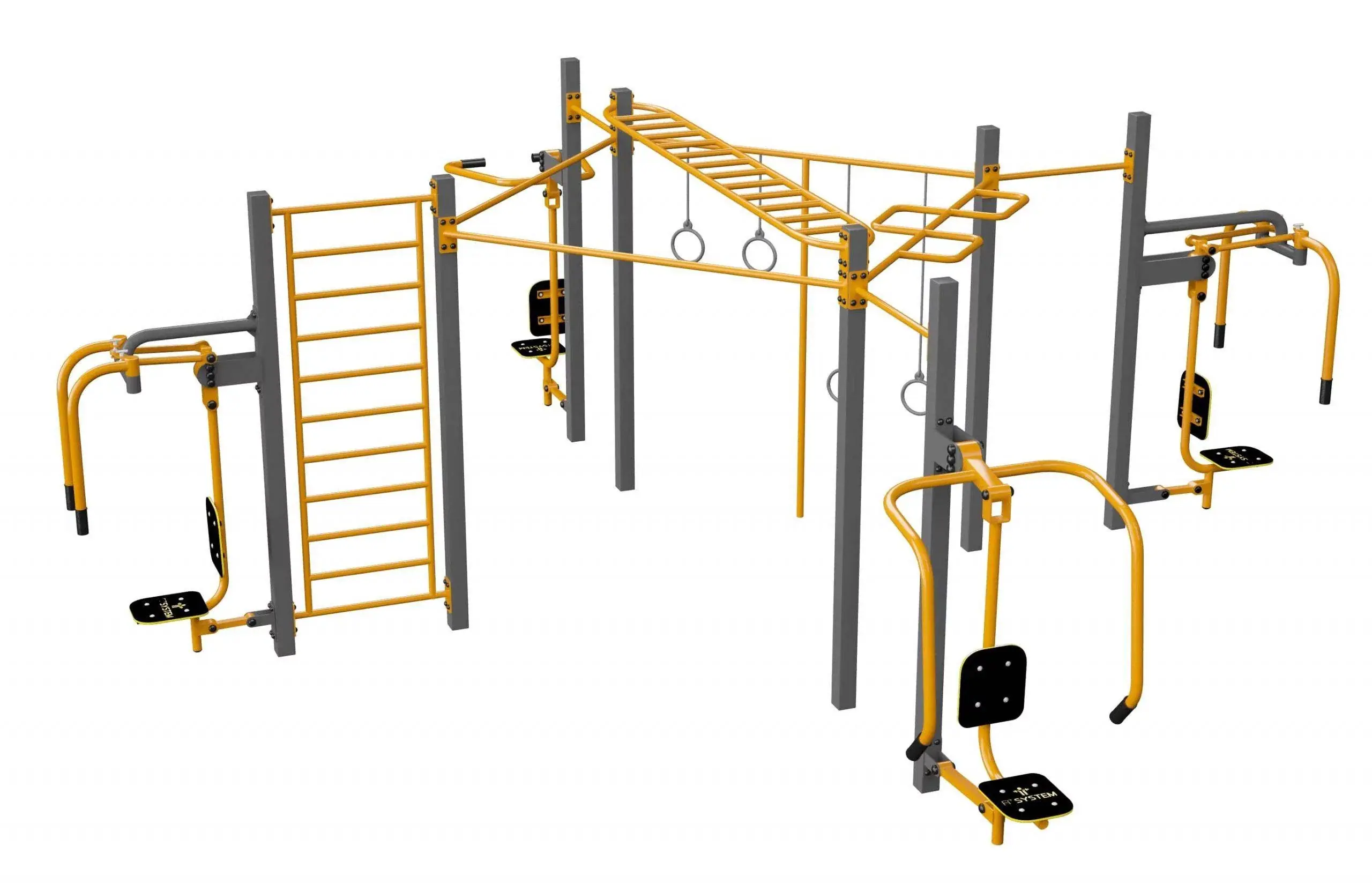
Pull-up bars, parallel bars and monkey bars suit users who want high-intensity work with no adjustment and no settings. This is the family with the highest throughput at peak hours and the one that attracts the youngest users. Our street workout and calisthenics cages group these elements into a single structure when the available footprint is limited.
Balance equipment
Balance beams, balance discs and balance boards improve stability, strengthen the trunk and reduce the risk of falls. On sites with an older user base, this family carries more public-health value than any other, and it is the one most often left out of a specification.
Flexibility and stretching equipment
Stretching posts, stretching benches and stretching frames improve range of motion at the muscles and joints. Two units, one at the start of the loop and one at the end, are enough to change how the whole circuit is used.
Why operators choose a fitness trail
The case for a trail is not only about fitness. It is about who gets served. Traditional gym sessions are too intense for a large share of the population, and a trail lets each user set their own pace, which brings in older adults and people with no sporting background. Group use follows naturally: families, walking clubs and rehabilitation groups use the same stations one after another without any booking system.
The operating economics are the second argument. Once installed, the equipment needs only periodic inspection and tightening, has no running costs, no supervision requirement and no subscription to administer. Spread across ten years and thousands of users, the cost per session is a fraction of any indoor equivalent. Our fitness trail stations are built specifically for that duty cycle.
Standards, surfacing and site requirements
Equipment installed for unsupervised public use falls under a defined framework. For permanently installed outdoor fitness equipment intended for adults, the European reference standard is EN 16630, covering safety requirements, entrapment, structural strength and installation. Children’s play equipment is a separate world: EN 1176-1 applies to the equipment and EN 1177 to the impact-attenuating surfacing. Never apply EN 16630 to a children’s unit, and never treat the two surfacing regimes as one.
Three site questions decide the layout. What is the free height of fall at each station, which determines the surfacing? How much clearance does each unit need around it, so two users are not in each other’s way? And is the circuit reachable by a wheelchair user, which is a design decision made at plan stage and not a retrofit. The outdoor fitness trail range includes accessible stations designed to be used from a seated position.
Guidance for users, and what to put on the panels
The instruction panel on each station is the only coaching most users will ever receive, so it has to carry the essentials. Users should know their own limits and start with lower resistance, increasing progressively as condition improves. A proper warm-up prevents strains and sprains. Hydration matters before, during and after the session. Anyone with an underlying health condition, or new to exercise, should get medical clearance before starting a programme. And every user should look over the equipment before use: a loose fixing or a damaged part is a hazard, and reporting it is faster than repairing an injury.
Building an effective session on the circuit
Set a clear objective, whether that is endurance or strength, and be consistent about turning up. A balanced programme mixes all five families rather than repeating the two easiest stations. Interval work, alternating hard efforts with recovery, suits users chasing conditioning and calorie expenditure. Circuit training, moving through a sequence of stations with minimal rest, keeps the heart rate elevated and builds muscular endurance. Both formats are exactly what a trail layout is designed to support, which is why station order matters as much as station choice.
Mistakes to avoid
- Skipping the warm-up and the cool-down. The most common cause of avoidable injury on public equipment.
- Poor execution. Performing an exercise incorrectly, often to keep up with someone else, turns a good station into a hazard.
- Too much resistance too soon. Progress comes from consistency, not from the highest setting on day one.
- Neglecting stretching and hydration. Both are free and both shorten recovery.
- On the specification side, buying a single family. Six pull-up bars is not a fitness trail; it is a rig with a long walk between elements.
Frequently asked questions
How many stations does a fitness trail need?
It depends on the length of the loop and the expected number of simultaneous users, not on a fixed number. The useful rule is coverage: every one of the five families should appear at least once before any family appears twice.
Can a fitness trail be used by older adults?
Yes, and they are often the largest user group. Self-paced resistance, seated stations and balance equipment make the format far more suitable for older users than a conventional gym floor.
Does the equipment need supervision?
No. Trails are designed for free, unsupervised access. That is precisely why the standard framework, the clearance zones and the instruction panels do the work an instructor would otherwise do.
What maintenance is involved?
Periodic visual inspection, checking and tightening of fixings, and inspection of moving parts and surfacing. Intervals shorten on coastal sites and on heavily used installations.
Specifying your circuit
The right station list depends on the length of your loop, the profile of your users and the budget you are working to. Send us the site plan and we will return a layout, an equipment schedule and a price. Request a quote and our team will build the proposal around your site rather than around a catalogue page.
Réalisations documentées
- Parcours ninja sur mesure, Rennes – îlot des Hautes-Ourmes
- Double mur ninja extérieur, Sallanches – Haute-Savoie