The Dip Station: Technique, Muscles and Specification
La station à dips guidée permet de travailler triceps et pectoraux bas avec assistance ou charge additionnelle, sans exiger la maîtrise du dips libre. Le réglage de la largeur des poignées modifie la répartition entre les deux groupes musculaires. C'est un poste à faible emprise, adapté aux salles contraintes.

The dip is one of the oldest and most efficient upper-body pressing patterns, and one of the few that costs almost nothing in floor area. Two parallel bars, a body and gravity: that is the whole mechanism. For a facility, the interesting question is not whether to offer it – almost every member programme includes a vertical press – but in which form: fixed bars, an assisted station, or a plate-loaded dip machine. This article covers what the movement loads, how it should be executed, the mistakes that generate injuries and complaints, and what to look at before ordering.
What the dip actually trains
The dip is a closed-chain vertical press. The body descends between two bars and is pushed back up by the arms. Three groups do the work:
- Pectoralis major, lower fibres – the more the torso leans forward, the greater their share.
- Triceps brachii – the more upright the torso and the closer the elbows stay to the body, the greater their share.
- Anterior deltoid – assists the press throughout the range.
The scapular stabilisers and the trunk work isometrically to hold the body still. That stabilisation demand is what makes the dip harder than a machine press at the same load, and also what makes it unsuitable for some members without assistance.
| Variant | Torso position | Main emphasis |
|---|---|---|
| Upright dip | Torso vertical, elbows close | Triceps |
| Leaning dip | Torso inclined forward | Lower pectorals |
| Assisted dip | Counterweight supports part of body mass | Same pattern, reduced load |
| Weighted dip | Belt or vest adds external load | Same pattern, increased load |
Correct execution
- Start position. Hands on the bars, arms extended and locked, shoulders pulled down and away from the ears, trunk braced, legs held still.
- Descent. Lower under control until the elbows reach roughly ninety degrees. This is the working range for the great majority of users.
- Press. Push back up to full extension without bouncing out of the bottom position and without swinging the legs.
- Tempo. Slow and controlled beats fast and partial. Momentum removes the load from the muscle and puts it on the joint.
On depth: going deeper is not automatically better. Descending far below the point where the upper arm passes the horizontal loads the anterior shoulder capsule and the long head of the biceps tendon in a position where they have little support. Depth should be set by the user’s shoulder mobility, not by a rule that says lower is always better – and in a public facility, the coached instruction should be the ninety-degree range.
Common mistakes and how to prevent them
- Shoulders shrugged toward the ears. Removes the scapular support and transfers load to the joint. Cue: chest up, shoulders down, before the first repetition.
- Uncontrolled torso swing. Turns a strength exercise into a momentum exercise. Cue: still legs, braced trunk.
- Range that changes during the set. Usually a sign the load is too high. Reduce the load, or move the member to an assisted station.
- Excessive added load too early. Weighted dips belong after the body-weight version is clean across full sets, not before.
Which equipment for which facility
The choice of station follows the membership, not the catalogue.
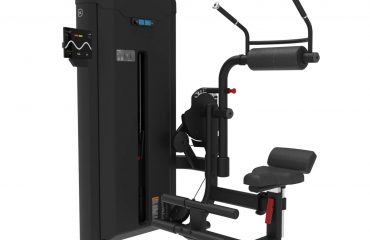
- Assisted chin-dip station. A counterweight carries part of the body mass, so a beginner can perform the same pattern with correct technique from the first session. This is the format that makes the dip available to the whole membership rather than to the strongest third of it. The weight-assisted chin-dip station is the typical example.
- Seated or plate-loaded dip machine. A guided path with a selectable or plate load, useful where supervision is limited or where the movement is being reintroduced after injury. The triceps dip station covers this use.
- Bars integrated into a rig. The lowest cost per user and the natural choice for cross-training rooms and for outdoor installations. See the street workout and calisthenics cages range.
Specification checklist
- Standards. Indoor stations should be supplied to EN ISO 20957-1 class S. Outdoor adult equipment falls under EN 16630, which is a different standard with different structural and installation requirements – the two are not interchangeable.
- Bar spacing. Fixed-width bars suit a narrow range of body sizes. Adjustable or slightly converging bars serve a wider membership and change the balance between triceps and pectorals.
- Grip diameter and finish. A grip that is too thick or too polished causes the hand to fail before the muscle does.
- Assistance increments. On an assisted station, check the smallest step of the counterweight: too coarse an increment strands beginners between two settings.
- Footprint and access. Dip stations are compact, which is exactly why they get pushed into corners. Leave clearance to step on and off and for staff to coach from the side.
Frequently asked questions
Are dips suitable for beginners?
Not in their free form for most beginners: the full body mass is a high entry load and technique degrades quickly. On an assisted station the same pattern becomes accessible from the first session.
Dips or bench press?
They are complementary, not interchangeable. The bench press is an open-chain horizontal press with an external load; the dip is a closed-chain vertical press against body mass, with a much higher stabilisation demand.
How do you make dips harder once body weight is easy?
Add external load with a dip belt or a weighted vest, or slow the descent. Both are preferable to adding repetitions indefinitely.
Do dips belong in an outdoor installation?
Yes, and they are one of the most used stations on calisthenics structures. The equipment must be specified for outdoor use, with the corresponding standard, materials and foundation, not simply moved outside.
Choosing your dip station
Free bars, assisted station or plate-loaded machine: the right answer depends on your members, your supervision level and your available floor area. Send us your plan and your usage brief and we will return a configured proposal – request a quote.
Réalisations documentées
- Cage street workout ultime, Carcassonne – armée française
- Cage street workout ultime, Tahiti – armée française, Polynésie
- Cage SP Max, centre EPIDE de Combrée – établissement public d’insertion
- Cage SP Max, lycée Saint-Bénigne de Dijon – établissement scolaire