Dead hang: how long to hold, benefits and a four-week programme
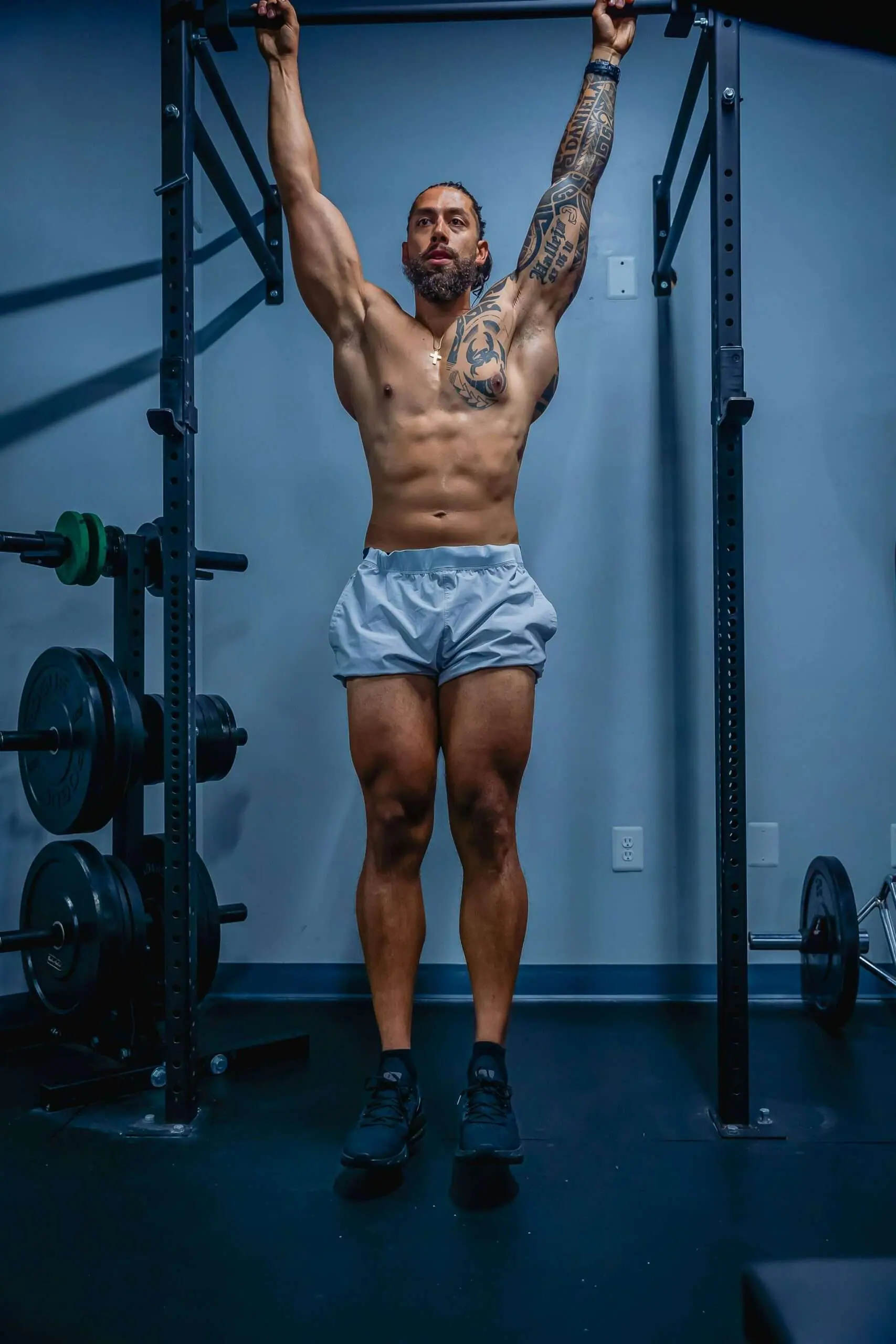
How long should you hold a dead hang? A beginner manages 10 to 20 seconds, an intermediate trainee 30 to 60 seconds, and an experienced athlete more than a minute — with 60 seconds of continuous hanging being the widely used benchmark to aim for. The dead hang (a passive hang from a bar with straight arms) is one of the most underrated exercises in fitness: it builds grip strength, gently decompresses the spine, improves shoulder mobility and posture, and requires nothing but a pull-up bar and zero technical skill. This guide covers target times by level, the benefits supported by research, correct technique and a four-week progression.
What exactly is a dead hang?
You hang from a horizontal bar with arms fully extended, body relaxed and feet off the floor. It is an isometric exercise: the muscles work statically, without visible movement — yet the forearms, shoulders, lats, trapezius and the whole trunk are heavily engaged. Two main variants exist:
- Passive dead hang: hang relaxed, shoulders allowed to rise slightly — best for stretching and grip endurance.
- Active dead hang: pull the shoulder blades down, away from the ears — works the back and shoulder stabilisers harder.
How long to hold, by level
| Level | Duration per set | Sets | Frequency |
|---|---|---|---|
| Beginner | 10-20 seconds | 3-4 | 2-3x per week |
| Intermediate | 30-45 seconds | 3-4 | 3-4x per week |
| Advanced | 60-90 seconds | 3-5 | 4-5x per week |
| Expert | 2 minutes and beyond | Goal-dependent | Daily possible |
Start by accumulating 60 seconds of total hang time per session across several sets, then progress towards 60 seconds in a single hold. Complete beginners can start at 8-12 seconds and add 2-5 seconds per week.
The benefits, honestly stated
- Grip strength. The dead hang is the simplest grip builder there is. In one study on climbers, four weeks of weighted hangs produced significant gains in grip strength and endurance. Observational research also correlates grip strength with overall health outcomes in adults — a correlation, not a guarantee, but a useful functional marker.
- Spinal decompression. Gravity gently tractions the spine during the hang. Many people who sit for long hours find it immediately relieving. It is a comfort and mobility effect — not a treatment for spinal pathology; seek medical advice for persistent back pain.
- Shoulder mobility and health. The overhead position takes the shoulders through full extension, releasing tension and maintaining range of motion — valuable for lifters, boxers and calisthenics athletes.
- Upper-body and trunk endurance. Without moving, you engage forearms, wrist flexors, rotator cuff, rhomboids, lats, trapezius and the abdominal wall. Isometric work of this kind also builds functional endurance.
- Posture. Strengthening the muscles that hold the spine and shoulder blades aligned helps counteract the rounded, desk-bound position over time.
Correct technique, step by step
- Set-up: stand on a bench or step under the bar. Take a pronated grip (palms forward), hands shoulder-width apart.
- Hang: step off the support, arms fully extended, feet off the floor.
- Engage: keep the trunk lightly braced to avoid excessive swinging and protect the shoulders.
- Breathe: calmly and continuously — never hold your breath.
- Dismount: return to the support under control; do not drop.
Avoid: bending the elbows, holding your breath, swinging, and pushing through joint pain in shoulders, elbows or wrists — stop if pain appears.
A four-week programme: zero to 60 seconds
| Week | Target per set | Sets x rest | Sessions | Focus |
|---|---|---|---|---|
| 1 | 10-15 s | 4 x 60 s rest | 3 | Grip familiarisation, breathing, posture |
| 2 | 20-25 s | 4 x 45 s rest | 3 | Trunk engagement, stability |
| 3 | 30-40 s | 3 x 45 s rest | 4 | Grip endurance, alternate active hangs |
| 4 | 45-60 s | 3 x 30 s rest | 4 | Max attempt, introduce mixed grip |
End each session with one clean-form set to failure and log your times.
Variants once 60 seconds is easy
- Active hang — scapulae drawn down throughout.
- Mixed grip — one palm forward, one back.
- Single-arm hang — advanced; requires excellent stability.
- Weighted hang — vest or dip belt, replicating the climbers’ protocol.
The dead hang is also the natural foundation for pulling work: our complete pull-up guide takes over where the one-minute hang ends.
Who benefits most?
- Street workout and calisthenics athletes — the foundation for pull-ups and muscle-ups.
- Desk workers — spinal traction and postural relief after long sitting.
- Combat-sport athletes — grip for grappling and clinch work.
- Older adults — maintaining functional grip strength, with a secure step and supervision as needed.
Shoulder safety: who should progress carefully
The dead hang is low-skill but not zero-risk. Three profiles should build up gradually or seek advice first:
- Existing shoulder conditions. Impingement, instability or a history of dislocation can be aggravated by a fully passive hang; start with feet-assisted partial hangs (feet lightly supported on a box, taking 30-50 % of body weight) and progress only pain-free.
- Heavier users returning to training. Grip and connective tissue need weeks to adapt; assisted hangs and short frequent sets beat rare maximal attempts.
- Hypermobile users. Favour the active hang from day one — scapulae engaged — rather than hanging passively on lax ligaments.
For everyone, the two golden rules are painless range only and a controlled dismount onto a support — most hanging injuries happen on the drop, not the hang.
Fitting hangs into a training week
The dead hang slots into almost any programme without displacing anything:
- As a warm-up: 2 x 20-30 seconds before upper-body sessions primes grip and opens the shoulders.
- As a finisher: one max hold after pulling work, logged week to week — a simple, motivating progress metric.
- As a desk-break reset: a bar at home turns two or three 30-second hangs into daily spinal decompression.
- In group formats: hang holds pair naturally with farmer carries and bottom-up kettlebell work in grip-themed blocks.
Frequently asked questions
Is a 30-second dead hang good?
Thirty seconds is a solid intermediate marker. Under 30 seconds suggests upper-body and grip strengthening will pay off quickly; over 60 seconds puts you in the well-trained range.
Can I do dead hangs every day?
Short accumulated hangs (2-5 minutes of total time) are well tolerated daily by most trained people. Beginners should start at 2-3 sessions per week and let tendons adapt — connective tissue adapts more slowly than muscle.
Does the dead hang fix back pain?
It provides comfortable spinal traction that many people find relieving, but it is not a medical treatment. Persistent or acute back pain warrants professional assessment before any hanging work.
What equipment do I need?
Any stable pull-up bar rated for your weight: a doorway bar at home, or a rack, rig or wall-mounted bar in a facility. In commercial settings the structure should be certified and properly anchored — see our note on freestanding rigs without drilling for premises where anchoring is impossible.
Equip your hanging and pulling zone
Light In Fitness supplies certified pull-up bars, racks, rigs and street-workout structures for clubs, boxes, municipalities and home facilities — with delivery and installation across Europe. Request a free quotation within 24 working hours.
Réalisations documentées
- Cage street workout ultime, Carcassonne – armée française
- Cage street workout ultime, Tahiti – armée française, Polynésie
- Cage SP Max, centre EPIDE de Combrée – établissement public d’insertion
- Cage SP Max, lycée Saint-Bénigne de Dijon – établissement scolaire
Sources et références
- NF EN 16630 – modules fixes d’entraînement physique de plein air : exigences de sécurité et méthodes d’essai (AFNOR)
- Code du sport, article L322-2 – garanties d’hygiène et de sécurité des établissements d’activités physiques et sportives (Légifrance)