Gym equipment replacement cycle: renewing a failing fleet
A fleet chosen on purchase price rather than total cost of ownership usually fails at 18 to 24 months, not in year one. This case study follows a mid-market independent club, roughly 800 active members over 500 to 700 m2, that reached its second year with treadmills out of service for weeks at a time, spare parts on three to four week lead times, and a measurable effect on cancellations. It sets out the diagnosis, the three-wave replacement plan that kept the club trading throughout, and the indicators tracked twelve months later.
Why under-specified fleets collapse at 24 months
France has around 4,300 fitness clubs (FIFAS, 2024 survey), and many equip their first installation with machines sold at entry pricing. The initial logic looks sound: save 30 to 40% on capital expenditure to protect cash flow in the opening months.
One point of vocabulary needs correcting first, because it drives the whole error. There is no such thing as a semi-professional class of equipment. EN ISO 20957-1:2024 defines usage classes, and only two matter to a buyer here: class H is designed for domestic use, class S for studio and commercial use. Class I covers inclusive equipment, and classes A, B and C denote accuracy levels. Machines marketed as semi-professional are class H equipment being sold for class S duty, and the failure pattern follows from that mismatch.
Genuinely professional equipment is designed for a 10 to 15 year service life with preventive maintenance, or 20 years on heavy steel frames. Class H equipment placed in commercial service shows heavy wear from around 18 months, noisy bearings, frayed cables, cracked upholstery, and is finished in three to five years.
The diagnosis of the existing fleet
| Item | Condition found | Operational impact |
|---|---|---|
| Treadmills (6) | 2 out of service, 3 with abnormal motor noise, 1 fully working | Queues on cardio at peak times |
| Indoor cycling bikes (10) | Magnetic brakes failing on 4, torn saddles on 6 | Impossible to run full classes |
| Cross trainers (4) | Excessive play in articulated arms, bearings at end of life | Member complaints about instability |
| Selectorised machines (12) | Frayed cables on 5, cracked padding | Safety risk identified, 3 machines taken out of service |
| Spare parts | Three to four week lead time, imported from outside the EU | Cumulative machine downtime of 30 to 60 days a year |
| Rubber flooring | Tiles lifting under heavy machines, accelerated wear at impact points | Vibration transmission and noise complaints from adjacent areas |
| Maintenance contract | None, repairs handled case by case | No budget visibility, response time dependent on the supplier |
The hidden link between breakdowns and cancellations
According to IHRSA survey data, 43% of gym users cite equipment quality as their first criterion when choosing a club, ahead of price, opening hours or atmosphere. The logical corollary is that faulty or unavailable equipment becomes a reason to cancel.
The path is almost always the same. A machine fails, the member substitutes or waits. Visit frequency drops, and 15 to 30 days without attendance is a strong early signal of disengagement in sector CRM data. Renewal is deferred, then cancelled at the contract term.
The arithmetic is worth stating precisely, because the French source states it loosely. On an 800 member file, moving monthly churn from 4% to 6% means 16 additional cancellations a month, not a two point annual change. At 80 to 95 EUR a month, that is 1,280 to 1,520 EUR of recurring revenue lost in the first month alone, and the effect compounds if recruitment does not keep pace. Against that, the initial saving on an under-specified fleet is recovered within a single year of elevated churn.
The replacement strategy: three waves, one supplier
Rather than replacing everything at once, which means both a cash shock and a partial closure, the renewal ran in three waves over four months, sequenced to keep the club open continuously.
Wave 1, cardio zone, month 1. Replaced first because it is the most visible and most used area. A cardio fleet sized for more than 10 hours of daily operation: wide-belt treadmills, professional bikes, cross trainers and rowers. The old fleet was removed in a day and the new one installed immediately after.
Wave 2, cycling and group exercise, month 2. Indoor cycling bikes replaced to secure the profitability of group classes, a structural revenue segment in mid-market clubs. Belt drive, heavy flywheel, dual-adjustment saddle and handlebars: comfort here directly determines class occupancy.
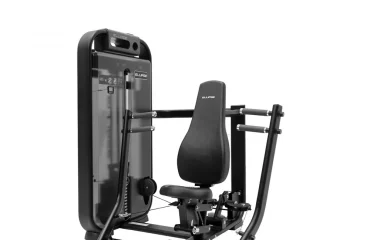
Wave 3, selectorised strength and flooring, months 3 to 4. Selectorised machines replaced with a professional stack-loaded series, plus a converging plate-loaded range for the free-loading zone. New 20 mm rubber tile flooring laid in the loading zones to absorb impact and limit vibration.
Running deliverable, preventive maintenance contract. An annual preventive contract covering the whole fleet, with a wear-part stock held in France: cables, upholstery, elastomers. Target lead time brought from three to four weeks down to 48 hours.
Results measured at twelve months
| Indicator | Outcome |
|---|---|
| Service incidents | Down 80% against the previous fleet, on a 12 month rolling basis |
| Wear-part lead time | 48 hours average, against three to four weeks previously |
| Expected service life of the new fleet | 10 to 15 years with preventive maintenance |
| Annual maintenance budget | 2 to 4% of fleet value, against unbudgeted emergency replacements previously |
These figures are specific to this case and are not transferable as they stand. They do illustrate the underlying logic: the real cost of an under-specified fleet never appears in the original quotation. It shows up in maintenance schedules, in member complaints and, above all, in the cancellation rate at 24 months.
Six decisions that structure a fleet renewal
Calculate total cost of ownership over seven years, not purchase price: our treadmill TCO breakdown shows the method. Verify the usage class on the declaration of conformity, and refuse class H equipment for commercial duty. Confirm where wear parts are stocked and what the contractual lead time is, before signing. Phase the replacement by zone so the club never closes. Sign the preventive maintenance contract at the same time as the equipment, not after the first failure. And replace the flooring under heavy machines at the same time, because a lifted tile field will damage a new fleet the way it damaged the old one.
Frequently asked questions
When should a commercial fleet be replaced?
Professional class S equipment with preventive maintenance runs 10 to 15 years, and heavy steel frames up to 20. The trigger is rarely age alone: it is the point where cumulative downtime, wear-part availability and member complaints start costing more than the residual value of the fleet. Track incidents per machine per year and you will see the crossover before the accountant does.
Is it cheaper to refurbish than to replace?
On a class S fleet with parts available, often yes: cables, upholstery, bearings and consoles are all serviceable. On class H equipment that has been running in commercial duty, no. The frame and the drive are the parts that failed, and those are not economically replaceable.
What should a preventive maintenance budget be?
Two to four per cent of fleet value per year is the working band for a commercial club. Without a preventive plan, corrective repairs cost several times that figure and always arrive at the worst moment. See the cardio machine maintenance schedule.
Can a renewal be done without closing?
Yes, and it should be. Phasing by zone over three to four months lets each area be stripped and reinstalled within a day, so members always have an alternative. The constraint is delivery scheduling and access, which is why removal and installation belong in the same contract as the supply.
Have your existing fleet audited
Light In Fitness has been a manufacturer and B2B distributor of professional fitness equipment since 2013, based at 6-8 rue Victor Laloux in Tours, France, with more than 2,500 customers equipped. We audit existing fleets, quantify downtime and part availability, and phase a renewal that keeps the club trading, with wear parts held in stock and warranties of 2 to 5 years by range, 20 years on steel frames and lifetime on stainless steel. Browse the cardio equipment and strength training machines ranges, or request a quote. We reply within 24 working hours.
Réalisations documentées
- Cage street workout ultime, Carcassonne – armée française
- Cage street workout ultime, Tahiti – armée française, Polynésie
- Cage SP Max, centre EPIDE de Combrée – établissement public d’insertion
- Cage SP Max, lycée Saint-Bénigne de Dijon – établissement scolaire
Sources et références
- NF EN ISO 20957-1 – équipement d’entraînement fixe, partie 1 : exigences générales de sécurité et méthodes d’essai (AFNOR)
- AFNOR Normalisation – dossier thématique sur les appareils d’entraînement fixes et leurs classes d’usage
À lire aussi sur le même thème
- The European Fitness Standards Map: Every Standard That Applies to Your Facility
- GDPR for gyms: member data, biometrics, badges and CCTV
- Measuring the ROI of a fitness floor: formulas, benchmarks and a recalculable scenario
- How Cultures Around the World Approach Sport and Fitness: France, Scandinavia, Asia and the Mediterranean