Choosing the Right Strength Machines for Muscle Gain
Le gain de masse musculaire dépend de la surcharge progressive et du volume de travail, pas du type de machine utilisée. Les machines guidées permettent d'accumuler ce volume en sécurité, les charges libres développent en plus la stabilisation. Un plateau complet associe les deux familles.

Muscle mass is built by progressive overload and accumulated training volume, not by any particular brand of machine. That single fact should govern how you equip a strength floor. Guided machines let users accumulate that volume safely and without a spotter; free weights add the stabilisation work that guided paths remove. A complete floor uses both. This guide walks through the machine families by muscle group and sets out the criteria that actually matter when you are choosing between them.
Guided machines or free weights?
The question is usually posed as a rivalry. On a commercial floor it is a question of coverage.
- Selectorised machines fix the movement path. A beginner can train close to failure without technique collapsing and without a partner. Adjustment takes seconds, which is what makes circuit programming possible.
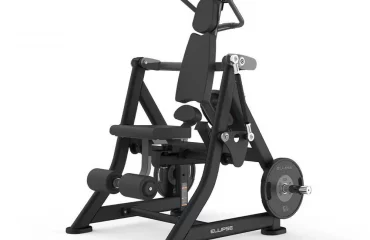
- Plate-loaded machines keep a guided path but load with olympic plates. They suit stronger users, tolerate heavier absolute loads and give a different resistance feel through the range.
- Free weights demand stabilisation, recruit more supporting musculature and transfer better to sport. They also need more supervision, more floor area and heavier flooring.
For a mixed membership the ratio is what you are really deciding. A club serving beginners and general fitness leans towards selectorised coverage; a facility with an athletic or CrossFit-adjacent membership pushes plate-loaded and free-weight capacity up.
Machine families by muscle group
Legs and glutes
The squat pattern is the foundation, which means a rack, a bar and a floor that can take the load. Around it, the leg press and the quadriceps and hamstring stations let users train the same musculature at controlled angles, which matters for beginners, for rehabilitation and for anyone training without supervision. Glute-specific stations have moved from optional to expected in most commercial specifications.
Back and chest
Lat pulldown, seated row, chest press and pec deck cover the majority of upper-body demand on a general floor. These are the stations that queue at peak hours, so duplication here is usually a better investment than adding an exotic single station.
Shoulders and arms
Shoulder press, lateral raise and dedicated biceps and triceps stations. Individually low-traffic, collectively the difference between a floor that feels complete and one that does not.
Core
Abdominal crunch machines let users load the trunk progressively, which floor work alone does not allow beyond a point. They complement rather than replace bodyweight crunches and raises. Note that no amount of abdominal work removes fat from around the abdomen; visible definition is a body-composition outcome, and it is worth having your coaching staff say so plainly.
Multi-station units
Where floor area or supervision is limited, a multi-station gym puts several exercises on one footprint with one set of weight stacks. Hotels, residential buildings, corporate rooms and small municipal facilities are the typical fit.
Where cardio fits
Cardio equipment does not build muscle mass, and it should not be sold as if it did. It supports conditioning, recovery and body composition, and for most members it is the entry point to the facility. Treadmills, cross trainers and rowing machines each recruit differently: a rower involves the legs, trunk and arms in one chain; a cross trainer spreads load across the body with low joint impact; a treadmill is the most specific to running. Plan the cardio zone as a separate capacity question from the strength floor, not as a leftover.
Selection criteria that matter in a commercial specification
| Criterion | What to check | Why it matters |
|---|---|---|
| Standard | EN ISO 20957-1 class S for indoor equipment | Commercial duty and supervised-use construction |
| Weight increments | Range of the stack and size of each step | Too coarse a step stalls progression for lighter users |
| Adjustment | Number of adjustments and time each takes | Determines throughput at peak hours |
| Range of motion | Whether the path suits short and tall users | An unusable station is dead floor area |
| Contact surfaces | Upholstery, grips, guide rails | These wear first and are what members notice |
| Footprint | Machine envelope plus user and circulation space | Catalogue dimensions are not installed dimensions |
Frequently asked questions
Do machines build less muscle than free weights?
Not inherently. Given equal effort and equal progressive loading, both produce hypertrophy. Free weights add stabiliser recruitment; machines add safety and accessibility. The difference matters most for athletic transfer, least for general members.
How many stations does a floor need?
It depends on peak concurrent users, not total membership. Count the busiest hour and design for it, then duplicate the stations that queue rather than adding variety.
Can beginners use plate-loaded machines?
Yes, with an induction. The limiting factor is plate handling and loading discipline rather than the movement itself.
Is a multi-station enough on its own?
For a hotel, a residential gym or a small corporate room, often yes. For a members club it will not carry peak demand, because only one or two users can work at once.
What should be specified first?
The floor and the layout. Machines can be added and swapped; a flooring build-up and a circulation plan cannot be changed without closing the room.
Building your equipment list
Tell us your surface area, your peak occupancy and the profile of your users, and we will build the station list and the layout together. Our strength training machines and plate-loaded machines cover both halves of that specification. Start on our quotation request page.