How to Choose a Professional Gym Equipment Manufacturer
Choosing a manufacturer to equip a gym, a public facility or a performance centre is not a line item on a spreadsheet. It is a decision that will affect your image, your breakdown rate and your profitability for the next ten years and more. With the growth of low-cost offers and unchecked imports, being able to recognise a genuine professional manufacturer has become a core buying skill rather than a nice-to-have.
This guide sets out how to tell a manufacturer from a reseller, the technical criteria that decide yes or no, what compliance documentation you should insist on, how to test an after-sales promise before you sign, and how to align the choice with your own business model.
Manufacturer or reseller: the difference nobody explains
Three profiles share the market: large international brands, multi-brand catalogue resellers, and manufacturer-distributors that design their own lines while also distributing a small number of carefully selected brands. For your facility, the difference shows up in build quality, in project support and in after-sales.
A genuine manufacturer:
- Designs its ranges and keeps developing them, drawing on engineering, biomechanics and feedback from the floor, where a pure reseller simply resells generic machines.
- Controls the structure (steel thickness, reinforcement, weld points) and the components (pulleys, cables, bearings), and therefore the real durability under intensive use.
- Can customise your equipment: frame and upholstery colours, specific configurations, dedicated series matched to your concept.
That manufacturer-distributor model is what Light In Fitness works to: heavy-duty engineering, steel built for intensive use, and a direct route from factory to facility without the usual layers in between.
The technical criteria that decide yes or no
Anyone who runs a floor knows this: a badly designed or under-specified machine shows itself within weeks. A professional manufacturer has to tick a defined set of technical boxes.
On strength machines
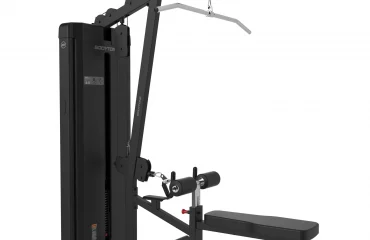
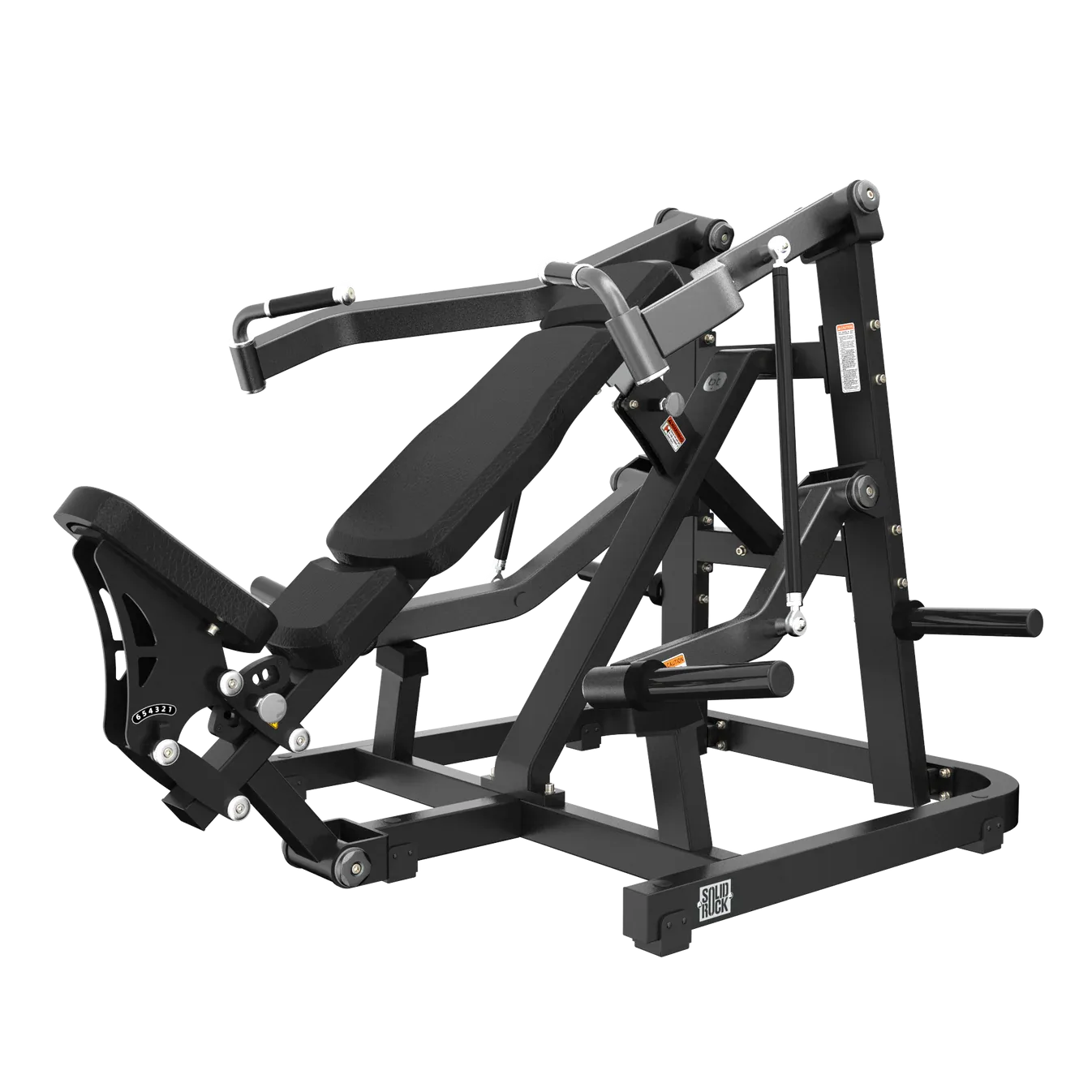
- Heavy structure. Steel of around 3 to 5 mm, sections dimensioned for intensive use, and no flex or wobble even under heavy loads.
- Guidance and mechanics. High-tensile cables, quality pulleys, smooth bearings, no jerking through the movement and a natural, joint-friendly path.
- Intelligent ergonomics. Multiple adjustments for seat, backrest and arms, clear index markings, and movement paths that work for a first-time member and for a trained athlete alike.
On professional cardio
- Power and endurance. Motors or resistance systems dimensioned to run every day, without overheating or premature wear.
- Cushioning and structure. Genuine capacity to absorb impact and protect joints, which is the critical point on treadmills.
- User experience. A readable console, genuinely useful programmes rather than gadgets, and power measurement where a performance zone needs it.
This is the logic behind our own professional strength machines and cardio range: heavy-duty equipment designed for facilities that run all day, not lighter equipment relabelled for professional use.
Standards, safety and public bodies: where you cannot afford an error
As soon as premises open to the public, local authorities, schools or outdoor street workout are involved, compliance stops being a vague topic. A serious manufacturer should be able to supply everything without improvising.
What a serious manufacturer can give you:
- Certificates of conformity to the applicable standards, indoor and outdoor, together with clear technical data sheets and user instructions in the language of the country of installation.
- References for projects already delivered to local authorities, schools, barracks, street workout parks or outdoor fitness trails.
- Practical advice on integrating safety, circulation and accessibility from the design stage rather than after the fact.
The reference framework is straightforward. Indoor equipment for a supervised facility open to the public falls under EN ISO 20957-1 class S; class I is the professional class covering inclusive access, a different scope rather than a level above class S. Outdoor adult fitness equipment falls under EN 16630. Children playground equipment falls under EN 1176-1, with impact-attenuating surfacing under EN 1177 – the two are never interchangeable, and EN 16630 never applies to children equipment.
Beyond the product standards, national and local rules on public access, fire behaviour of materials and accessibility apply where the facility is located. A manufacturer who tells you a single certificate covers everything, everywhere, is telling you something useful about the manufacturer.
That is the positioning behind our street workout structures and public-sector projects: compliant, durable outdoor equipment in stainless or structured steel, specified as part of a whole project rather than as a catalogue item.
After-sales, parts and follow-up: the real difference over ten years
On paper, almost anyone can line up good photographs and a PDF data sheet. Over ten years the question becomes different: how long does your equipment stay in service, and at what cost.
The questions to ask before you sign:
- What is the warranty on the structure, on wear parts and on the electronics, and what are the actual conditions attached to each?
- What is the typical lead time for spare parts, how long is parts availability guaranteed, and where is the stock held relative to your site?
- Is there a real technical team able to diagnose, install, service and repair, or only a distant email support address?
A machine out of service is not only a repair cost. On a busy floor it is a queue, a complaint and, eventually, a cancelled membership. That is why parts availability belongs in the purchase decision rather than in the maintenance budget three years later.
Aligning the choice with your business model
The best manufacturer is not the same for a high-volume budget club, a premium studio, a hotel or a public authority. Start from your model, not from the catalogue.
High-traffic budget club
Priorities: robustness, cost in use, parts availability, ease of maintenance. A direct factory model gives you heavy structural build at a mid-range price, which is difficult to obtain from the largest brands without the budget rising sharply.
Premium club, studio or image-led concept
Priorities: design, visual coherence, customisation, user feel. Here a combination of proprietary lines and a small number of selected partner brands lets you build a floor that does not look like every chain in the market.
Local authorities, schools, barracks and public facilities
Priorities: standards, durability, simplicity of use, safety and vandal resistance. Stainless and outdoor solutions, and turnkey project delivery, are built for exactly this kind of requirement.
Frequently asked questions
How can I check that a supplier really manufactures?
Ask for the technical drawings of a specific reference, the steel specification, and where the range is produced. A manufacturer answers those questions in detail; a catalogue reseller changes the subject to price.
Is a lower price always a warning sign?
No, but an unexplained one is. A direct factory model genuinely removes cost. A price that is low because the steel is thinner, the bearings are cheaper or the parts supply does not exist is a different thing, and it shows up in year two.
What documentation should come with delivery?
Certificates of conformity to the applicable standard, technical data sheets, assembly and user instructions in the language of the country of installation, and a maintenance schedule. For public projects, keep all of it in the facility file.
Should we buy everything from one supplier?
Not necessarily, but a single supplier for a zone makes layout, spares and after-sales considerably simpler. Splitting a floor across five suppliers usually costs more in downtime than it saves at purchase.
In short
A good manufacturer is not simply the one that makes attractive machines. It is the one that aligns design, compliance, after-sales and commercial model with the reality of your project. Ask for the steel specification, the certificates, the parts lead time and the references, and judge on the answers. Request a quote and our team will build a configuration around your facility.
Réalisations documentées
- Cage street workout ultime, Carcassonne – armée française
- Cage street workout ultime, Tahiti – armée française, Polynésie
- Cage SP Max, centre EPIDE de Combrée – établissement public d’insertion
- Cage SP Max, lycée Saint-Bénigne de Dijon – établissement scolaire