Where to Buy a Professional Leg Press at the Best Price

Introduction
The leg press is one of the stations no serious strength floor goes without. Whether the room serves a general membership or a competitive squad, it is a strategic purchase for a club, a studio, a hotel gym or a municipal facility. Choosing the right model and buying it at the right price is where the difficulty lies. This guide from Light In Fitness sets out what actually determines the value of a leg press, so you can compare offers on the points that matter rather than on the headline figure alone.
Why invest in a leg press
What the machine delivers
The leg press targets the muscles of the lower body, in particular the quadriceps, the hamstrings and the glutes. It is designed to offer a safer alternative to the barbell squat while still allowing heavy loading, with limited stress on the joints.
1. Safety and effectiveness
Unlike the free squat, where technique is decisive in preventing injury, the leg press provides stability and support. It suits users who want to move significant load without the risk that free movements carry for the back and the knees, which is precisely what an operator needs on an unsupervised floor.
2. Muscular isolation
The leg press isolates the lower body. Adjusting foot position on the platform shifts the emphasis between different areas of the legs, which makes a single station unusually versatile for programming.
3. Exercise variety
Beyond the standard push, the platform supports variations that load the muscles differently. That variety keeps a station in use across a wide range of member goals instead of serving only one.
Who the station is for
The leg press is not only for bodybuilders and athletes. It is equally valuable for anyone working on general physical condition, because it allows effective leg training with a low injury risk. That makes it suitable across ages and fitness levels, which is what justifies the floor space in a mixed-membership club.
A long-life asset
Buying a quality leg press means buying equipment capable of years of intensive use. For a commercial facility this is the whole point: the cost that matters is the cost per year of service, not the purchase price on its own.
The criteria that decide the purchase
1. Build quality
Construction is the single most important criterion. A robust steel frame and a durable finish are what deliver stability and service life. Ask about the steel section and the finishing system, not just the appearance.
2. Load capacity
Load capacity is a key performance indicator. The machine must handle the loads your strongest members will use, with margin above that for progression. Check the rated capacity against the reality of your floor rather than against an average user.
3. Ergonomics and comfort
Ergonomics decide whether a station is used or avoided. A well-padded seat, proper back support and an adjustable foot platform are essential. These are what allow users of different heights to train in a correct position, which is a safety matter as much as a comfort one.
4. Ease of adjustment
A good leg press is simple to use, with intuitive adjustment of seat position, platform angle and load. Integrated levers and safety catches let a user change the setup quickly and safely, which matters when the station turns over every few minutes at peak time.
5. Size and footprint
Measure the space where the machine will stand, including the user’s working area and the circulation around it. A leg press that fits the floor plan on paper but blocks a walkway in practice is the wrong machine. Light In Fitness offers several sizes for exactly this reason.
6. Budget
Budget is a real constraint, and the task is to find the balance between cost and quality. Our range covers different budget levels without compromising on the construction standards that decide service life.
Choosing the right leg press for your facility
Start from the training objective
Define what the station is for: strength, hypertrophy or general conditioning. If the priority is heavy loading, a high load capacity is the deciding specification. If the priority is throughput on a mixed floor, adjustment speed matters more.
Analyse the available space
Measure the area accurately and choose a model that fits without crowding the room. Where space is tight, the format itself is part of the answer: a vertical leg press occupies a far smaller footprint than a 45-degree machine.
Check durability and warranty
A leg press is a long-term investment. Confirm what the warranty covers, for how long, and what happens on parts availability several years out. Ask for those terms in writing before you commit.
Test comfort and ergonomics
Look for adjustable seats, a well-designed foot platform and comfortable back support. These features are what prevent injury and support correct posture during the exercise, and they are best assessed in person rather than from a specification sheet.
Consider the additional features
Some machines offer angle adjustment or more advanced safety systems. These can genuinely improve the training experience and make the station more versatile, but they should not be traded against frame quality.
The leg press ranges available
Entry-level models
For a facility fitting out its first strength area, or a compact room, entry-level models offer solid value. They are straightforward and effective, and they are built to the same professional standards as the rest of the range.
Intermediate models
For more demanding installations, intermediate models add load capacity and improved adjustment. They suit facilities that want to intensify training and broaden the range of exercises available on one station.
Top-of-range models
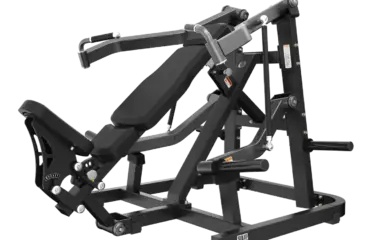
For serious strength floors and performance environments, the top of the range offers exceptional durability, advanced features and customisation options. The full selection sits in our plate-loaded machines and strength training machines categories.
Frequently asked questions
Why buy a leg press from Light In Fitness?
We manufacture and distribute professional equipment and we specify it for the way a commercial facility actually uses it. The range covers several budget levels and our team supports the specification from floor plan to installation.
How do I know which model suits my facility?
Our team advises on the model according to the training objectives, the user profile and the space available. Send us the room dimensions and the intended use and we will come back with a recommendation.
What are the delivery arrangements?
Delivery terms, lead times and installation options are confirmed for your country and your site when we quote, because they depend on the destination and on the access conditions at the delivery address.
What is the returns policy?
The commercial terms applying to your order, including returns, are set out in the quotation. Ask our team to confirm them before you place the order.
Are payment terms available?
Payment and financing arrangements vary by market and by customer type. Our team will confirm what is available for your project when quoting.
Conclusion
A leg press is a significant investment for any facility, and the right purchase is the one that still performs in year eight. Judge it on frame construction, load capacity, ergonomics, adjustment and footprint, and treat the price in that context rather than on its own.
Tell us the size of your room, the profile of your users and the load range you need, and we will put together a costed proposal. Start with our quote request page.