Assisted Pull-Up and Dip Machine: The Professional Guide
Few machines earn their floor space as quickly as the assisted pull-up and dip station. Pull-ups and dips are two of the most effective upper-body exercises there are, and they are also two that most new members cannot perform at all. A counterweighted station closes that gap: it lets a beginner train the exact movement pattern from day one, and it lets a strong member train the same pattern without assistance. This guide covers what the machine does, which muscles it trains, how to use it correctly and what to look at when you are specifying one for a professional facility.
What is an assisted pull-up and dip machine?
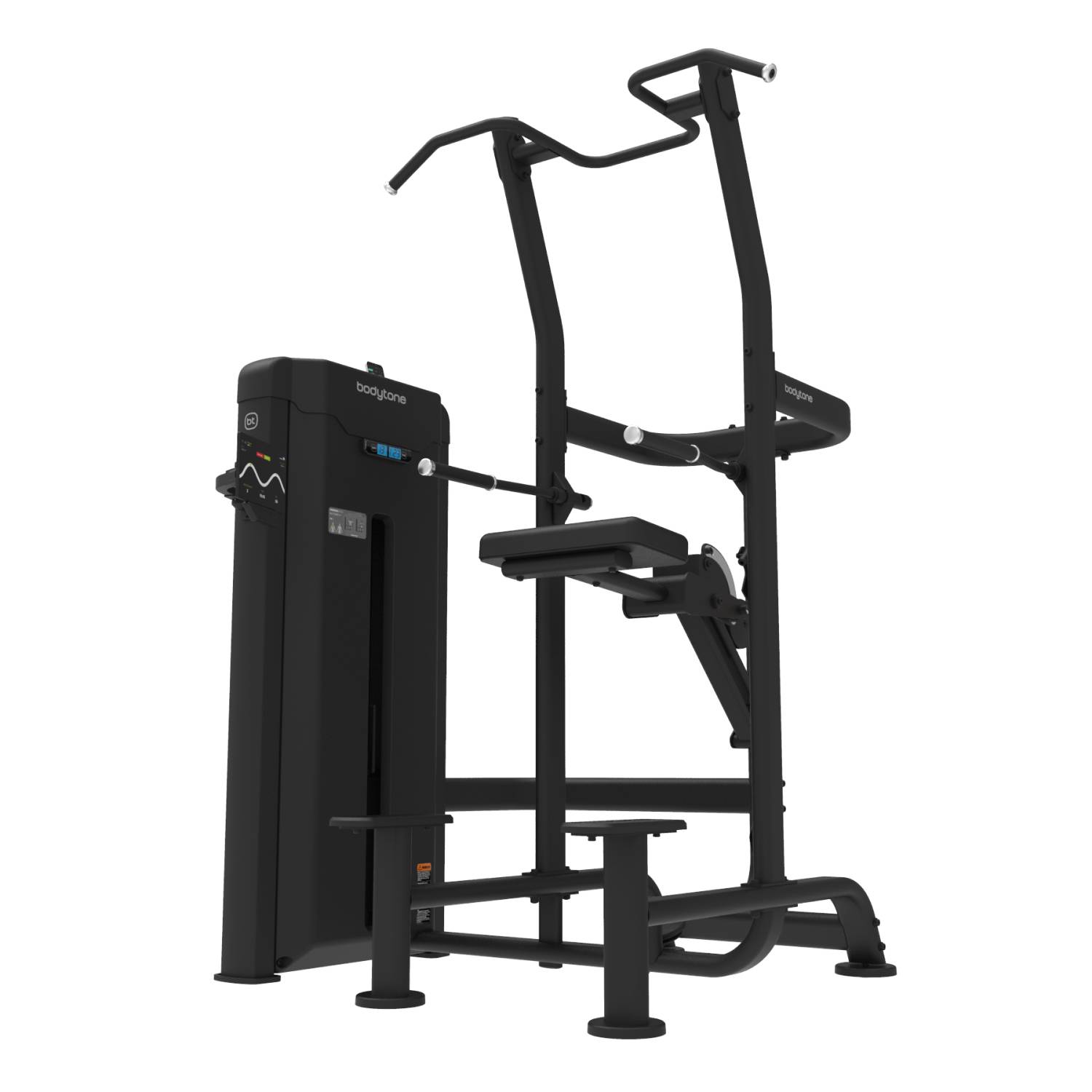
An assisted pull-up and dip machine is a strength station built to train the upper body, principally the back, shoulders and arms, by offsetting part of the user’s bodyweight. The user kneels or stands on a platform connected to a counterweight; the heavier the counterweight selected, the more of the bodyweight is supported and the easier the repetition becomes.
The station combines two exercise positions in one frame. The upper handles and pull-up bar serve the vertical pulling patterns; the parallel dip bars, set at chest height, serve the vertical pushing pattern. Because assistance is selected on a weight stack, the same frame serves a member on their first pull-up and a member working through unassisted repetitions, which is exactly the range a commercial gym has to cover.
Stations of this type sit in the selectorised family of equipment. If you are comparing options across a fit-out, our Gold Line selectorised machines and the Bodytone Forza FH range both include the vertical pulling and pushing stations discussed here.
The benefits of an assisted pull-up and dip station
Targeted upper-body development
The station trains the back, shoulders and arms directly. Assisted pull-ups load the latissimus dorsi, the trapezius and the biceps brachii; assisted dips load the pectorals, the anterior deltoids and the triceps brachii. Between them the two movements cover the vertical pull and the vertical push, which are the two patterns most often missing from a beginner’s programme because they are the two they cannot yet perform.
Adjustable assistance
The defining advantage is that the level of assistance is selectable. A member with no pulling strength starts with a high counterweight and completes full-range repetitions on the first session. As strength develops, the counterweight comes down, the relative load increases, and progression happens on the same machine with no change of exercise. That is a rare property: most machines are outgrown, this one is grown into.
Safety and controlled positioning
Ergonomic handles and a stable footplate or kneepad keep the user in a fixed, supported position for the whole set. The movement path is defined, the assistance is constant and there is no requirement for a spotter. In a facility where supervision is not continuous, that combination matters: it means a movement pattern that is normally coach-dependent becomes something a member can train alone.
Versatility on a single footprint
One frame covers assisted pull-ups, assisted dips and, depending on configuration, unassisted dips, knee raises and other trunk work. For an operator, several exercises on one footprint is the whole argument: floor area is the scarcest resource in most gyms, and a station that serves four patterns is worth more per square metre than one that serves a single pattern.
Efficient sessions
Because several exercises can be performed at one station, members move through their upper-body work without crossing the floor between sets. That keeps circuits tight, reduces queuing at peak hours and suits the members whose time in the building is limited.
How to use the machine correctly
The station is straightforward to use, but the detail of the set-up determines whether the training effect is what was intended.
1. Set the assistance
Select the counterweight according to current strength. A beginner sets a high level of assistance so that full-range repetitions are possible with good form. A stronger user reduces the assistance to increase difficulty. The correct setting is the one that allows the target repetitions to be completed with the last two or three feeling genuinely hard.
2. Take up the starting position
For pull-ups, face the machine, grip the upper handles and step or kneel onto the platform with the arms fully extended and the shoulders engaged rather than hanging loose. Check that the feet or knees are properly placed on the support before releasing the bodyweight onto it.
3. Perform the movement
For assisted pull-ups, pull the body upwards using the arms and back, leading with the elbows and finishing with the chest towards the bar. For assisted dips, lower the body by bending the arms while keeping the elbows close to the torso, then press back to the start. Control the lowering phase in both movements rather than dropping into it.
4. Progress
As strength develops, reduce the assistance progressively to increase difficulty. This is the whole point of the machine: the progression is built into the weight stack, and the endpoint is a member performing the movement unassisted.
Programming the station
For general upper-body strength, 2 to 3 sets of 8 to 12 repetitions is a sound starting prescription, increased progressively as strength develops. The exact volume depends on the member’s goals and current condition, and both pulling and pushing should be programmed across the week rather than one at the expense of the other.
In a circuit or induction programme, the assisted station is where the vertical patterns belong for the first several months of a member’s training. Pairing it with a horizontal row and a chest press covers the four principal upper-body patterns with three machines. Our multi-station gyms combine several of these functions where floor space is tight.
Specifying a station for a professional facility
Equipment installed in a commercial gym, hotel, sports hall or club is in continuous use by users of very different bodyweights and abilities, and should be specified accordingly. Indoor equipment for professional use is covered by EN ISO 20957-1 class S, the professional-use classification. Class I designates professional equipment for inclusive access; it is a distinct professional category rather than a step above class S.
Beyond the classification, the points that separate stations in practice are the frame construction and welding, the guidance system of the counterweight carriage, the quality of the bearings and cables, the range of handle positions and grip widths, and the increments on the weight stack, since small increments matter more here than on most machines: a member progressing off assistance needs fine steps, not jumps.
Frequently asked questions
Which muscles does the assisted pull-up and dip machine target?
It targets the back, shoulders and arms. The pulling movements recruit the latissimus dorsi, the trapezius and the biceps brachii; the dip movements recruit the pectorals, the deltoids and the triceps brachii.
Can beginners use this machine?
Yes, and beginners are the primary case for it. The adjustable assistance means a member with no pulling strength can complete full-range repetitions from the first session and reduce the assistance as they get stronger.
What is the difference between a pull-up and a dip?
A pull-up is a vertical pulling movement in which the body is drawn upwards using the arms and back. A dip is a vertical pushing movement in which the body is lowered by bending the arms, elbows close to the torso, and then pressed back up. Both train the upper body, but they load different muscle groups.
How many sets and repetitions should be prescribed?
That depends on the individual’s goals and condition. A common starting point is 2 to 3 sets of 8 to 12 repetitions, progressing as strength improves.
Is the machine safe to use unsupervised?
Used with correct set-up and good form it is one of the safer ways to train these patterns, because the assistance is constant and no spotter is required. Members should still be inducted on setting the counterweight, taking up a stable position and avoiding forced end ranges.
How much floor space does a station need?
That depends on the model and on the circulation space your layout requires around it. Send us your floor plan and we will confirm the footprint and clearances for the specific station before you commit to a layout.
Specifying your station
The assisted pull-up and dip machine is one of the few pieces of equipment that serves a facility’s weakest and strongest members on the same frame, which is why it belongs in almost every commercial specification. Which model suits your site depends on your membership profile, your supervision model and the space available.
Light In Fitness has supplied professional strength equipment to gyms, hotels, clubs, sports halls and public facilities since 2013. Tell us about your project and we will put together a specification and a costed proposal. Request a quote and our team will come back to you with a configuration built around your site.
Réalisations documentées
- Cage street workout ultime, Carcassonne – armée française
- Cage street workout ultime, Tahiti – armée française, Polynésie
- Cage SP Max, centre EPIDE de Combrée – établissement public d’insertion
- Cage SP Max, lycée Saint-Bénigne de Dijon – établissement scolaire
À lire aussi sur le même thème
- The Professional Lateral Raise Machine: Everything Gym Operators Need to Know
- Professional Abdominal and Back Extension Machines: A Specification Guide
- Professional Chest and Triceps Machines: The Complete Guide
- Découvrez le Leg Curl Allongé : La Clé pour des Ischio-jambiers Puissants et en Bonne Santé