At What Age Can You Start Strength Training in a Gym?
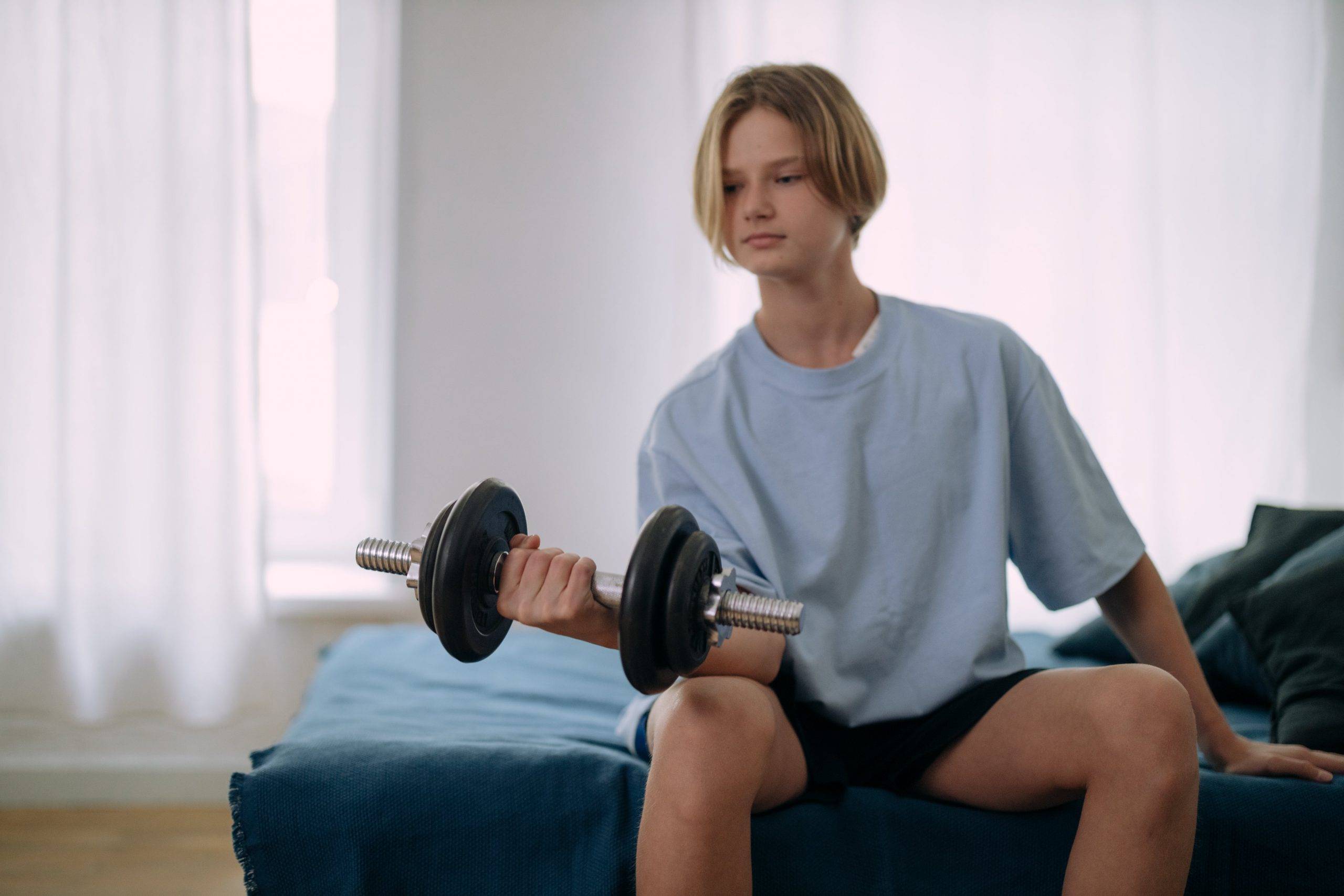
Few questions come back as often at the reception desk of a fitness facility as this one: at what age can you start strength training? Parents ask it before signing up a teenager, coaches ask it before writing a first programme, and operators ask it because their insurance, their internal rules and their equipment layout all depend on the answer. There is no single figure that settles it. Physical maturity, motivation, individual goals and the quality of supervision all weigh more than the number on an ID card.
This guide is written for the people who run the room rather than the people training in it: club managers, school and university sports departments, local authorities, rehabilitation centres and hotel or residence operators. It sets out the development phases, the practical starting points, the precautions that apply at every age, and the equipment decisions that follow from them.
Why the age question is an operational question
Strength training is a physical activity aimed at developing and reinforcing muscle mass. It suits every level, including complete beginners, and it can be adapted almost infinitely. That adaptability is exactly why the age question cannot be answered with a single threshold: the same room, with the same machines, can be safe for a fifteen year old and unsuitable for a twelve year old, depending only on how access is organised.
For an operator, three decisions follow from the age policy: who may enter the free weights area unaccompanied, which machines are set up with a load increment small enough for a light user, and how many supervised slots the timetable has to carry. Getting those three right costs nothing at the design stage and is expensive to retrofit later.
Development phases and what they mean on the gym floor
Each stage of growth has its own characteristics and its own constraints.
Childhood and pre-adolescence
During this period children are growing and their bodies are going through a great many changes. The joints and bones under construction should not be placed under excessive pressure. General practice is to wait until a child has reached a certain level of physical maturity before introducing loaded lifting. This varies from one child to the next, but as a general rule it is preferable to wait until at least twelve years of age before starting a structured strength programme.
That does not mean nothing happens before twelve. Movement quality, coordination and bodyweight work are the right content for this age, and they are best delivered on dedicated equipment rather than on adult machines. Outdoor circuits designed for this age band fall under EN 1176-1 for the equipment and EN 1177 for the impact attenuating surface, which are the playground standards, not the adult fitness ones.
Adolescence
Teenagers go through rapid growth and are often the most motivated group in the building. They want to get in shape and build muscle, and they will do it with or without guidance. This is the moment where technique is learned or bad habits are set for a decade. Supervision by an experienced coach is not a nice extra at this stage; it is the condition that makes the activity worthwhile.
Adults and older adults
From around sixteen, with a sound base level of general fitness, a full strength programme can be followed. Progression is the same principle at every age after that: adapted loads, correct movement patterns learned before intensity is added. There is no upper limit. Strength work develops and reinforces the muscles, improves general condition, supports weight loss, tones the body and helps prevent injury, which is precisely why it belongs in senior residences and rehabilitation settings as much as in a commercial club.
Practical starting points
| Stage | What is appropriate | Supervision |
|---|---|---|
| Before 12 | Play, coordination and bodyweight movement; no structured loaded programme | Constant, by a qualified adult |
| From 12 | Structured strength programme, light loads, technique first | Specialist coach, session by session |
| From 16 with a sound fitness base | Full strength programme with progressive loading | Coach for the learning phase, then periodic review |
| Adults and older adults | Strength work adapted to condition and goals | Induction plus programme review |
In every case, a health professional should be consulted before any strength programme is started. For a facility, that translates into a simple rule: a documented induction before first access, and a written parental authorisation for minors.
Precautions and good practice at every age
Whatever the age at which someone starts, the same short list protects them.
- Start slowly. No complex movements and no heavy loads at the outset. Simple exercises with light weights, so that technique is learned first.
- Warm up. Before every session, take the time to prepare muscles and joints for the work ahead.
- Use correct technique. Learn the right pattern for each exercise and execute it properly. This is the single most effective injury prevention measure there is.
- Increase intensity gradually. Do not overtrain. Intensity is added over weeks, not within a session.
- Rest and recover. Rest periods between sets and between sessions are part of the programme, not a gap in it.
- Stretch afterwards. Appropriate stretching after each session helps limit soreness and maintain flexibility.
The base movements that structure most programmes are squats, bench press, pull-ups and rows, working the abdominals, glutes, thighs, triceps, pectorals and biceps. Strength training should not be confused with fitness classes or cardio work, although the three combine well. Cardio helps burn additional calories and supports weight loss, while strength work raises resting metabolism over the long term by increasing muscle mass, which changes body composition rather than only body weight.
Loaded lifting is also not the only route. Bodyweight exercises such as push-ups, squats and planks are highly effective for building strength and muscular endurance, and dumbbells or resistance bands extend the range considerably. For a facility, that matters: a well designed bodyweight and free weight zone serves younger members long before they are ready for a full machine circuit.
Supervision and professional coaching
At any age, supervision by an experienced coach is recommended when starting strength training. A qualified coach teaches the correct patterns, builds a programme matched to individual needs, and guides the member through the first months. Just as importantly, a coach prevents injuries by checking that the loads are right, watching form during execution and adjusting the programme as progress is made.
From an operator point of view, supervision capacity is what sets the real minimum age in your facility. A club with a coach on the floor at all times can safely open its strength area to supervised under sixteens. An access controlled site with no staff present at certain hours cannot, and the internal rules should say so explicitly.
Equipping a facility for several age groups
A room that serves teenagers, adults and older members needs three things: equipment rated for continuous professional use, load increments fine enough for light users, and a layout that keeps beginners away from the heaviest stations.
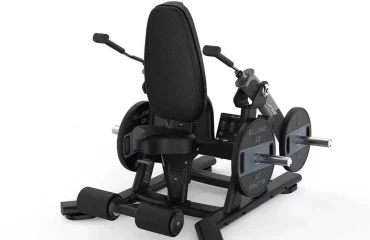
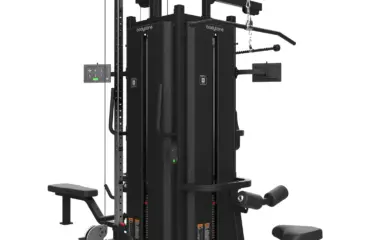
Indoor machines should meet EN ISO 20957-1 class S, the class intended for supervised professional environments. Selectorised machines with small weight increments and adjustable ranges of movement are the most versatile answer for a mixed population, since the same station can serve a fifteen year old learning a movement and an experienced adult. Our professional strength training machines cover selectorised, plate loaded and free weight configurations for exactly this kind of mixed use.
Where a younger audience is served outdoors, the reference frameworks change: EN 16630 applies to outdoor fitness equipment for adults, while equipment designed for children falls under EN 1176-1 with EN 1177 for the surfacing. Our outdoor fitness equipment for children range is built for that age band rather than scaled down from adult stations. Schools and education providers will find the equipment and compliance context set out in our guide to school sports equipment.
Frequently asked questions
Is there a legal minimum age for strength training?
There is no single age that applies everywhere. What matters is physical maturity, supervision and progressive loading. As a general rule, a structured strength programme is not started before twelve, and a full programme is appropriate from around sixteen with a sound fitness base. National regulations and your insurer may set additional conditions for minors, so check the rules applicable in your country.
Does strength training stunt growth in teenagers?
The concern behind the question is real but the target is wrong: the risk is excessive pressure on growing joints and bones, not strength training as such. Supervised work with adapted loads and correct technique is precisely what avoids that risk. Unsupervised heavy lifting is what should be prevented.
Can members train effectively without machines?
Yes. Push-ups, squats and planks build strength and muscular endurance, and dumbbells or resistance bands widen the range further. A dedicated bodyweight zone is often the best entry point for younger members. Fully equipped strength rooms simply offer more variety and allow far more specific work.
What should an operator put in the internal rules?
A minimum age for unaccompanied access to the free weight area, a requirement for parental authorisation for minors, a mandatory induction before first use, and the hours during which the strength area is supervised. These four points cover most of the practical situations.
Planning your facility
There is no single age at which strength training begins. There is a sequence: movement quality first, then structured work under supervision from around twelve, then progressive loading from around sixteen, then a lifetime of adapted training. A facility that reflects that sequence in its equipment and its rules can serve every one of those groups in the same room.
Light In Fitness has been designing and supplying professional fitness equipment since 2013 for clubs, schools, local authorities, hotels and rehabilitation centres. Tell us the age profile of your members, your floor area and your supervision arrangements, and we will put together a configuration that matches. Request a quote and our team will come back to you with a costed proposal.