Toroz Indoor and Outdoor Obstacle Courses for Facilities
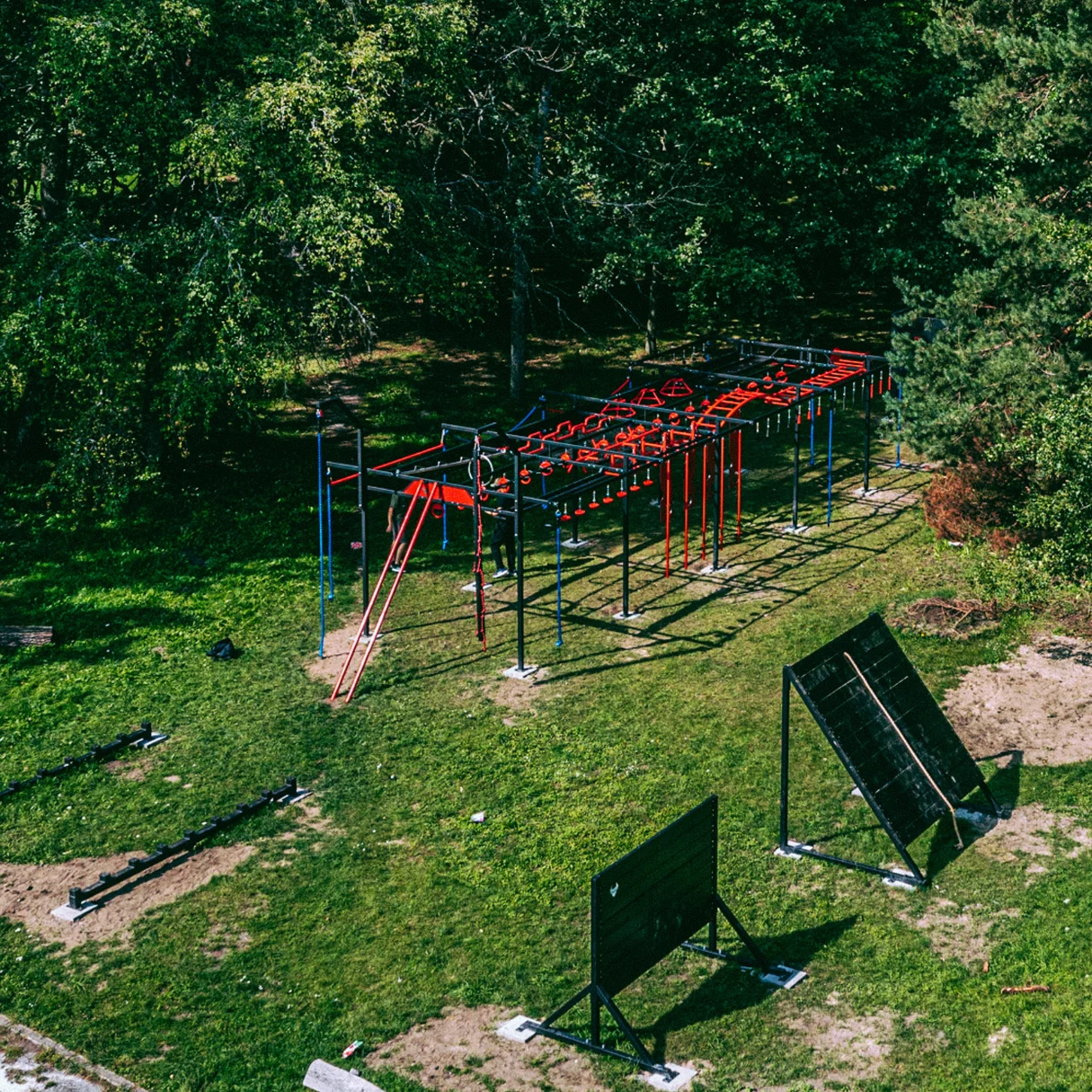
Obstacle course training has moved from a novelty to a programmable activity that facilities can actually build a timetable around. For an operator, that changes the question. It is no longer whether members enjoy climbing, hanging and jumping, it is whether an obstacle rig can be installed safely, supervised sensibly and used by the range of people who walk through your door.
The Toroz range is built for exactly that context: modular obstacle and ninja rigs that can be configured for an indoor hall or an outdoor site, specified for adult use or, in the appropriate configuration, for children. This guide sets out how the two environments differ, what standards apply to each, and what an operator needs to have settled before an order is placed.
Indoor and outdoor are two different projects
The same activity in two environments produces two entirely different specifications, and the mistake most often made is to treat them as one purchase.
Indoors, the constraints are structural and dimensional. Ceiling height decides which obstacles are possible at all, since anything involving hanging, swinging or a wall traverse needs clear height above the highest handhold plus a fall zone below it. The slab has to accept the anchoring or the ballast, and the neighbours have to accept the noise, because obstacle training is loud in a way that a strength floor is not. In return you get year-round programming, controlled lighting and no weather.
Outdoors, the constraints are ground conditions, weather and access. Foundations have to be designed for the soil you actually have. The finish has to survive UV, frost and salt if you are near the coast. Access has to be controlled or the structure has to be safe for anyone who wanders onto it, which is a very different design brief from a supervised indoor session. In return you get a much larger footprint, no height limit and a facility that markets itself from the roadside.
Standards: get this right first
Obstacle structures sit across three different standards, and confusing them is the single most expensive mistake on this kind of project.
Indoor equipment in a supervised commercial or public facility falls under EN ISO 20957-1 class S, the class written for professional use with unrestricted access.
Outdoor equipment intended for adults falls under EN 16630, the standard for permanently installed outdoor fitness equipment.
Equipment intended for children is a separate world: EN 1176-1 governs the equipment and EN 1177 governs the impact-attenuating surfacing beneath it. These are two distinct standards and they are not interchangeable, and EN 16630 has no application to children’s equipment. If your site is open to children, or realistically will be used by them, the project is a playground project and has to be specified as one from the beginning.
Surfacing and fall zones
On an obstacle course the surfacing is not a finish, it is a safety component. Anything a user can fall from needs an impact-attenuating surface sized to the free height of fall, and that surface has to extend beyond the structure, not just sit underneath it.
Indoors this usually means dense matting or a rubber system laid to the fall zone. Outdoors it means a specified surfacing, which is where budgets are most often underestimated: the surfacing and the groundworks on an outdoor obstacle project regularly cost as much as the structure itself. Plan them together or the project stalls halfway.
Configuring a Toroz rig
The Toroz range is modular, which is what makes it workable for operators. Rather than buying a fixed course, you configure a sequence of obstacles to the space, the users and the budget you have, and you can extend it later.
That flexibility is worth using deliberately. A course built entirely from hanging and grip obstacles will be used by a small, strong minority and stand empty the rest of the time. A course that mixes balance, traverse, climb and hang gives beginners a route through and keeps the strong users challenged, and it is the configuration that fills a timetable rather than a photograph.
See the Toroz ninja warrior and OCR rigs for the modules available, the wider OCR obstacle course selection for complete configurations, and the ninja warrior rig range for indoor-oriented structures.
Installation is a construction project
This is worth saying plainly, because it is where projects go wrong. A permanently installed obstacle structure is not self-assembly equipment. It needs designed foundations or a designed anchoring solution, it needs installation by people who do this work, and on a public site it needs a post-installation inspection before it opens.
It also needs a maintenance regime afterwards: scheduled inspection of fixings, grips, cables and surfacing, with records kept. On a supervised commercial site this is routine. On a municipal or open-access site it is a legal expectation, and the inspection records are the first thing anyone asks for after an incident.
Budget for site preparation, installation and first inspection from the beginning. A supplier who quotes only the structure is quoting part of the project.
Who this suits
Obstacle rigs work best where there is a reason for people to come back to them, which in practice means somewhere with programming or somewhere with a captive audience.
Cross-training boxes and functional gyms use them as a timetabled class rather than open equipment, which is the configuration with the highest utilisation.
Campsites, holiday villages and resorts get exceptional value from an outdoor course, because it is a visible amenity that photographs well and occupies guests of very mixed ability. Here the design has to assume unsupervised use.
Municipalities, schools and clubs use them to widen what an outdoor sports area offers. The specification question is whether the users will be adults, children or both, because that decides which standard the project sits under.
Armed forces, fire services and training centres use them as assessed circuits, where the priority is repeatability and durability rather than variety.
Frequently asked questions
Can the same rig go indoors or outdoors?
The modules are configured differently for each. The finish, the anchoring and the surfacing all change, and the applicable standard changes with them, so it should be specified for one environment from the start.
Which standard applies to an outdoor obstacle course?
EN 16630 for outdoor equipment intended for adults. If the equipment is intended for children, EN 1176-1 applies to the equipment and EN 1177 to the impact-attenuating surfacing.
What ceiling height do I need indoors?
That depends entirely on the obstacles you choose, so it is settled against your actual hall rather than a general figure. Send us the height and the floor plan and we will tell you what fits.
Can we install it ourselves?
A permanently installed structure needs designed foundations or anchoring and professional installation, plus an inspection before opening on a public site. It is a construction project, not a flat-pack.
What maintenance does it need?
Scheduled inspection of fixings, grips, cables and surfacing, with records kept. Frequency depends on usage and on whether access is supervised.
Planning your course
Every obstacle project starts with the same three answers: the site, the users, and whether access is supervised. Send us those, along with dimensions and ground conditions, and we will come back with a configuration, the surfacing requirement and a costed proposal: request a quote.
Light In Fitness has equipped professional and public sites since 2013 and works on obstacle projects from the first sketch through to installation.
Réalisations documentées
- Parcours ninja sur mesure, Rennes – îlot des Hautes-Ourmes
- Double mur ninja extérieur, Sallanches – Haute-Savoie