Strength Training Programme for Men: Home and Gym Routines
Un programme de musculation efficace repose sur des mouvements polyarticulaires, une progression de charge planifiée et une récupération suffisante. Squat, soulevé de terre, développé couché, développé militaire et tractions constituent la base commune à la prise de masse comme à la perte de gras. Le matériel nécessaire diffère peu entre une salle et un espace domestique bien équipé.
An effective strength training programme rests on compound movements, a planned load progression and enough recovery. Squat, deadlift, bench press, overhead press and pull-ups form the common base for both muscle gain and fat loss. The equipment required differs surprisingly little between a commercial gym and a well equipped home setup.
Whether the goal is losing fat, building muscle or simply getting back in shape, the deciding factor is a clear plan: effective exercises, progression, recovery and nutrition. The foundation movements come back again and again, and the job is to perform them cleanly, then increase the stimulus gradually.
Safety note. Do not jump straight to an advanced routine without several months, and ideally several years, of consistent training. Anyone with a medical condition, persistent pain or a previous injury should seek medical advice or work with a qualified coach before starting.
Contents
- The principles that actually drive progress
- Home routine with dumbbells
- Beginner gym routine: 3 day full body
- Intermediate gym routine: 4 day upper/lower
- Advanced gym routine: 6 day push/pull/legs
- Training after 40
- Nutrition
- FAQ
The principles that actually drive progress
1) Progressive overload
To build a better physique you have to increase the stimulus over time: more repetitions, more sets, more load, or better execution through range and control. That is what triggers adaptation, in strength and in hypertrophy alike.
2) Training volume
Strength training is not about emptying the tank once. It is about repeating an effective stimulus week after week. Volume, expressed as sets multiplied by repetitions, is the variable you organise first, and frequency is how you spread it across the week.
3) Your level
- Beginner: less than one year of consistent training.
- Intermediate: at least one year, with stable technique and heavier loads.
- Advanced: two years and more, needing both more volume and more intensity.
4) Technique and injury prevention
You progress faster by staying healthy. Warm up properly, keep the last repetition of a set as clean as the first, and treat mobility work as part of the session rather than an optional extra.
5) The equipment behind the programme
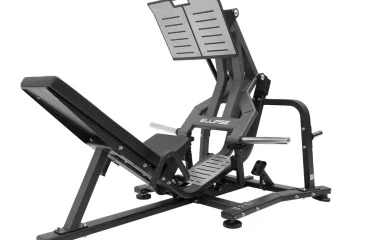
Every routine below is built from a short list of hardware: a barbell and plates, adjustable dumbbells, a bench, a rack and a handful of machines. For a facility, that translates directly into an equipment schedule: olympic barbells, squat racks and power racks, benches and a core of strength training machines covering the pull, push, leg and cable patterns.
Home routine with dumbbells
Training at home works well provided the essentials are respected: compound movements, good execution and progression. A pair of adjustable dumbbells and a flat bench are enough to build real strength.
- Equipment: flat bench plus adjustable dumbbells, or two pairs of dumbbells.
- Rest: 60 to 90 seconds between sets.
- Fat loss goal: add cardio between sessions, for example brisk walking, cycling or running.
Day 1: legs, shoulders, abs
- Legs: dumbbell squats – 3 x 6-8
- Shoulders: standing shoulder press – 3 x 6-8
- Legs: dumbbell lunges – 2 x 8-10 per leg
- Shoulders: dumbbell upright row – 2 x 8-10
- Hamstrings: dumbbell Romanian deadlift – 2 x 6-8
- Shoulders: lateral raises – 3 x 8-10
- Calves: seated calf raise – 4 x 10-12
- Abs: crunch with raised legs – 3 x 10-12
Day 2: chest and back
- Chest: dumbbell bench press or floor press – 3 x 6-8
- Back: bent over dumbbell row – 3 x 6-8
- Chest: dumbbell flyes – 3 x 8-10
- Back: single arm dumbbell row – 3 x 6-8
- Chest: push-ups – 3 x 10-12
- Back and chest: dumbbell pull-over – 3 x 10-12
Day 3: arms and abs
- Biceps: alternating curl – 3 x 8-10 per arm
- Triceps: overhead triceps extension – 3 x 8-10
- Biceps: seated curl – 2 x 10-12 per arm
- Triceps: bench dips – 2 x 10-12
- Biceps: concentration curl – 3 x 10-12
- Triceps: dumbbell kickback – 3 x 8-10 per arm
- Abs: plank – 3 x 30 seconds
This routine covers the whole body with very little equipment and will already produce genuine strength and muscle gains. Where a residence, a hotel or a company wants to offer the same thing to its users, a compact dumbbell set and two benches cover it.
Beginner gym routine: 3 day full body
Starting in a gym can be intimidating. The most effective approach is to repeat the fundamentals in full body form three times a week, focusing on technique and steady progression.
- Frequency: 3 sessions per week
- Rest: 90 to 180 seconds on the main lifts, 60 to 90 seconds on accessories
- Intensity: a load allowing the repetitions with roughly two reps in reserve
Day 1: full body
- Legs: barbell back squat – 3 x 5
- Chest: barbell bench press – 3 x 5
- Back: seated cable row – 3 x 6-8
- Shoulders: seated dumbbell shoulder press – 3 x 6-8
- Triceps: rope pushdown – 3 x 8-10
- Shoulders: lateral raises – 3 x 10-12
- Calves: seated calf raise – 3 x 10-12
- Abs: plank – 3 x 30 seconds
Day 2: full body
- Back and hamstrings: barbell deadlift or trap bar deadlift – 3 x 5
- Back: pull-ups or lat pulldown – 3 x 6-8
- Chest: incline barbell or dumbbell press – 3 x 6-8
- Shoulders: machine shoulder press – 3 x 6-8
- Biceps: barbell or dumbbell curls – 3 x 8-10
- Shoulders: reverse fly machine – 3 x 10-12
- Calves: standing calf raise – 3 x 10-12
Day 3: full body
- Legs: leg press – 3 x 5
- Back: T-bar row – 3 x 6-8
- Chest: pec fly machine or dumbbells – 3 x 6-8
- Shoulders: single arm dumbbell shoulder press – 3 x 6-8
- Triceps: dumbbell or machine triceps extension – 3 x 8-10
- Shoulders: cable or dumbbell front raises – 3 x 10-12
- Calves: seated calf raise – 3 x 10-12
- Abs: decline crunch – 3 x 10-12
Three full body sessions give a complete stimulus with enough recovery. Add load or repetitions as soon as the session starts to feel easy.
Intermediate gym routine: 4 day upper/lower
After a few months, continued progress usually requires more volume and a more structured organisation. A four day upper/lower split does that well.
- Frequency: 4 sessions per week
- Rest: 90 to 180 seconds on the big lifts, 60 to 90 seconds on accessories
- Intensity: two reps in reserve on most sets, harder on the final set
Day 1: upper body
- Chest: barbell bench press – 4 x 6-8
- Back: barbell row – 3 x 6-8
- Shoulders: seated dumbbell press – 3 x 8-10
- Chest and triceps: dips – 3 x 8-10
- Back: pull-ups or lat pulldown – 3 x 8-10
- Triceps: lying dumbbell triceps extension – 3 x 10-12
- Biceps: incline dumbbell curl – 3 x 10-12
Day 2: lower body
- Legs: barbell back squat – 4 x 6-8
- Legs: leg press – 3 x 8-10
- Quadriceps: leg extension – 3 x 10-12
- Quadriceps: walking lunges with dumbbells or barbell – 3 x 10-12
- Calves: calf raise on the leg press – 4 x 12-15
- Abs: decline crunch – 4 x 12-15
Day 3: upper body
- Shoulders: overhead press – 4 x 6-8
- Chest: incline dumbbell press – 3 x 8-10
- Back: single arm cable row – 3 x 10-12
- Shoulders: cable lateral raises – 3 x 10-12
- Rear delts and traps: face pulls – 3 x 10-12
- Traps: dumbbell shrugs – 3 x 10-12
- Triceps: overhead triceps extension – 3 x 10-12
- Biceps: machine preacher curl – 3 x 12-15
Day 4: lower body
- Back and hamstrings: barbell deadlift – 4 x 6
- Glutes: barbell hip thrust – 3 x 8-10
- Hamstrings: dumbbell Romanian deadlift – 3 x 10-12
- Hamstrings: lying leg curl – 3 x 10-12
- Calves: seated calf raise – 4 x 12-15
- Abs: leg raises on the roman chair – 4 x 12-15
When progress stalls, advanced techniques such as drop sets and supersets can be introduced, but sparingly: they raise fatigue faster than they raise stimulus.
Advanced gym routine: 6 day push/pull/legs
At an advanced level, continued muscle gain generally demands more volume and more intensity. A push/pull/legs split allows each muscle group to be trained twice a week.
Important: do not run this programme without at least two years of serious training. It is demanding, and recovery becomes the limiting factor.
- Frequency: 6 sessions per week plus one rest day
- Rest: 90 to 180 seconds on the big lifts, 60 to 90 seconds on accessories
- Intensity: two reps in reserve on most sets, with the option of going to failure on the last set
- Superset: exercise A followed immediately by exercise B, then rest
Pull A
- Back and hamstrings: deadlift – 5 x 5
- Back: pull-ups or lat pulldown – 3 x 10-12
- Back: T-bar row or seated cable row – 3 x 10-12
- Rear delts and traps: face pulls – 4 x 12-15
- Biceps: hammer curls – 4 x 10-12 superset with dumbbell shrugs – 4 x 10-12
- Biceps: standing cable curls – 4 x 10-12
Push A
- Chest: barbell bench press – 5 x 5
- Shoulders: seated dumbbell press – 3 x 6-8
- Chest: incline dumbbell press – 3 x 10-12
- Triceps: pushdowns – 4 x 10-12 superset with lateral raises – 4 x 10-12
- Chest: cable crossovers – 4 x 10-12
Legs A
- Legs: barbell back squat – 5 x 5
- Hamstrings: dumbbell Romanian deadlift – 3 x 6-8
- Legs: leg press – 3 x 8-10
- Hamstrings: lying leg curl – 4 x 10-12
- Calves: seated calf raise – 4 x 12-15
- Abs: decline crunch – 4 x 12-15
Pull B
- Back: barbell row – 3 x 6-8
- Back: pull-ups, weighted if needed – 3 x 8-10
- Back: single arm row – 3 x 8-10
- Lower back: back extensions – 4 x 10-12 superset with preacher curls – 4 x 10-12
- Traps: barbell shrugs – 4 x 10-12
- Biceps: standing dumbbell curls – 4 x 10-12
Push B
- Shoulders: overhead press – 5 x 5
- Chest: dumbbell press, flat or incline – 3 x 8-10
- Chest and triceps: dips, weighted if needed – 4 x 10-12
- Shoulders: single arm cable lateral raises – 4 x 10-12
- Chest: pec fly machine – 4 x 10-12
- Triceps: overhead rope triceps extension – 4 x 10-12
Legs B
- Legs: front squat – 5 x 5
- Hamstrings: glute ham raise – 3 x 8-10
- Legs: walking dumbbell lunges – 3 x 10-12 per leg
- Quadriceps: leg extension – 4 x 10-12 superset with standing calf raise – 4 x 12-15
- Abs: hanging leg raises – 4 x 12-15
A six day split is highly effective but demanding. Progress will depend far more on recovery and nutrition than on adding another exercise.
Training after 40
With age, muscle mass and bone density tend to decline. Resistance training is one of the most effective countermeasures available, which is why it belongs in the programming of any facility serving an older membership.
- Start with the beginner programme, even for someone athletic but new to resistance training.
- Allow more recovery: often 48 hours or more before training the same group heavy again.
- Use joint friendly options where needed: goblet squat, guided machines, controlled variations.
- Keep mobility work in: ten regular minutes on hips, shoulders and ankles usually makes a large difference.
Persistent joint pain is a reason to seek professional assessment, not a reason to push through.
Nutrition
Training provides the stimulus; nutrition largely determines recovery and progression. Set calories first, then macronutrients, and keep protein intake consistent day to day rather than concentrating it around sessions.
- Muscle gain: a modest calorie surplus alongside strength and hypertrophy work.
- Fat loss: a controlled deficit, high protein, and keeping the heavy lifting in the programme so that the weight lost is fat rather than muscle.
Supplementation is optional. Where performance and recovery are the objective, creatine is the most studied option; it supports the programme rather than replacing any part of it.
Frequently asked questions
What is the Big 5 and the 5×5 routine?
The Big 5 usually refers to five compound movements: bench press, squat, overhead press, pull-ups and deadlift. A classic approach applies a 5×5 format, five sets of five repetitions, to some of them.
How do you build an effective training plan?
Start from your level, choose a realistic frequency of three, four or six days, then build around the big lifts and add accessories afterwards. Progression is planned, not improvised.
Should you do cardio when the goal is muscle gain?
Yes, in measured doses. Cardio supports cardiovascular health and active recovery. Where fat loss is the priority, it takes a larger share of the week.
How long should a session last?
It depends on intensity, volume and rest periods. The useful measure is whether the planned sets were completed with good execution, not the time on the clock.
I am no longer sore. Am I still progressing?
Yes. Soreness is not a reliable indicator of muscle growth. Track load, repetitions, recovery and consistency instead.
Equipping a facility to deliver these programmes
Whatever the level, a suitable programme plus steady progression plus coherent nutrition are the strongest levers for a stronger, more muscular body. For a club, a hotel, a residence or a corporate gym, the practical question is which equipment lets members follow these routines without queueing: racks, benches, barbells, dumbbells and a machine line covering the main patterns. Send us your floor plan and your membership profile and we will return an equipment schedule and layout: request a quote.