Buying professional strength equipment: the complete guide
Fitting out a gym floor is a very different exercise from buying a few pieces of kit. Whether you run a commercial club, a hotel wellness suite, a municipal sports hall, a rehabilitation centre or a corporate facility, the strength equipment you specify has to survive continuous use, suit the members you actually have and fit the room you actually own. This guide sets out the criteria professional buyers apply when specifying a first strength line, and the questions worth settling before a single machine is ordered.
Start with the room, the traffic and the users
Three constraints shape every strength specification. The first is the room: usable floor area, ceiling height, access routes for delivery, and the load the slab will accept. The second is traffic. A hotel suite serving a handful of guests at a time and a club running full peak-hour circuits do not need the same number of stations, nor the same duty rating on each one. The third is the user profile: a facility whose members are mostly beginners needs guided, self-explanatory stations, while a strength-focused club needs racks, benches and free weights with enough clear space around them to be used safely.
Settle those three constraints before comparing brands. A machine that looks excellent in isolation becomes a poor purchase if it blocks a circulation aisle, duplicates a movement already covered elsewhere, or demands coaching supervision your team cannot provide at every hour of opening. Under-equipping creates queues at peak times; over-equipping fills a room with stations that are never used and that still have to be cleaned, serviced and insured.
Building the equipment mix
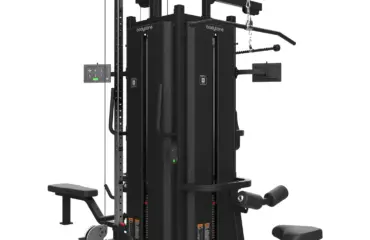
A balanced professional strength line usually combines three families. Selectorised machines give newcomers a safe and repeatable entry point: the path of the movement is guided, the load changes in a single gesture and the instructions stay on the frame. Plate-loaded machines reproduce the feel of free weights while keeping the trajectory under control, which suits members who have passed the first months. Free weights, benches and racks cover the compound lifts that no machine replaces, but they need floor space, storage and a level of supervision that has to be planned rather than improvised.
Most first fit-outs are built around the guided line, then extended. Start with the movements every programme uses: a chest press, a row or pulldown, a leg press or squat station, a shoulder press, and a bench with an adjustable back. Add specialised stations once you can see which ones your members actually queue for. Browse the full guided range in our strength training machines section and the seating and support options under weight benches.
Size matters as much as the movement. A compact multi-station covering several exercises on one footprint often makes more sense in a hotel or a residential facility than four separate machines, while a busy club will lose members to queues if it tries to cover peak hours with a single combined unit.
Accessories: a small line in the budget, a large effect on the floor
Accessories are rarely the headline of a fit-out, yet they decide how comfortably the equipment is used. Training gloves improve grip on a bar and protect the hands of members who train several times a week. Lifting belts support the trunk during heavy squats and deadlifts. Pulling straps let a member hold a bar for the last repetitions of a rowing or pull-up set when grip fails before the target muscle does. Flat-soled training shoes give ankle support and a stable contact with the floor during squats.
For an operator these items also raise a practical question: are they supplied by the facility, sold at reception, or brought by the member? Whatever the answer, plan storage. Racks, trays and lockers keep small equipment off the floor, shorten the cleaning round and cut the number of items that quietly disappear. Our fitness accessories range covers the day-to-day items a strength floor consumes.
What your team tells members about food and recovery
Equipment is only half of the result your members are looking for. A balanced diet, built on protein, carbohydrates, fats, vitamins and minerals, is what turns training into progress. Protein supports the repair and construction of muscle tissue, carbohydrates supply the energy a session demands, and fats play their part in the absorption of vitamins and minerals. Whole foods such as lean meat, vegetables, fruit, whole grains and nuts remain the simplest sources of all of these.
Hydration before, during and after the session belongs in the same conversation: it keeps energy levels stable and prevents dehydration. Coaching teams that repeat this message consistently see fewer members plateau in the first months. Water points and clear signage on the floor cost very little and carry that message all day long.
The movements a beginner floor has to cover
Newcomers progress fastest on a short list of fundamental movements, and the equipment plan should make every one of them available without a queue. Push-ups work the triceps, the chest and the front deltoids and need nothing but floor space. Squats load the quadriceps, the glutes and the hamstrings, and can be run bodyweight, on a guided station or in a rack depending on the member. Pull-ups train the back, the biceps and the forearms, on a fixed bar or on an assisted machine for members who cannot yet lift their own bodyweight. The bench press, again working the triceps, chest and front deltoids, can be set up on a bench with a bar or with dumbbells.
Each of these movements has a correct technique, and each of them punishes a wrong one. That is the strongest argument for guided stations in a facility that cannot staff the floor continuously: the machine itself carries part of the instruction.
Getting more out of every session
Regularity produces results, but the structure of the session decides how quickly. A warm-up prepares the body and reduces the risk of injury. Correct technique on every exercise both protects the member and produces the intended effect. Limiting distraction keeps attention on the movement rather than on a screen. And recovery after the session is as much a part of the programme as the session itself: it is when the body rebuilds and comes back stronger for the next one.
These four points are simple to state and easy to skip. Facilities that build them into their induction, their signage and their coaching language see the difference in retention long before they see it in equipment wear.
Standards, durability and cost over the life of the machine
Cost is a legitimate criterion, but on a professional site it has to be read over the life of the equipment rather than at the moment of purchase. Indoor equipment installed in a facility open to users must be built to EN ISO 20957-1 class S, the professional class for supervised and public access environments. Frame construction, bearing quality, upholstery and the availability of spare parts decide whether a machine is still on the floor in ten years or has already been replaced twice.
Refurbished equipment can be a sensible route for a facility opening on a tight budget, provided the origin, the class of the equipment and the availability of parts are all documented. What does not work is transposing a domestic-grade product into a professional environment: the duty cycle, the liability and the maintenance schedule are simply not the same.
Which strength machines should a new facility buy first?
Cover the main movement patterns before adding specialised stations: a chest press, a row or pulldown, a leg station, a shoulder press and an adjustable bench. Specialised machines come later, once member demand shows where the queues form.
Which standard applies to indoor professional strength equipment?
EN ISO 20957-1 class S, the professional class. Class I is a professional class designed for inclusive access, not a higher intensity level above class S.
How much space does a strength line need?
It depends on the mix. Guided machines need their own footprint plus a clear approach; free weights, benches and racks need a safety perimeter around the working area as well as storage for bars and plates. The layout plan should be drawn before the order, not after delivery.
Should the facility supply training accessories?
Not necessarily, but the decision should be deliberate. If members bring their own belts, straps and gloves, plan for storage; if the facility supplies them, plan for cleaning and replacement.
Specifying your strength line
The right equipment is the equipment that matches your room, your traffic and your members, built to a class that survives professional use. Send us your floor plan, your opening hours and the profile of your members, and we will put together a specification and a costed proposal: request a quote.