Street Workout Equipment: A Complete Guide to Urban Fitness Areas
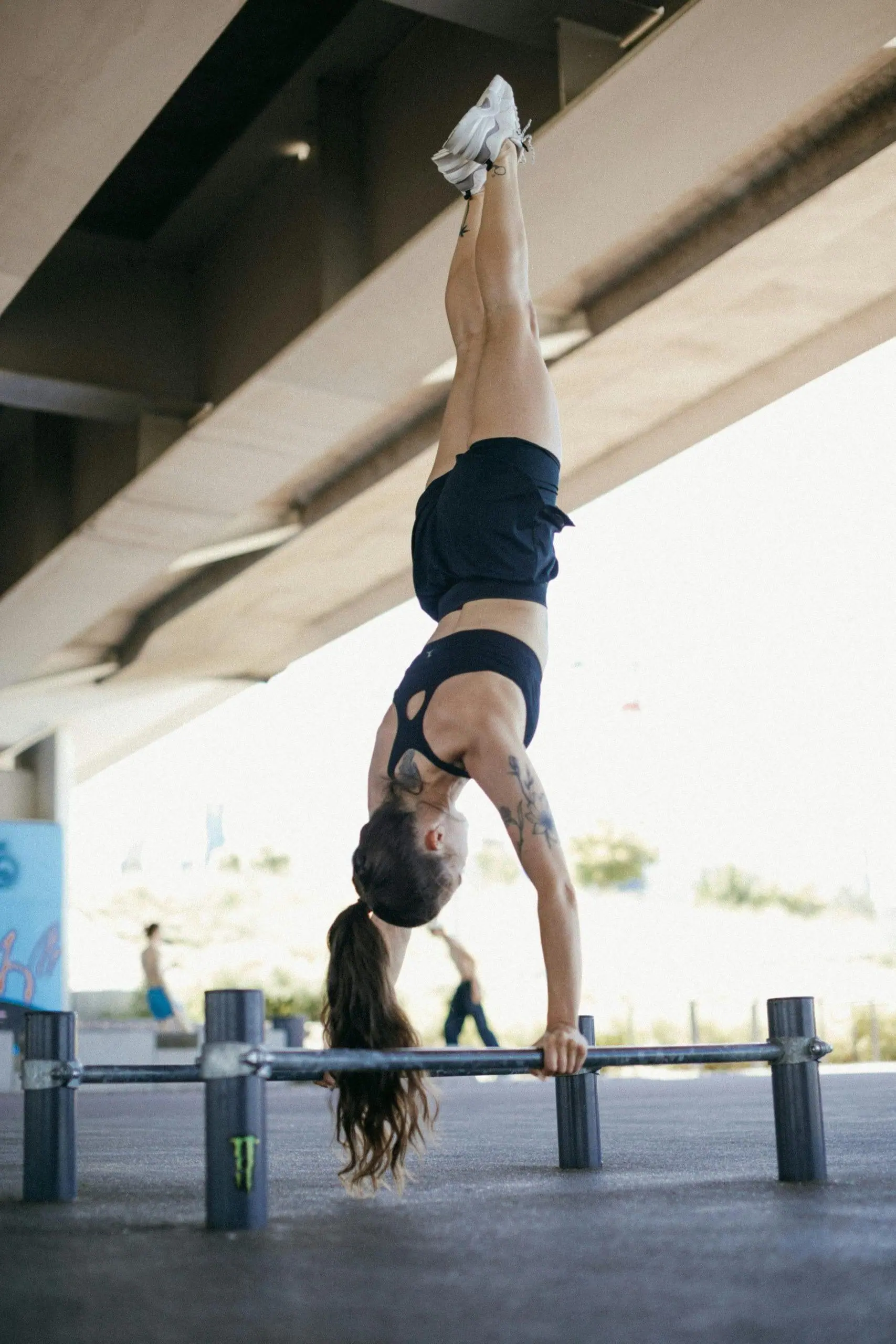
Street workout is a fast-growing discipline that combines body-weight strength, gymnastics and functional training. For anyone specifying an urban fitness area, that combination is the whole point: one installation serves beginners doing their first assisted pull-up and experienced athletes holding a front lever, on the same structure, at no extra cost per user.
This guide covers the equipment that makes a street workout area work, the surfacing and standards that go with it, and the layout decisions that determine whether the area fills up or sits empty.
What street workout is
Street workout uses body weight to develop strength, endurance and flexibility. It is practised mainly outdoors, on structures such as pull-up bars, parallel bars and dedicated street workout stations, through movements like pull-ups, dips and push-ups. Users develop varied athletic qualities while improving balance and coordination.
The differences from conventional gym training matter to a specifier. Traditional strength training centres on machines and free weights indoors; street workout is body-weight based, builds functional strength and body control, and is strongly social. People train in groups, which is why an outdoor area generates community activity that an indoor room rarely produces.
For a municipality, a school, a club, a campsite or a residential scheme, that is the return on the investment: a facility with no membership barrier, no staffing requirement and no opening hours.
The essential equipment
The street workout rig
The rig is the central item. It carries pull-up bars and the apparatus needed for a wide range of exercises, from pull-ups and dips through to more advanced gymnastic movements, in a single dedicated body-weight training space.
Rigs for public installation are built to withstand permanent outdoor exposure, which is what gives them their service life and their safety in use. The street workout rig range spans compact single structures through to complete street workout parks, and the right size is set by the expected number of simultaneous users rather than by the available budget alone.
Parallel bars
Parallel bars are valued for their versatility. They cover dips, calisthenics movements and upper-body strengthening work, and they are the progression route towards more advanced skills such as planches and handstands, which demand both strength and body control.
Their compact design means they adapt easily to an existing area, which is what turns an ordinary outdoor space into a training area without rebuilding it.
Wall bars and complementary apparatus
Outdoor wall bars and calisthenics stations extend what the area can do, particularly for mobility and postural work that pure pulling structures do not cover. Parallettes and resistance bands add variation at almost no cost, though these are user-supplied rather than installed items.
Impact-attenuating surfacing
Safety is not optional, and street workout is no exception. Impact surfacing protects users during dynamic movements and static holds alike, reducing the severity of falls and the risk of injury. Beyond safety, a comfortable surface supports performance, because users concentrate on technique instead of on the ground.
Areas built with proper outdoor sports flooring are increasingly the norm rather than the exception, and the surfacing specification depends on the free height of fall of the structures above it. This is why the surface is chosen after the rig, never before.
Standards and responsibilities
Permanently installed outdoor fitness equipment for adults sits within the framework of EN 16630, and that is the standard to name in a specification or tender document. Where the area is intended for children, an entirely separate framework applies and EN 16630 must not be cited for it.
Installation is not a landscaping task. The structures are anchored, and the foundations are designed for the loads the equipment generates. After handover, the area carries an inspection routine: scheduled visual checks, periodic inspection of fixings and structure, and a defined route for users to report a fault.
Designing the area
A street workout park needs to be planned around use, not around the catalogue.
Variety of apparatus. Include enough different elements, parallel bars and adapted apparatus among them, that several exercises are possible at once. A single bar produces a queue.
Clear use zones. Each element needs its own space, and the circulation between them has to work when the area is busy rather than when it is empty.
Progression built in. Bars at different heights and apparatus of different difficulty let a beginner and an advanced user share the structure, which is what keeps the area in use in year three.
Accessibility. Ground-level elements and a continuous approach surface decide who can actually reach and use the installation.
Where the brief is specific, a custom configuration is usually a better answer than forcing a standard structure onto an awkward site.
Frequently asked questions
How much space does a street workout area need?
More than the footprint of the rig. Each structure has a use zone and an impact area that must stay clear, and those zones set the usable area, not the outline of the steelwork.
Who is a street workout area for?
Everyone, which is its main advantage as public infrastructure. The same structure serves beginners and experienced athletes because the difficulty comes from the exercise chosen, not from a setting on a machine.
What maintenance does it need?
Scheduled visual checks, periodic inspection of the fixings and the structure, cleaning, and monitoring of the surfacing. The surface and the moving or contact points are what wear first.
Can it be installed on grass or on an existing hard surface?
The structures need a prepared foundation designed for the anchoring loads, and the surrounding impact area has to meet the surfacing requirement set by the height of the equipment. Neither grass nor an existing hard standing satisfies that by default.
Planning your street workout area
Send us the available area, the user profile you want to serve, the level of supervision on site and your budget envelope. We will come back with a structure selection, a layout drawn with the use zones and a surfacing specification: request a quote.
Réalisations documentées
- Cage street workout ultime, Carcassonne – armée française
- Cage street workout ultime, Tahiti – armée française, Polynésie
- Cage SP Max, centre EPIDE de Combrée – établissement public d’insertion
- Cage SP Max, lycée Saint-Bénigne de Dijon – établissement scolaire
Sources et références
- NF EN 16630 – modules fixes d’entraînement physique de plein air : exigences de sécurité et méthodes d’essai (AFNOR)
- Code du sport, article L322-2 – garanties d’hygiène et de sécurité des établissements d’activités physiques et sportives (Légifrance)
À lire aussi sur le même thème
- Stainless Steel Outdoor Dumbbells, 2 kg to 100 kg
- Outdoor Fitness Trail Equipment: The EN 16630 Planning Guide
- Professional Outdoor Fitness Equipment: A Complete Overview
- 10 conseils pour optimiser votre entraînement et préparation physique en endurance
- How to Choose a Professional Sports Equipment Supplier