Aller au contenu
Light In Fitness
  • Strength training
    • Selectorised
      • Strength training
      • Selectorised
      • Smith machines
      • Bodytone Forza
      • Forza FH
      • Gold Line
      • Lexco
      • Bodytone SRX
      • Power Line
      • Authentique range
      • Strong Line
    • Plate loaded
      • Plate loaded
      • Gold Line
      • Etenon Olympic
      • Etenon R8
      • Lexco plate loaded
      • Solid Rock
      • O Live Pro
      • Etenon PC series
      • TITAN range
      • Shock range
      • Lexco LSP series
      • Chest press machines
    • Benches
      • Benches
      • Racks and cages
      • Squat and power racks
      • Barbells
      • Coloured barbells
      • Booty Area
      • Power sleds
      • Multi station gyms
      • Multi station gyms
      • Vertical leg press
      • Cable stations
    • Accessories
      • Accessories
      • Kettlebells
      • Gym storage
      • Special offers
      • Double power racks
      • EVOM4 multi station
      • MT6 indoor cycling
  • Cardio equipment
    • Treadmills
      • Cardio equipment
      • Treadmills
      • Professional treadmills
      • Bodytone treadmills
      • Etenon treadmills
      • Lexco treadmills
      • Outdoor treadmills
    • Exercise bikes
      • Exercise bikes
      • Upright bikes
      • Bodytone bikes
      • Recumbent bikes
      • Lexco seated bikes
      • Cycling bikes
    • Cardio machines
      • Cardio machines
      • Lexco cardio
      • Cross trainers
      • Lexco cross trainers
      • Rowers
      • Ski ergometers
      • Stair climbers
      • Xebex
  • Wellness
    • Cold plunge baths
      • Wellness
      • Cold plunge baths
      • Portable baths
      • Fixed baths
      • Chillers
      • Cold plunge bath accessories
    • Sauna, steam and spa
      • Sauna, steam and spa
      • Sauna and steam room
      • Outdoor saunas
    • Acrylic and rigid spas
      • Acrylic and rigid spas
      • Zodiac pools
      • Pool surfacing
      • Aquatic and wellness
    • Pilates
      • Pilates
      • Inflatable air tracks
  • CrossFit and Hyrox
    • CrossFit rigs
      • CrossFit and Hyrox
      • CrossFit rigs
      • Freestanding rigs
      • Wall mounted rigs
      • Functional rigs
      • Cross training cages
      • Cross training stations
      • Portable structures
    • Ziva
      • Ziva
      • Container gym
      • Parkour and CrossFit parks
    • Floor level MMA cages
      • Floor level MMA cages
      • Podium MMA cages
      • Punch bag rails
      • Tatami mats
      • Roll out mats
    • Standards
      • Standards
      • Prices
  • Street workout
    • Stainless steel Functional Rig worldwide
    • iGreenMill outdoor treadmill worldwide
    • Calisthenics cages
      • Street workout
      • Calisthenics cages
      • Street workout parks
      • Custom configurator
      • Uruk parks
      • Parkour and CrossFit parks
      • Hexagon range
      • Mini outdoor cages
      • Calisthenics cages
      • Stainless workout cages
      • Stainless equipment
      • Outdoor wall bars
    • Stainless steel outdoor
      • Stainless steel outdoor
      • Stainless machines
      • Outdoor gym
      • Steel4Fit
      • TRAINER OutdoorStart
      • TRAINER OutdoorFit
      • TRAINER sets
      • Outdoor strength machines
      • Compact 3 in 1 stations
    • Fitness trail
      • Fitness trail
      • OUTDOOR FITNESS I
      • Adapted and rehabilitation
      • Accessible outdoor
      • TRAINER accessible
      • Galvanised range B
      • Wooden trail
      • Fitness trail stations
      • Obstacle courses
    • Ninja Warrior
      • Ninja Warrior
      • Toroz Ninja and OCR
      • Outdoor Ninja structures
      • Warped walls
      • Parkour
      • Obstacle trail modules
      • Pump tracks
  • Playground
    • Rope play modules
      • Playground
      • Rope play modules
      • Rope play sets
      • Combined rope structures
      • Complex play systems
      • Rope climbing pyramids
      • Rope climbing nets
      • Rope structure parts
    • Diamond Collection
      • Diamond Collection
      • Tubular play structures
      • Play towers
      • Elevated playhouses
      • Bespoke playgrounds
    • Swing sets
      • Swing sets
      • Spring riders
      • Playground roundabouts
      • Playground furniture
      • Children sports parks
      • Kids outdoor fitness
      • Kids cardio machines
      • Mobility wheels
      • Kids balance stations
    • Playground surfacing
      • Playground surfacing
      • Wood chips
      • Operator duties
      • Inspections
  • Rubber flooring
    • Rubber flooring
      • Rubber flooring
      • Weightlifting tiles
      • Fire rated tiles
      • Coloured tiles
      • Wood effect tiles
      • COV A tiles
    • Interlocking tiles
      • Interlocking tiles
      • 7 mm interlocking tiles
      • 6 mm patterned sports flooring
      • Pool surfacing
      • Rubber rolls
      • Sports court rolls
      • Floor underlay
    • Fitness, gym and Pilates mats
      • Fitness, gym and Pilates mats
      • Smooth surface mats
      • Moulded surface mats
      • Roll out mats
      • Tatami mats
    • Outdoor flooring
      • Outdoor flooring
      • Turf sled tracks
      • Turf sled tracks
      • Artificial turf tiles
      • Stable matting
    • Multi-sport courts
      • Multi-sport courts
      • Basketball court tiles
      • Pickleball surfacing
      • Mini modular multisport court
      • Standard modular multisport court
      • Max modular multisport court
      • Modular 3×3 basketball court
      • Multisport and 3×3 complex
    • Sports flooring tiles, deliveries
  • By facility type
    • By facility type
      • By facility type
      • Public sector
    • Buying sports equipment through public tender
      • Buying sports equipment through public tender
      • Supplier file
      • Specification template
      • Specification clauses
      • Funding
    • Case studies
      • Case studies
      • References
    • Standards
      • Standards
      • Warranties
      • After sales
      • Glossary
      • Blog
  • FRENESDE
  • No products in cart.
  • Home
  • Expert guides on professional fitness equipment
  • Guides Acheteurs
  • The Seated Machine Pullover: Technique, Coaching and Equipment Guide

The Seated Machine Pullover: Technique, Coaching and Equipment Guide
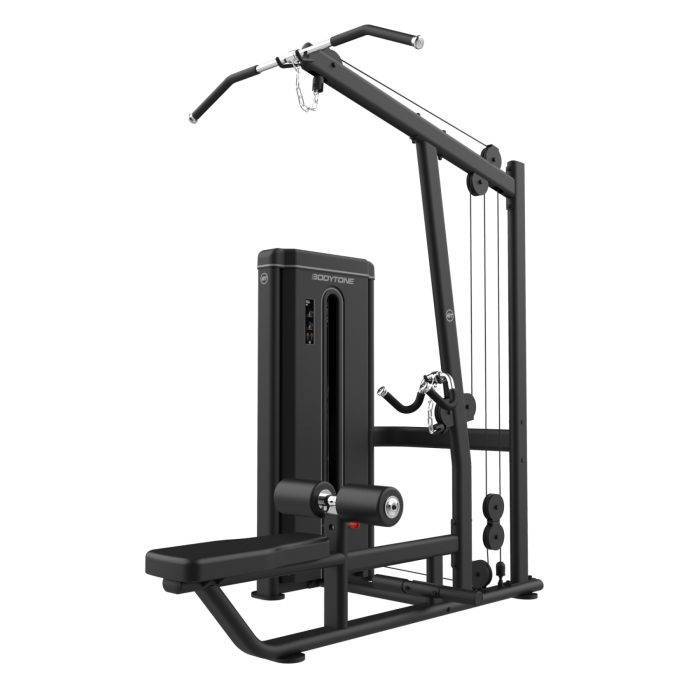
by Michaël Galy / Tuesday, 26 March 2024 / Published in Guides Acheteurs
comment réaliser un pull over assis à la machine guide complet

The seated machine pullover is one of those exercises that separates a well-programmed strength floor from an average one. It trains the lats through a movement pattern almost nothing else on the floor covers, it is easy to teach, and it suits members who cannot yet perform a pull-up. This guide is written for the people who run the floor: how the movement works, how to coach it, the mistakes that show up in every gym, and what to look for when you specify the machine itself.

On this page

  • What the seated machine pullover is
  • Which muscles the movement actually trains
  • How to coach the movement
  • The errors you will see on your floor
  • Why the machine earns its place on a commercial floor
  • Specifying a pullover machine
  • Frequently asked questions
  • Specifying for your own facility
  • À lire aussi sur le même thème

What the seated machine pullover is

The seated machine pullover is a strength exercise performed on a dedicated machine. The user sits with the back supported, takes hold of a bar or handles positioned above and in front of the shoulders, and drives them down and back with the arms held long, until the upper arms are alongside the torso. The load then returns under control to the starting position.

The defining feature is that the elbow angle stays essentially fixed. The work happens at the shoulder, not at the elbow, which is what makes this a shoulder extension movement rather than a pull in the usual sense. That single detail is the difference between a pullover that trains what it is supposed to train and one that turns into a poorly executed triceps exercise.

Which muscles the movement actually trains

The primary mover is the latissimus dorsi, working through shoulder extension across a long range. Alongside it, the teres major, the sternal fibres of the pectoralis major, the long head of the triceps and the serratus anterior all contribute, and the trunk works isometrically to hold position against the load.

It is worth being precise here, because gym floor lore is not. The seated machine pullover is not a deltoid exercise and it is not an upper trapezius exercise. If a member feels it in the upper traps, that is a coaching problem: they are shrugging into the movement instead of driving from the lat.

How to coach the movement

  1. Set the seat. The user sits with the back flat against the pad and the feet firmly on the floor or the platform. Seat height should place the shoulder joint in line with the machine’s axis of rotation. This is the single most important setup step and the one most often skipped.
  2. Set the start position. Adjust the bar or handles so that, at the top, the arms are long and the shoulders are flexed without the user having to lean or reach out of the seat.
  3. Take the grip. A pronated grip, palms facing down, is the standard position. Grip firmly without squeezing hard enough to recruit the forearms into the movement.
  4. Drive down and back. The arms stay long with a small, fixed bend at the elbow. The user drives the upper arms down towards the torso, thinking about the elbows travelling rather than the hands.
  5. Hold the finish briefly. A short pause with the upper arms alongside the torso, ribs down, without arching the lower back.
  6. Return under control. The eccentric is where most of the useful work happens. It should be slower than the drive, and it should stop where shoulder position is still controlled rather than at the mechanical limit of the machine.

The errors you will see on your floor

  • Too much load. The moment the load exceeds what the lat can move, the body finds a way around it: the elbows bend, the torso rocks, the ribs flare. Cue lighter, cue slower.
  • Bending the elbows. This converts the exercise into a triceps movement and removes the range that made it worth programming.
  • Rocking the torso. Momentum from the trunk unloads the target muscle and loads the lumbar spine. The back stays against the pad.
  • Locking the elbows out hard. A small fixed bend protects the joint. A locked, hyperextended elbow under load does not.
  • Chasing depth. Range should be the range the member can control with the shoulder in a good position, not the range the machine allows.

Members should be told to stop the set if they feel pain rather than effort, and to raise it with an instructor. Anyone with a shoulder history should have the movement cleared by a health professional before it goes into their programme.

Why the machine earns its place on a commercial floor

It reaches members a pull-up never will. A large proportion of any membership cannot perform a pull-up and will not attempt one. The machine pullover gives those members a loaded lat movement from day one, with the back supported and the load set by a pin.

It covers a pattern most floors are missing. Lat pulldowns and rows dominate back programming, and both bend the elbow. A pullover trains shoulder extension with the arm long, which is a different demand and a genuinely different stimulus.

It is fast to induct on. Seat, grip, drive, return. New members are productive on it within a single induction, which matters when your instructor time is the scarce resource.

It supports rehabilitation and return-to-sport work. The supported position and the fine load increments make it usable in settings where free-weight alternatives are not appropriate.

Specifying a pullover machine

Not all pullover machines are the same, and the differences matter more here than on most stations.

  • Seat and pad adjustment range. The machine has to fit the range of body sizes in your membership. A machine that only aligns correctly for users of average height will be misused by everyone else.
  • Axis alignment. Check that the shoulder can be placed in line with the machine’s pivot across the whole adjustment range, not just at one setting.
  • Load increment. On a selectorised unit, look at the smallest increment available. On a plate-loaded unit such as the Bodytone SRX12 pullover machine, the increment is your plate selection, which is an advantage for strong users and something to plan around for beginners.
  • Class of equipment. Indoor stationary training equipment for professional use falls under EN ISO 20957-1, class S. Specify it and ask for the documentation.
  • Footprint and access. The machine needs clear entry and exit for a user who is seating themselves under a loaded bar, not just its own base area.

The rest of the plate-loaded range sits in our plate-loaded machines category, and the wider SRX line is on the Bodytone SRX page.

Frequently asked questions

Which muscles does the seated machine pullover work?

Primarily the latissimus dorsi through shoulder extension, with the teres major, the sternal fibres of the pectoralis major, the long head of the triceps and the serratus anterior contributing. The trunk works isometrically to hold position.

How often should the exercise appear in a programme?

For most members, two to three sessions per week covering this pattern, with at least one day between sessions that train it hard, is a reasonable starting point. Frequency should follow the member’s goals and training age rather than a fixed rule.

Is the machine pullover suitable for beginners?

Yes, and it is one of the better first back exercises precisely because the back is supported and the load is set by a pin. Start light and prioritise position over load.

Are there useful variations?

Grip width and grip type change the emphasis slightly. A neutral grip, palms facing each other, is often more comfortable for members with shoulder restrictions. A pronated grip, palms down, is the standard. Changing the grip does not change what the exercise fundamentally trains.

Does it help posture?

Strengthening the lats and the muscles that stabilise the trunk supports better postural endurance, which is what most people mean by posture. It is not a corrective exercise on its own, and it will not undo the effects of how a member spends the other twenty-three hours of the day.

Specifying for your own facility

A pullover machine is a small line on an equipment schedule that closes a real gap in most back programming. The decisions that matter are adjustment range, axis alignment, load increment and the class of equipment you insist on.

Tell us your membership profile, your floor plan and the rest of your strength schedule, and we will tell you whether a pullover station belongs in your plan and which configuration fits. Request a quote to get started.
À lire aussi sur le même thème

  • Choosing the Right Group Exercise Classes for Your Gym
  • Renforcement des Quadriceps : Guide Complet sur l’Exercice de la Leg Extension
  • Sculptez vos Pectoraux avec le Pec Deck : Guide Complet pour Maîtriser cet Exercice Efficace
  • Consolidez vos Pectoraux : Guide Complet sur le Développé Assis à la Machine pour les Pectoraux

Tous les articles « Guides Acheteurs »

Tagged under: guide

About Michaël Galy

Michaël Galy est fondateur et directeur de Light In Fitness, expert en équipements de fitness et musculation professionnels depuis 2013. Fort de plus de 15 ans d'expérience dans l'équipement sportif professionnel, il accompagne les salles de sport, box CrossFit, hôtels, collectivités et établissements de santé dans leurs projets d'aménagement fitness de A à Z. Consultant reconnu en France et en Europe, Michaël Galy a équipé plus de 500 établissements professionnels. Il partage régulièrement son expertise sur les tendances fitness, les normes de sécurité et les meilleures pratiques d'aménagement des espaces sportifs professionnels.

What you can read next

LES 5 MEILLEURES FAÇONS DE RÉDUIRE LES DOULEURS MUSCULAIRES
Les 5 meilleures façons de réduire les douleurs musculaires
appareil de musculation fh01 chest press bodytone: perfectionnez votre entraînement de la poitrine.
Amortir son matériel de sport : durées, méthodes, facture
comment faire une salle de fitness dans sa ville guide complet pour créer votre propre salle de fitness
How to Open a Gym in Your Town: A Complete Guide
TOP
This website uses cookies to improve your experience. We assume you are happy with this, but you can opt out if you wish. Cookie settingsAccept
Privacy policy

Privacy policy

This website uses cookies to improve your browsing experience. Cookies classified as necessary are stored in your browser because they are essential to the basic operation of the site. We also use third party cookies that help us analyse and understand how you use this site. These cookies are stored in your browser only with your consent. You can also disable these cookies. Disabling some of them may affect your browsing experience.
Necessary
Always Enabled
Necessary cookies are essential for the website to work properly. This category only covers cookies that provide the basic functionality and security features of the site. These cookies do not store any personal information.
Non-necessary
Cookies that are not strictly necessary for the site to work et qui sont utilisés spécifiquement pour collecter des données personnelles via des analyses, des publicités ou d\'autres contenus intégrés sont qualifiés de cookies non nécessaires. Il est obligatoire d\'obtenir le consentement de l\'utilisateur avant d\'exécuter ces cookies sur votre site web.
SAVE & ACCEPT
My quotation request 0