The Seated Chest Press Machine: Setup, Technique and Specification
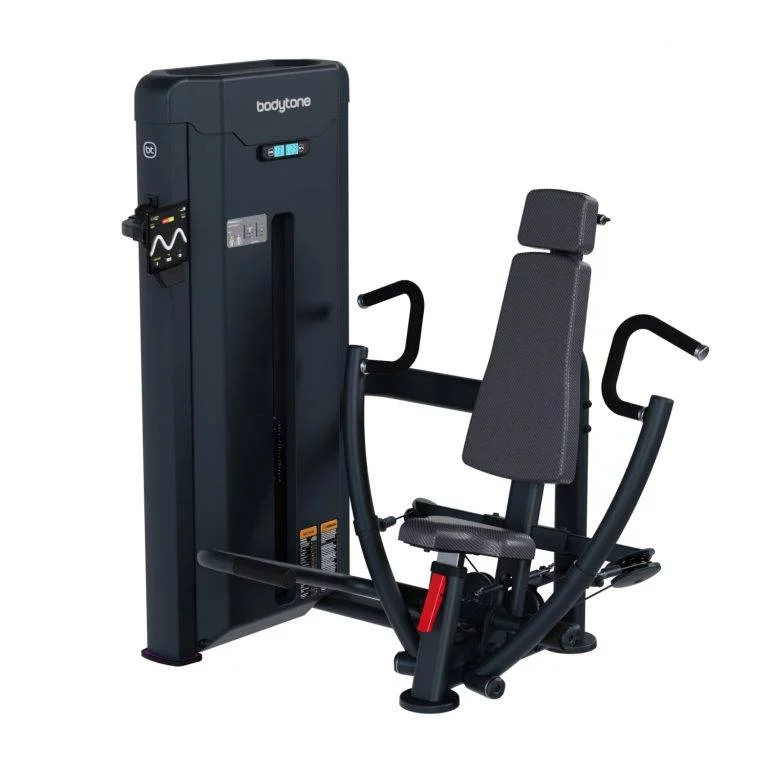
The seated chest press is one of the most heavily used stations on any commercial gym floor, and one of the most frequently used badly. It is the station a new member goes to first when they want to train chest, because it is the one that looks like it will not drop anything on them. That instinct is sound, and it is exactly why the machine deserves proper attention: it carries a disproportionate share of a facility beginner traffic, and how well it is set up determines what those members experience in their first weeks.
This guide covers both sides of the station: how a member should set it up and perform the movement, and what an operator should look for when specifying one for a club, a hotel, a residential gym, a corporate facility or a rehabilitation centre.
What the seated chest press does
The seated chest press reproduces the horizontal pressing pattern of the bench press along a guided path. The user sits with the back supported, grips two handles at chest height and presses them forward until the arms are extended, then returns under control.
It trains the pectoralis major as the prime mover, with the anterior deltoid and the triceps contributing. Because the trunk is supported and the path is fixed, the user can concentrate on muscular effort rather than on stabilising the load, which is what makes it productive for beginners and useful as a finishing movement for experienced members.
The chest press machine range covers the different loading systems and geometries described below.
Why it belongs on a commercial floor
Compared with a barbell bench press, the machine removes the two things that make heavy chest pressing awkward in an unsupervised room. No spotter is required, and the user cannot be trapped under the load: on a machine the handles simply stop. That matters most in facilities where supervision is intermittent, which describes most hotel gyms, residential gyms and corporate rooms, and a fair number of clubs outside peak hours.
It also reduces exposure to the injury pattern most associated with heavy free-weight pressing, including pectoral tears, because the load is controlled through a defined range and cannot be dropped. This is a genuine safety advantage, not a substitute for teaching people to press properly.
None of this makes the machine better than free weights in absolute terms. The two answer different questions. Free weights recruit stabilisers and build transferable pressing strength; the machine allows controlled, high-effort work with a low technical entry cost. A well specified floor carries both, and members move between them.
Setting up the machine
The machine is not adjusted to mood, it is adjusted to the person. Most incorrect repetitions on a chest press start before the first repetition.
- Seat height. Set it so the handles sit at roughly mid-chest level when seated. Handles too high shift the work to the shoulders; too low and the wrists and elbows take a poor angle.
- Back contact. The whole back should be in contact with the pad, shoulders down and back rather than rolled forward.
- Grip width. Take the grip that puts the forearms roughly perpendicular to the bar path, with shoulder width as the starting reference.
- Range setting. Where the machine has a start-position adjustment, set it so the movement begins with the hands at or slightly in front of the chest, not behind it, which protects the shoulder at the deepest point.
- Feet. Flat on the floor or on the footplate, with the hips staying in the seat.
- Load. Choose a weight that allows the whole set with the back stable. Overloading here does not build a bigger chest; it recruits the shoulders and the lower back to finish the repetition.
Performing the movement
Press the handles forward smoothly to full but not locked-out extension, hold briefly, then return slowly to the starting position under control. The return is where most of the useful work is done and where most members rush.
Breathing follows the movement: exhale on the press, inhale on the return. Keep the shoulders down and the back against the pad throughout. If the hips lift, the shoulders roll forward or the movement becomes jerky, the load is too heavy for the current set.
For programming, the station suits moderate to high repetition work as a primary chest movement for beginners, and lower repetition work or finishing sets for experienced members. Drop sets and band-assisted variations can be added for advanced members, but they are not appropriate for someone still learning the pattern.
Choosing the right machine for your floor
Selectorised or plate loaded
A selectorised chest press adjusts in seconds with a pin, which suits circuits, group instruction and general-population members, and it prevents a user exceeding the machine capacity. A plate loaded chest press gives an exactly known load and is limited only by the frame, which suits strength-focused members, but the facility has to store and rack the plates. Most floors of any size carry one of each. The wider selectorised machine range shows how the chest press fits alongside the other stations.
Converging or parallel path
A converging machine brings the handles towards each other as they travel forward, reproducing the natural arc of the movement more closely. A parallel-path machine keeps them at a constant width. Converging geometry is generally preferred for chest work; parallel machines are simpler and often more compact. Know which one you are being quoted.
Adjustability
The wider the range of member heights, the more adjustment matters. Seat height range, start-position adjustment and handle options are what allow one station to serve a 1.55 m member and a 1.95 m member without either of them improvising.
Build and standard
Indoor equipment for supervised commercial use falls under EN ISO 20957-1 class S. Check the conformity documentation for the specific reference, and check the practical things too: the pads, the guide rails, the cable or lever mechanism, and whether replacement pad kits are available. A station this busy will need parts.
For a concrete example of a commercial specification, the Bodytone FH01 chest press shows the level of build and adjustment expected on a club floor.
Frequently asked questions
Is the chest press machine better than the bench press?
Neither is better in the abstract. The machine is safer without a spotter, easier to learn and better suited to high-effort work with a controlled range. The bench press recruits more stabilising musculature and builds pressing strength that transfers more widely. Specify both if the floor allows it.
How should the seat be set?
So the handles sit at roughly mid-chest height with the back flat against the pad. If the elbows finish above shoulder height at the start of the movement, the seat is too low; if the press feels like an overhead movement, it is too high.
How many chest press stations does a gym need?
Count simultaneous users at peak hour rather than total membership. In most general-population facilities the chest press is one of the first stations to saturate, alongside the lat pulldown and the leg press, so it is a common candidate for duplication when the floor is extended.
Which standard applies?
EN ISO 20957-1 class S for indoor equipment in supervised commercial use. Request the documentation for the exact reference you are buying and keep it with the facility records.
Can beginners use it without instruction?
They will, so design for it. Clear pictogram instructions on the machine, a sensible default seat position and an induction that covers the station are what make an unsupervised first attempt a good one. Correct form matters more than the load for both results and injury prevention, and that message is best delivered on the machine itself.
Specifying the station
Choose the loading system that matches how your floor is supervised, favour converging geometry and generous adjustment for a mixed membership, confirm the usage class, and check parts availability before you compare prices. Detailed equipment quotations, including layout for the chest area, are available for any professional project.
Réalisations documentées
- Dalles et sols sportifs : livraisons documentées – plusieurs chantiers
- Sol sportif extérieur, square Georges-Vallerey – Taverny (95)
À lire aussi sur le même thème
- The Seated Machine Biceps Curl: A Complete Guide for Operators
- Entraînement avec un médecine-ball – avantages, les meilleurs exercices pour l’abdomen et les arts martiaux
- 8 Meilleures Huiles Naturelles pour une Peau Saine et Rayonnante
- Optimiser vos Performances Sportives : Les Meilleurs Exercices pour Sculpter le Bas de votre Corps