The Complete Guide to Impact Absorbing Rubber Flooring
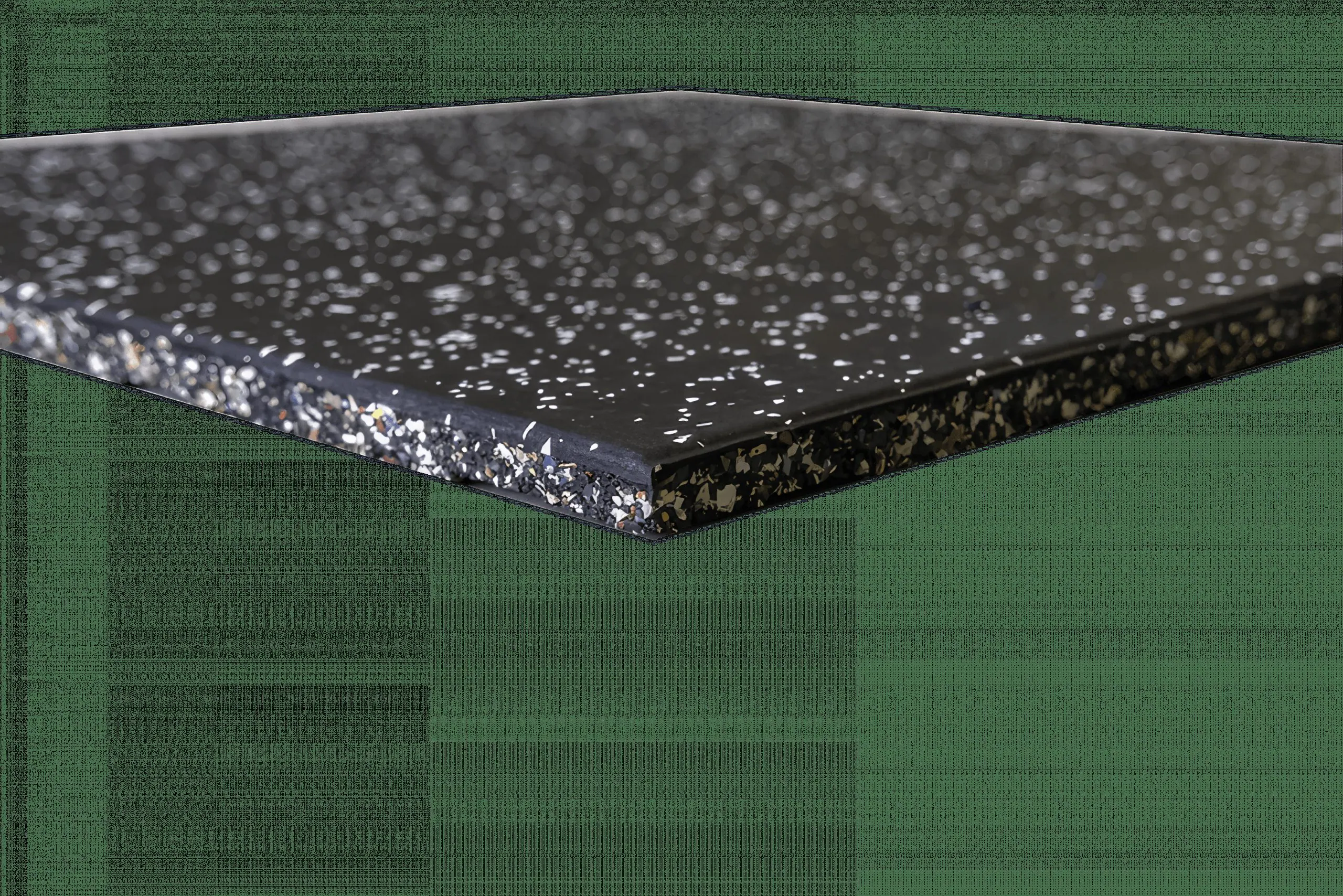
Impact absorbing rubber flooring is one of those specifications that looks simple on a plan and decides everything once the site is open. It is what stops a fall from a play tower becoming an injury, what keeps a dropped barbell from cracking a slab, and what makes an industrial aisle bearable to stand on for eight hours. This guide covers what the material is, which standards apply, how to select a thickness, and how to install and maintain it.
What rubber safety flooring actually is
Rubber safety flooring is made of rubber granulate bound with resin to form a stabilised, resilient surface. The granulate is frequently recycled from end-of-life tyres, which gives the product both its shock absorbing behaviour and a genuine circular-economy argument. Under load it deforms and returns, spreading the energy of an impact over time instead of transmitting it straight into a joint or a slab.
It comes in three formats: tiles, rolls, and wet-pour poured in place. Tiles install quickly and can be replaced one at a time. Rolls give large areas with few visible joints. Wet-pour produces a continuous seamless surface, which is what most playground designers want around complex equipment.
Where it is specified
Playgrounds and public play areas
Under play equipment the surfacing is a safety component, not a finish. Rubber tiles, usually with a drainage profile on the underside, keep their grip in the wet and let water through instead of holding puddles. Bright colours allow zoning and graphic layouts, and because the surface is modular, a damaged area is repaired without lifting the whole installation. UV stable formulations keep both the colour and the absorbing performance over years outdoors. See our playground surfacing range.
Gyms, boxes and sports halls
In a training room, the same material answers three problems at once: it protects joints during high impact work, it protects the slab from dropped loads, and it cuts the structure borne noise and vibration that reach the floors below, which is the single most common source of complaints in a building shared with offices or flats. Rolls suit cardio and class areas, thicker tiles suit free weight and lifting zones. Our rubber gym flooring tiles cover both.
Industrial and technical areas
Industrial floors need resistance to impact, to chemicals and to temperature swings. Reinforced rubber tiles take heavy point loads and repeated traffic from handling equipment, resist oils, solvents and acids, and reduce operator fatigue by giving underfoot comfort in standing workstations. Colour contrast is also used to mark pedestrian routes and storage zones, which improves circulation safety at no extra cost.
Standards: get these right first
For play areas, two European standards work as a pair and are never interchangeable. EN 1176-1 covers the play equipment itself. EN 1177 covers the impact attenuating surfacing and defines how the critical fall height of a surface is determined. The rule that follows from it is simple: the surfacing is selected from the free height of fall of the equipment above it. A thickness chosen from a catalogue photograph rather than from that figure is not a compliant installation.
For adult outdoor fitness equipment, the reference is EN 16630. For indoor training equipment it is EN ISO 20957-1 class S. Where the floor is laid inside a building, ask for the declared reaction to fire class as well: tiles are supplied with classes such as Cfl-s1, and the smoke index is part of the class, not an optional suffix. For industrial areas, requirements come from the operator’s own risk assessment and from the national rules applicable to the site, so specify against those rather than against a generic label.
Choosing thickness, density and finish
Four parameters decide the specification. Thickness sets the level of impact attenuation and, on a playground, follows directly from the fall height. Density governs resistance to compression and therefore behaviour under heavy static loads. Finish, whether smooth, granulated or profiled, governs grip and water drainage. Pigments and additives are selected for UV exposure and chemical exposure.
Two practical points are easy to forget. First, the thickness of the covering raises the finished floor level, which matters for doors, thresholds and skirting. Second, ask for samples: granulate size and colour behave very differently in a photograph and on site. Rubber flooring rolls and tiles of the same nominal thickness do not always behave the same way under the same load.
Installation
Preparing the substrate
The substrate has to be clean, dry and flat. On concrete, check for cracks, fill voids and level where necessary. On tiled or asphalt substrates, confirm that nothing is loose and remove dust, oil and residue. Check the moisture content of the slab before bonding anything to it: trapped moisture is the usual cause of blisters under a bonded floor. Outdoors, work in dry weather at a moderate temperature.
Laying tiles, rolls and wet-pour
Tiles are either interlocked or bonded with a suitable adhesive; set out the layout first to keep cuts to a minimum. Rolls are bonded around the perimeter and along the centre with an elastomeric adhesive, unrolled progressively and rolled with a heavy roller to expel air. Wet-pour is mixed to the specified resin and granulate ratio, spread with a screed or trowel, and left to cure, commonly for 24 to 48 hours, before any finishing coat is applied.
Maintenance
Sweep or vacuum weekly to remove dust, leaves and abrasive particles. Avoid dragging heavy loads and use protective pads under equipment on castors. Replace damaged tiles promptly rather than patching them. Outdoors, make sure water drains and check for moss.
For a deeper clean, use warm water with a neutral detergent. Avoid ammonia and aggressive solvents, which attack the binder. Scrub with a soft brush or use low pressure washing. Treat grease and oil marks locally with a mild degreaser formulated for rubber floors, then rinse thoroughly and let the surface dry.
Compared with other floor coverings
Against tiles or timber, rubber is far softer and safer in a fall. Against vinyl, it is less slippery and better at resisting impact and wear. Against a bare concrete slab, it damps both noise and vibration. Its initial cost is higher than a basic vinyl floor, but low maintenance and a long service life usually reverse that comparison well before the end of the first decade. Where solvents or oils are present, check the chemical resistance data before ordering.
Design and layout
Colour is a functional tool as much as an aesthetic one. In a play area, contrasting bands separate activity zones and mark running tracks. In a gym, colour codes distinguish lifting platforms, agility lanes and free weight zones and make the room easier to use without signage. In an industrial building, contrast marks pedestrian routes and storage areas. Terrazzo-style and multi-pigment finishes give a contemporary look where the floor is part of the visitor experience, and combining rubber with timber or metal creates a deliberate contrast in reception and showroom areas.
Frequently asked questions
Which standard applies to playground surfacing?
EN 1177 for the impact attenuating surfacing and EN 1176-1 for the play equipment. The surfacing is selected from the free height of fall of the equipment.
Tiles, rolls or wet-pour?
Tiles for fast installation and easy local repair, rolls for large continuous areas with few joints, wet-pour for a seamless surface around complex equipment.
Can it be laid over an existing floor?
Yes, if the existing floor is stable, clean, dry and flat. Any loose covering has to be removed first, and slab moisture has to be checked before bonding.
How long does it last?
Several years outdoors with UV stable formulations, and considerably longer indoors, provided the surface is cleaned regularly and damaged areas are replaced rather than left.
Specify your floor
Tell us the surface area, the use, the fall height where equipment is involved, and the substrate you are laying on. We will return a format, a thickness and a costed proposal. A 60 mm safety tile such as this EN 1177 rubber tile is a common starting point under play equipment. Request a quote.
Réalisations documentées
- Dalles et sols sportifs : livraisons documentées – plusieurs chantiers
- Sol sportif extérieur, square Georges-Vallerey – Taverny (95)
Sources et références
- Décret n° 96-1136 du 18 décembre 1996 – prescriptions de sécurité relatives aux aires collectives de jeux (Légifrance)
- NF EN 1176-1 – Équipements et sols d’aires de jeux, partie 1 : exigences de sécurité et méthodes d’essai générales (AFNOR)
- NF EN 1177 – revêtements de surface amortissants : détermination de la hauteur de chute critique (AFNOR)