Professional strength training equipment: the full range explained
Light In Fitness fabrique et distribue des équipements de musculation professionnels pour salles, box, hôtels, EHPAD et collectivités. La gamme couvre les charges guidées, les charges libres, les racks, le cardio et les sols sportifs. L'entreprise assure le devis, la livraison, l'installation et le SAV depuis Tours (37).

Light In Fitness manufactures and distributes professional strength training equipment for gyms, cross-training boxes, hotels, care homes, clubs and local authorities. The range spans selectorised machines, free weights and plate loaded machines, racks and cages, cardio and sports flooring. Quotation, delivery, installation and after-sales are handled in house from the company base in Tours, France. This guide answers the questions an operator actually asks before committing to a fit-out.
What professional actually means on a specification
Professional is not a marketing adjective, it is a class. For indoor equipment the reference is EN ISO 20957-1 class S, the studio class: machines designed for continuous use by a large number of different users, none of whom is supervised in how hard they train. That is the line to look for on any quotation you receive.
Class S covers frame strength, stability, the durability of moving parts and the safety of the user interface under repeated, uncontrolled load. It is what allows a machine to take a hundred users a day for years rather than a few sessions a week. Equipment built for one household in a spare room is a different product with a different duty cycle, and it does not belong on a commercial floor however attractive the price looks.
One point is worth clearing up because it is often misread. Class I is not a grade above class S. It is a professional class for equipment with inclusive access, intended to be usable by people with reduced mobility. Choosing between S and I is a question of who uses the room, not of how heavy the training gets.
What the range covers
Selectorised machines
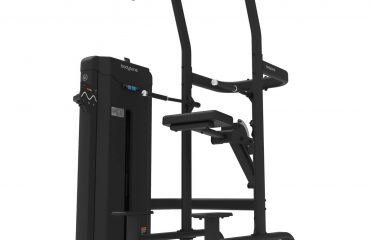
A weight stack, a pin and a guided movement path. These are the backbone of a mixed-ability floor: a new member can load the machine correctly on the first attempt, and the movement cannot go badly wrong. See the selectorised machines and, for a full commercial line, the Gold Line selectorised range.
Plate loaded machines and free weights
Plate loaded machines give a guided path with the loading feel of free weights, which is why they suit stronger members and performance-oriented sites. The Gold Line converging machines use a converging path that follows the natural arc of the pressing movement rather than a fixed straight line.
Racks, cages and benches
Squat racks, power racks and cages carry the barbell work: squat, bench, overhead press, rack pulls. Benches are specified alongside them, not as an afterthought, because bench height and pad width decide whether the rack is usable by your actual membership. Browse racks and cages and weight benches.
Cardio
Treadmills, exercise bikes, indoor cycling bikes, rowers, cross trainers and stair climbers, all in the cardio equipment category. Cardio is where duty cycle bites hardest: a treadmill belt and deck in a commercial gym wear on running hours, not on calendar age. The M003 professional treadmill is a typical commercial-floor unit.
Sports flooring
Flooring is part of the equipment order, not a separate trade. It protects the slab, controls noise transmission to the floors below and defines the zones. Rubber tiles in the free weight area, a different specification under cardio, and a dedicated lifting surface where barbells are dropped. See rubber gym flooring tiles.
Matching the equipment to the site
- Commercial gyms: the widest mix, because the membership is the widest. Selectorised for the majority, plate loaded and racks for the strength area.
- Cross-training boxes: rigs, racks, barbells and flooring take priority over machine stacks.
- Hotels and residential schemes: compact, unsupervised, low maintenance. Multi-station gyms and cardio, few loose weights.
- Care homes and rehabilitation centres: low starting loads, easy seat access, inclusive-access machines where the user base requires it.
- Local authorities, clubs and schools: durability and ease of inspection matter more than the badge on the frame.
Beginners and experienced members on the same floor
Operators often ask whether professional equipment is suitable for members who have never trained. It is, and the answer is in the layout rather than the catalogue. Guided-path machines let an untrained member start safely without an induction for every movement. Free weights and racks serve the experienced members. A floor plan that puts the guided machines on the route in from reception, and the barbell area further back, does more for retention than any single machine choice.
Muscle groups the range covers
Chest, back, shoulders, arms, glutes, quadriceps, hamstrings, calves, abdominals and lower back are all covered, most of them by more than one machine. The practical question for a buyer is not whether a muscle group is covered but how many stations you can afford to devote to it: a floor with two chest stations and no posterior chain work will queue in one place and sit idle in another.
Frequently asked questions
How do I check that equipment is genuinely professional?
Ask for the class on the technical sheet. Indoor equipment specified to EN ISO 20957-1 class S is built for commercial use. If a supplier cannot state the class, that is your answer.
Is the equipment suitable for members who have never trained?
Yes. Guided-path selectorised machines are designed to be safe on the first use without supervision. That is precisely why they exist.
How is the equipment bought?
Directly, against a quotation drawn up from your floor plan. The quotation covers the machine list, the flooring and the installation, and after-sales support follows from the same source rather than from a third party.
Does the supplier install?
Yes. Delivery and installation are part of the scope, which matters for heavy plate loaded machines and racks that have to be anchored and levelled correctly.
Getting a specification for your site
Send the floor plan, the surface area, the ceiling height, the type of site and the profile of your members. From that we build the equipment list, the flooring specification and the layout. Request a quote and you get a line by line proposal with the class, the dimensions and the warranty stated for each item.